The most startling consequence of the invariance of the speed of light is that it forces us to abandon the notion of absolute time. This means the time interval between two events depends on the velocity of the clocks used to measure the interval. The following thought experiment should help you understand this concept of the relativity of time intervals.
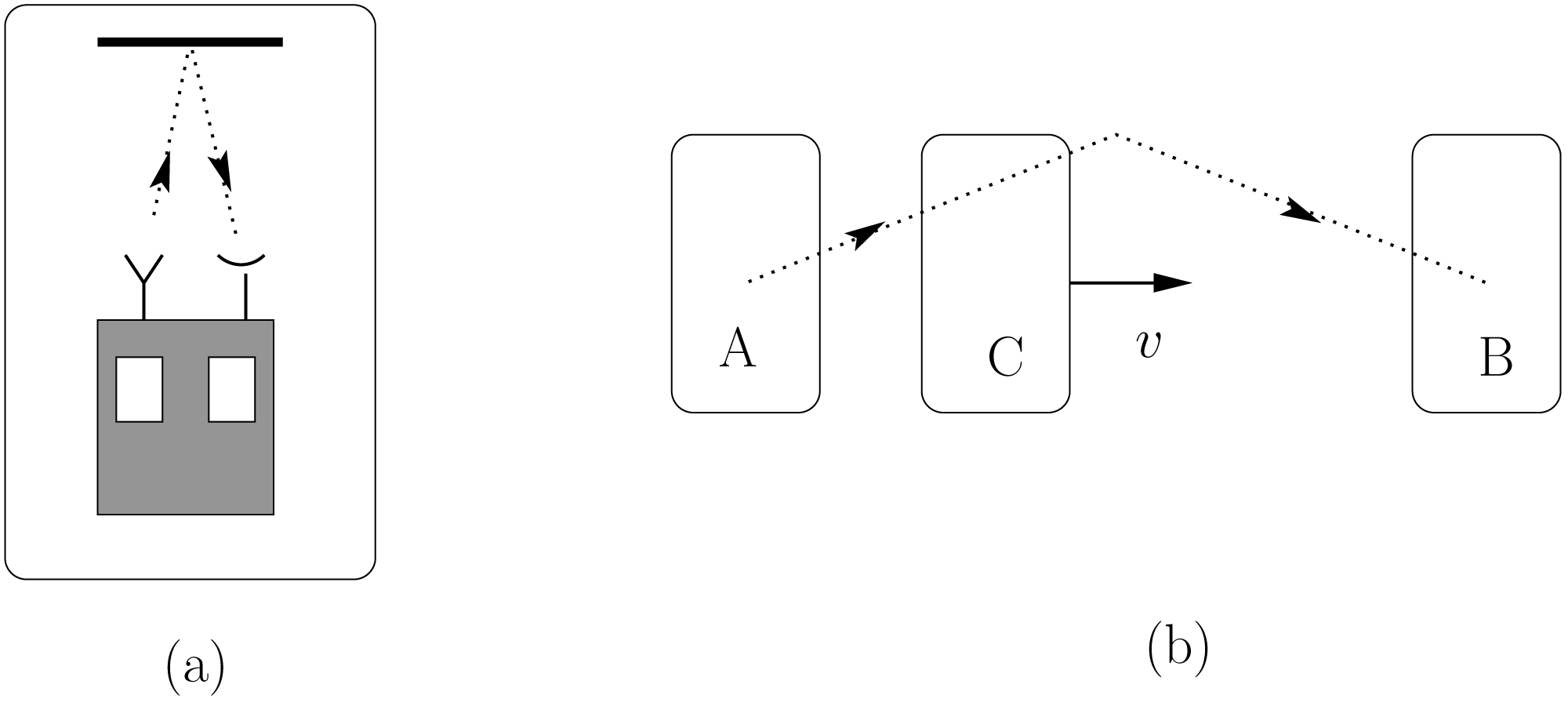
Imagine three identical clocks constructed as follows. Each clock contains a light source that emits a pulse of light toward a mirror some fixed distance away (see Figure 15a). The mirror reflects the pulse back toward the source. When the reflected pulse returns to the source and hits a triggering device, the source immediately fires a second pulse, which reflects from the mirror and triggers a third pulse, and so on. A count registers in a counter for each return pulse so the number of counts becomes a measure of elapsed time.
We place two of these light clocks, A and B, a fixed distance apart and at rest in a reference frame attached to the constant velocity Earth. We put the third clock, C, on a spaceship traveling at a constant velocity \(\vec{v}\) relative to the Earth (see Figure 15b), and perpendicular to the direction of travel of the light pulse in the clocks.
Figure15.(a) A light clock used in the thought experiment described in the text. (b) Light clock C passing rest-frame clocks A and B. The dotted line shows the path of C’s light pulse as observed in the rest frame of A and B.
Suppose clock C emits a light pulse at the exact instant it passes clock A. Also suppose that the distance between A and B is such that clock C passes clock B at the precise instant clock C’s reflected pulse returns to the source. We therefore have two events: Event #1 = “C passes A” and Event #2 = “C passes B.” We label the time interval between these two events — measured by clock C — as \(\Delta t_C\text{.}\) The quantity \(\Delta t_C\) is called the proper time interval between the two events; proper time is defined as the time measured on a single clock that is present at both events. In the case discussed above, clock C measures the proper time. In our particular arrangement, the proper time is exactly one tick.
“Simple,” you might think. “The answer is obviously exactly one tick, the same as that measured by clock C, right?” Wrong. As we will see, the concepts of absolute time (i.e., everyone and everything measures the passage of time the same way) is a casualty of the invariance of the speed of light.
For the question posed above to have any meaning, clocks A and B must be synchronized; i.e., observers in the Earth’s reference frame would say that the two clocks are reading the same time. (Note: this is not a trivial matter — we will discuss synchronization more fully in Chapter 3.) The two-clock time \(\Delta t_{AB}\) is then the difference between the time reading on clock A at Event #1 (clock C at clock A) and the time reading on clock B at Event #2 (clock C at clock B).
In clock C’s reference frame, clock A passes C first, and then clock B passes C. The time interval between these events is \(\Delta t_C\) on clock C and therefore the light pulse in clock C travels a round-trip distance equal to \(c\Delta t_C\text{.}\) But from Figure 15 this same pulse (the one inside clock C) travels a longer, zig-zag path when viewed from the frame in which clocks A and B are at rest. Because of the invariance of the speed of light, this longer distance must translate into a longer time interval. This means the round trip time for clock C’s pulse is one tick as measured on clock C, but it is more than one tick when measured on clocks A and B. In other words, the elapsed time between the event “C passes A” and the event “C passes B” is longer when measured with the two clocks A and B than when measured with the single clock C.
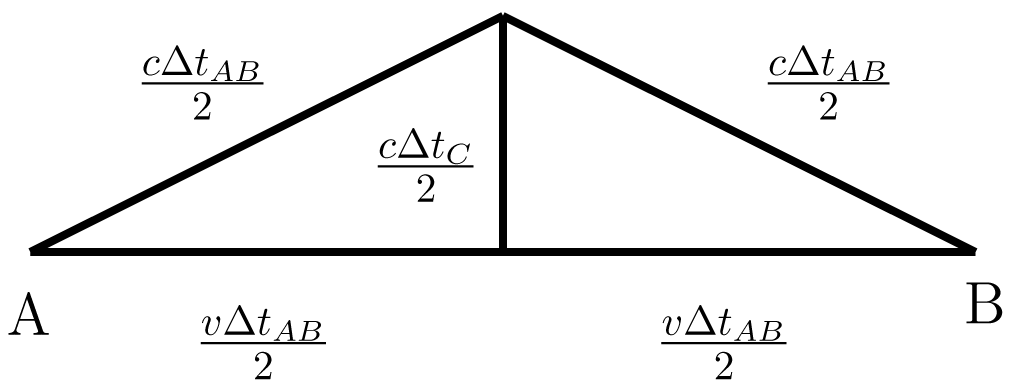
Figure16.Diagram for derivation of the proper time relation. In this figure \(\Delta t_{AB}\) is the elapsed time determined from the clocks A and B, and \(\Delta t_C\) is the elapsed time on clock C.
How much longer is the time interval \(\Delta t_{AB}\) measured on the A and B clocks than the proper time interval \(\Delta t_C\) measured on clock C? We can find out by looking at the path taken by the pulse of light in clock C viewed from C’s reference frame and from A and B’s reference frame (see Figure 16). As we’ve already seen, in clock C’s frame the pulse travels straight up and down along the vertical line in the figure and the total round-trip distance is \(c\Delta t_C\text{.}\) The same pulse, traveling for time \(\Delta t_{AB}\) relative to A and B travels the total zigzag distance \(c\Delta
t_{AB}\text{.}\) Clock C itself travels a distance \(v\Delta t_{AB}\) relative to clocks A and B while the pulse makes one round-trip in C. Therefore, using the Pythagorean theorem on either small triangle in Figure 16, we find
This very important relation is sometimes called the “proper time relation” or the principle of “time dilation.” Qualitatively, it expresses the fact that different observers measure the passage of time differently depending on their relative motion.
Hidden inside (2.4.3) is another result from special relativity; namely, no object can travel at a speed greater than \(c\) relative to any other object or reference frame. A superluminal speed (\(|v| > c\)) would result in an imaginary proper time, something that has no physical meaning. You will learn later that this speed limit is imposed by energy considerations as well (it would take an infinite amount of energy to accelerate an object with mass 1
Of course, a photon of light can be considered an “object” that travels at a speed \(c\text{,}\) but this is a massless object. We’ll say more about this in Chapter 4.
to a speed \(v = c\) relative to an observer, and more than an infinite amount of energy to achieve a speed \(v > c\)). Therefore, because \(|v| \leq c\text{,}\) the proper time interval \(\Delta t_{ proper}\) between two events is always smaller than the time \(\Delta t_{ two-clock}\) measured in a frame that requires two synchronized clocks for measurement.
A father and his daughter are traveling on a train that moves with a constant speed of \(1.8\times 10^8\,\text{m/s}\) (\(= 0.6c\)) relative to the ground. They pass a parked VW Beetle at which point the two of them simultaneously yell, “Red Punch Buggy!” and punch each other on the shoulder. Three seconds later, the daughter yells, “Jinx!” What is the time between these two events according to a person inside the VW who is waiting for the train to pass?
Solution: The key question — who measures the proper time (i.e., the smaller time interval)? To answer this, write this down in terms of events. Event A \(=\) father/daughter punch each other; Event B \(=\) daughter jinxes her dad. In this example, the father/daughter are at both events (not the person in the car), so they measure the smaller (proper) time interval, which has already been stated to be \(3\,\text{s}\text{.}\) So, we are given \(\Delta t_{ proper}\) and we are solving for \(\Delta t_{ two-clock}\text{,}\) which is the time interval measured by the person in the car.
In this example, the father and daughter on the train measured the proper time because they were at both events, so the time interval is smaller from their reference frame. Be careful, though: sometimes the observer standing on the Earth measures the smaller time interval — it all depends on what the events are and who happens to be present at both of them.
Note also that we expressed \(v\) as a fraction of the speed of light — it makes things a lot simpler to write \(v\) in this manner. We’ll say more about this later