Duck Dodgers hops in his spaceship and leaves the Earth at a speed \(0.6c\) in an attempt to reach the newly discovered Planet X before aliens from Mars.
Mission control on Earth sends an encoded message (a flashing beacon) to Duck Dodgers warning him about the progress of the Martian ship. The light pulses travel at a speed \(c\) relative to observers on the Earth. How fast are the pulses traveling relative to Duck Dodgers?
Duck Dodgers doesn’t understand the message that he received, so he sends a radio message back toward the Earth asking for clarification. The radio signal is traveling at a speed \(c\) relative to the Duck. How fast is the signal traveling relative to observers on the Earth?
The radio message is intercepted by the Martian who is behind Duck Dodgers but traveling in the same direction at a speed \(0.8c\) relative to the Earth. How fast is the radio message going relative to the Martian?
The radio message is also intercepted by one of the Martian’s monsters who is traveling back toward the Earth to attack. The monster is traveling at a speed \(0.9c\) relative to the Martian. How fast is the radio signal relative to the monster?
A particle travels at speed \(0.50c\) relative to Captain Kirk. Mr. Spock is traveling at a speed \(0.70c\) relative to Captain Kirk, in the same direction as the particle. Calculate the speed of the particle relative to Mr. Spock.
A proton’s velocity is measured to be \(0.6c\) relative to an observer on earth.
A rocket is traveling in the same direction as the proton, with a speed \(0.8c\) relative to the proton. Determine the speed of the rocket relative to earth.
A rocket is traveling in the opposite direction as the proton, with a speed \(0.8c\) relative to the proton. Determine the speed of the rocket relative to earth.
After traveling on vacation to Betelgeuse to witness a supernova, Fred and Ethel are returning home, traveling at a speed \(0.75c\) relative to and toward the Earth. Ethel is particularly anxious to get home and see her new great-great-great-great-great-great-great-great grandson, so she hops on the emergency shuttlecraft, which leaves Fred’s ship traveling at a speed of \(0.75c\text{,}\) relative to Fred. How fast is Ethel’s shuttle traveling relative to the Earth?
A particle of mass \(3m\text{,}\) moving at speed \(0.60c\) in the positive \(x\)-direction, collides with and sticks to a particle of mass \(2m\) originally at rest. Assume a head-on collision.
Calculate the initial total momentum before impact, using the classical definition, \(p = mu\text{,}\) for momentum.
Now transform to a primed frame in which the particle of mass \(3m\) is at rest. Use the relativistic velocity transformation to compute the velocities \(u^\prime_{3m}\text{,}\)\(u^\prime_{2m}\text{,}\) and \(u^\prime_{5m}\) in the primed frame.
Still in the primed frame, check whether momentum \(mu^\prime\) is conserved by computing the total momentum before the collision and the total momentum after the collision.
Repeat your calculation using the classical expression for kinetic energy. The classical expression is incorrect at these speeds, and you should see a drastically different answer from that which you obtained in part (a).
Electron A has a total energy of \(1.0\,\text{MeV}\text{.}\) Electron B has a kinetic energy of \(0.25\,\text{MeV}\text{.}\) Electron C has a kinetic energy of \(0.75\,\text{MeV}\text{.}\) Electron D has a momentum of \(1.0\,\text{MeV} /c\text{.}\) For each of the electrons A through D, determine its energy, momentum, kinetic energy, and speed.
A certain particle has a total energy of \(1.20\,\text{MeV}\) and a momentum of \(0.95\,\text{MeV} /c\text{.}\) Calculate the particle’s mass, kinetic energy, and velocity.
Compute the momentum and velocity of a proton that has a total energy equal to 7 times its rest energy. (\(m_{ proton} =
938\,\text{MeV} /c^2\text{.}\))
Show, from (4.4.6) and the result of problem Problem 4.6 that any massless particle moves at the speed of light and that if a particle moves at the speed of light it must have zero mass.
A proton (mass \(938\,\text{MeV} /c^2\)) is traveling at velocity \(0.60c\) in the \(+x\) direction relative to a spaceship which itself is traveling at velocity \(0.80c\) in the \(+x\) direction relative to Earth. Calculate the velocity and then the energy and momentum of the proton as measured in the Earth frame.
A particle’s energy and momentum in one frame are \(41\,\text{MeV}\) and \(40\,\text{MeV} /c\) respectively. Find the particle’s energy and momentum as measured in a different frame in which the particle’s speed is \(u^\prime = 0.8c\text{.}\)
Given a particle with \(E_A = 21\,\text{MeV}\) and \(p_A
= 15\,\text{MeV} /c\) as measured in reference frame A, and \(E_B = 20\,\text{MeV}\) as measured in frame B, determine the mass \(m_B\) and momentum \(p_B\) of the particle as measured in frame B.
The Fermi National Accelerator Laboratory (Fermilab) is located outside Chicago, Illinois, and is one of the world’s largest particle accelerator facilities. At Fermilab, protons (mass \(938\,\text{MeV} /c^2\)) are given huge amounts of energy and achieve velocities that are nearly the speed of light.
Prior to a recent upgrade, protons at Fermilab could reach speeds that were only \(163\,\text{m/s}\) slower than the speed of light. How much energy is required to get a proton from rest up to the speed \(u = c - 163\,\text{m/s}\text{?}\)
After the upgrade, the protons were able to reach the speed \(u
=c - 132\,\text{m/s}\) (a whopping increase of \(31\,\text{m/s}\)). How much additional energy is required to get this \(31\,\text{m/s}\) increase?
The Large Hadron Collider currently being developed at CERN (a particle accelerator facility in Europe) is designed to get protons up to an energy of \(7.0\,\text{TeV}\text{.}\) (\(1\,\text{TeV} =
10^{12}\,\text{eV}\)). Determine \(u/c\text{,}\) the ratio of the speed of the proton to the speed of light (note that \(u/c\) is NOT equal to 1!)
A certain J-boson has mass of \(150\,\text{MeV} /c^2\text{,}\) speed of \(0.8c\text{,}\) and total energy of \(250\,\text{MeV}\text{.}\) Determine the J-boson’s momentum and kinetic energy.
A proton (mass \(938\,\text{MeV} /c^2\)) traveling down a beam pipe at Fermilab is determined to have kinetic energy of \(1.2\,\text{GeV}\text{.}\) Determine this proton’s momentum and speed.
An evil genius fires a rocket into a star, destroying the star. Ten minutes later, as measured in the reference frame of the star, debris thrown out from the explosion demolishes a populated planet a distance \(7\,\text{lt-min}\) from the star, as measured in the star/planet frame. Simultaneous with the explosion (according to the star/planet reference frame), the Starship Enterprise is \(5\,\text{lt-min}\) from the star, on the opposite side from the planet. The Enterprise is heading toward the star/planet system with a speed of \(0.6c\) relative to the planet and star.
Draw a spacetime diagram for this situation. Take the star/planet reference frame as the unprimed frame, and draw the world lines of the star and the planet, showing that they are \(7\,\text{lt-min}\) apart. Indicate the destruction of the star as event A on your spacetime diagram, and indicate the destruction of the planet as event B on your spacetime diagram. Also, draw the world line for the debris sent from the star to the planet.
Draw the world line of the Starship Enterprise on your spacetime diagram, showing both the velocity of the spaceship and the correct location of the Enterprise when the star explodes.
Calculate the time interval between the explosion of the star and the destruction of the planet, as measured by Starfleet officers on board the Enterprise. (Hint: use your result from (c) to determine an expression for the distance between events — according to the Enterprise — in terms of the unknown time between events.)
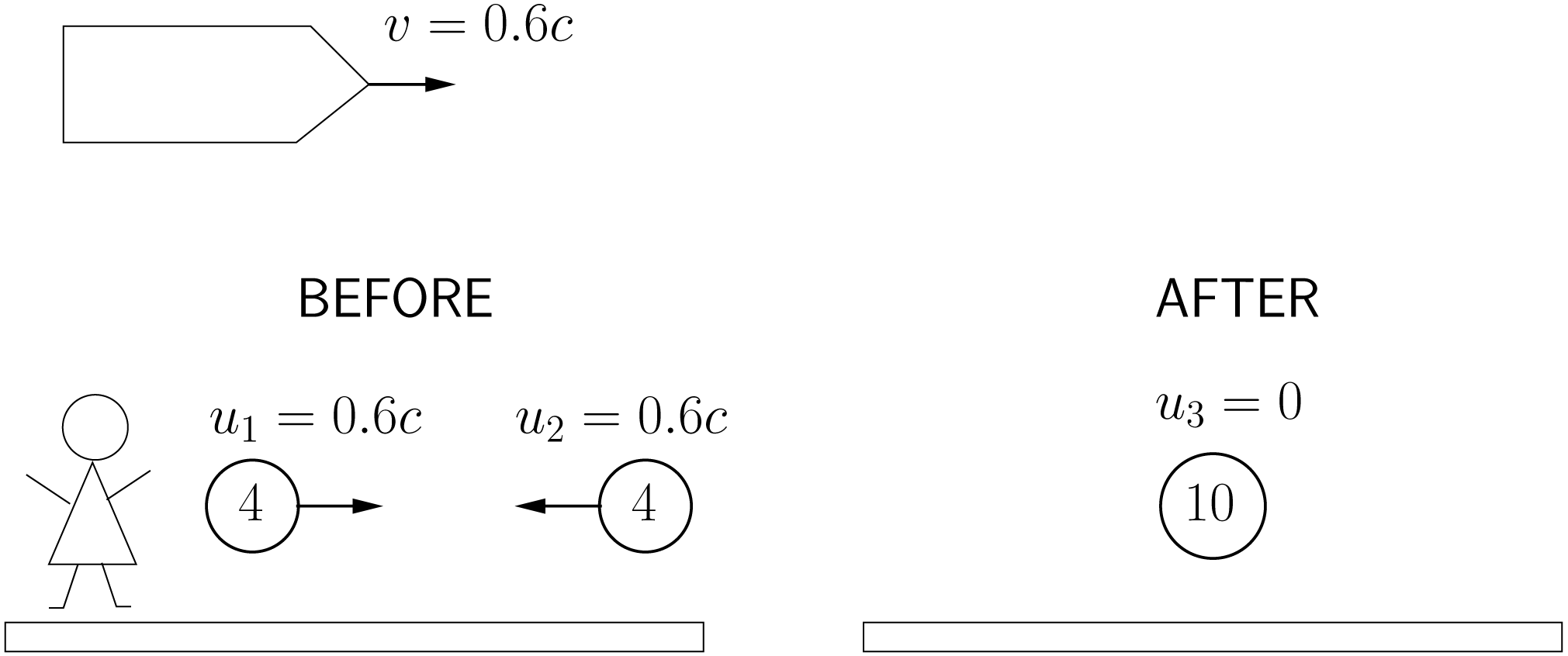
A mad scientist at rest in a lab on the earth is colliding particles together to make more massive particles. She creates head-on collisions of particles with a mass of \(4\,\text{GeV} /c^2\) and speed \(0.6c\) to create particles at rest with a mass of \(10\,\text{GeV} /c^2\) (see Figure 4.20.)
In the rest frame of the scientist, the \(4\,\text{GeV} /c^2\) particles have equal and oppositely directed momenta, and the \(10\,\text{GeV} /c^2\) particle is at rest, so momentum is conserved.
An observer in a rocket flying over the lab at a speed \(v=0.6c\) views this experiment (see Figure 4.20.)
Test whether relativistic momentum is conserved according to the observer in the rocket. Your test should include detailed numerical calculations demonstrating the conservation (or non-conservation) of relativistic momentum.
Test whether relativistic energy is conserved according to the scientist in her lab. Your test should include detailed numerical calculations demonstrating the conservation (or non-conservation) of relativistic energy.
Test whether relativistic energy is conserved according to the observer in the rocket. Your test should include detailed numerical calculations demonstrating the conservation (or non-conservation) of relativistic energy.