Section 5.4 Nuclear masses, fusion and fission
A particularly important application of the material in this chapter is nuclear power generation. There are two main approaches: fusion and fission. Nuclear fusion involves the merging (fusing) of two light nuclei (usually hydrogen) to form a more massive nucleus (usually helium), whereas fission involves the splitting of a very massive nucleus (e.g., uranium) into two or more lighter nuclei. For the process to release kinetic energy, conservation of relativistic energy requires that the end product(s) have a smaller total mass than the initial nucleus or nuclei.
1
The story of how fission was discovered is quite interesting. It starts with Lise Meitner and Otto Hahn, who conducted “transuranium” experiments where they bombarded massive nuclei with the goal of making more massive nuclei (more massive than uranium). But the experiments produced puzzling results. Meitner — with her nephew Otto Frisch — later provided an explanation. Instead of making more massive nuclei, they realized that the nuclei were breaking up with a resulting loss of mass, and Meitner used Einstein’s theory of relativity to explain the increase in energy observed in the process. Meitner — who was inexplicably overlooked for the Nobel Prize for the fission discovery — also discovered a radiation process which was named the Auger effect after a scientist who also discovered this process, a couple of years after Meitner had discovered it.
To develop a quantitative relationship between changes in kinetic energy and changes in mass, consider a simple fission decay in which particle A with mass \(m_A\) and kinetic energy \(K_A\) decays into a particle B with mass \(m_B\) and kinetic energy \(K_B\) and a particle C with mass \(m_C\) and kinetic energy \(K_C\text{:}\)
\begin{equation*}
\textbf{A} \longrightarrow \textbf{B} + \textbf{C}.
\end{equation*}
Total relativistic energy is conserved (\(E_\text{before} =
E_\text{after}\)) giving
\begin{equation}
E_A = E_B + E_C.\tag{5.4.1}
\end{equation}
This can be written in terms of kinetic energy using (4.5.2), giving
\begin{equation}
m_Ac^2 + K_A = (m_Bc^2 + K_B) + (m_Cc^2 + K_C).\tag{5.4.2}
\end{equation}
Rearrangement yields the expression
\begin{equation}
(K_B + K_C) - K_A = -\left[(m_Bc^2 +m_C) - m_Ac^2\right],\tag{5.4.3}
\end{equation}
or
\begin{equation}
\Delta K_\text{system} = -\Delta m_\text{system} c^2.\tag{5.4.4}
\end{equation}
This relationship is easily generalized to larger numbers of particles, and it also holds in fusion reactions.
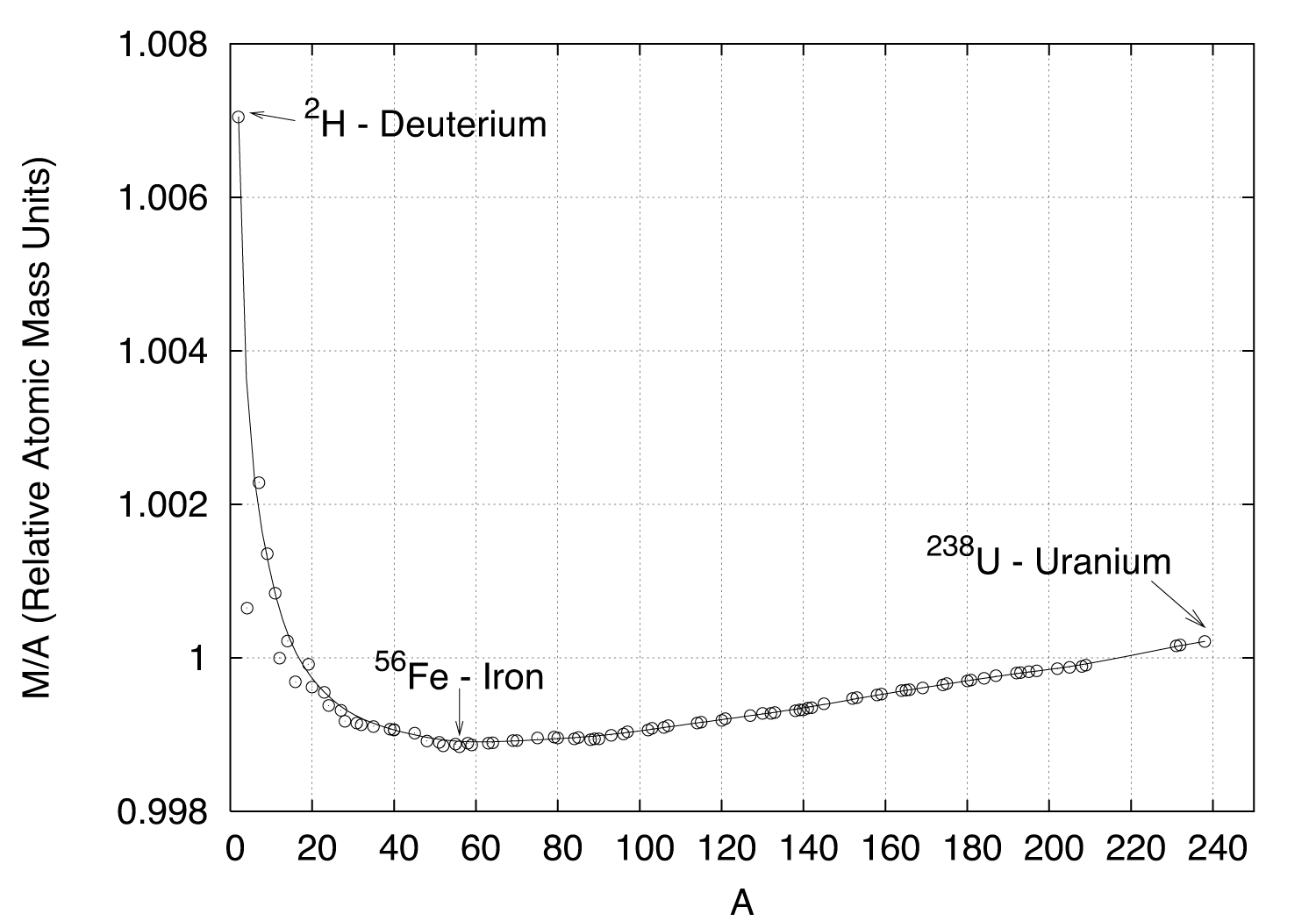
Figure 37 shows a plot of the masses of the elements, divided by the total number of protons and neutrons (nucleons) in the nucleus of each atom. This plot is very illuminating when considering fusion and fission processes. The fusion of two \(^2\)H nuclei to form a single \(^4\)He nucleus results in a lower overall mass, since the number of nucleons does not change; consequently, this process releases kinetic energy. On the other hand, elements with large atomic number \(A\) have a larger mass/nucleon than those with intermediate values of \(A\text{;}\) consequently, kinetic energy can also be released by splitting up one of these heavier atoms (fission).
Of the two processes — fission and fusion — fission is a much easier process to achieve in the laboratory or in industrial processes. Many large nuclei are naturally unstable, e.g., \(^{235}\)U can spontaneously decay via the fission process \({}^{235}\text{U} \rightarrow
{}^{134}\text{Xe} + {}^{100}\text{Sr} + {}^1n\text{.}\) Practically, then, the issue boils down to setting things up such that the process can be accelerated when desired, and can be inhibited when unwanted. From that perspective, the concept of a chain reaction is relevant. The idea of combining multiple nuclear fissions into chain reactions —which was pioneered by Lise Meitner, Otto Hahn, Fritz Strassmann, and Enrico Fermi in the 1930s — is straightforward: if the neutrons that are released in a fission process bombard another nearby (unstable) nucleus, they can trigger the fission of that nucleus as well. Practically, all that is needed is a large enough density of the unstable nucleus (e.g., \(^{235}\)U) and a chain reaction will start. This idea was pursued by the Manhattan Project in the 1940s to develop an atomic bomb, the detonation of which was achieved by explosively compressing a uranium sample to increase its density above the critical value for a chain reaction. Alternatively, the strength of the fission chain reaction can be controlled by absorbing some of the neutrons produced in the fission reaction. Graphite rods (which absorb neutrons) are commonly used to “moderate” the reaction in this way to allow the reaction to proceed in a controlled manner in power generators.
Nuclear fission power has a few serious drawbacks: (a) the fuel (uranium, plutonium, etc.) is expensive and limited in supply. If society were to switch entirely to uranium-fission-based power generation, it is estimated that the supply of uranium would last for only 50–100 years. (b) The by-products of the fission reaction are nuclei which themselves are unstable and radioactive; consequently, the material poses a health hazard unless properly stored.
2
Wider application of current technology in waste reprocessing and the use of specialized breeder reactors would extend the uranium fuel supply by a factor of more than 10, though these practices are currently avoided in many countries due to the low cost of uranium and the associated nuclear proliferation risks.
Another drawback of nuclear fission reactors — which is diminishing with improved technology — is the concern that they could “melt down” and release massive amounts of radiation (this actually happened to the Chernobyl 4 reactor in the Soviet Union in 1986). This threat has been lessened recently by the development of much better systems, including a “melt-proof” system with an expandable core; if the temperature of the core exceeds a defined value, the core expands, dropping the density of the fissile material down below its critical value and stopping the chain reaction. (This works even if all cooling is stopped.) But even this system isn’t perfect, as there is always the concern that a terrorist attack or gross human error could result in the release of disastrous amounts of radioactive waste into the environment.
In contrast to fission reactors, nuclear fusion reactors use water as their fuel (actually the \(^2\)H isotope of hydrogen, also called deuterium, which is found in small amounts in water) and produce helium as a by-product, so waste disposal is less of a problem. The nuclear energy production is also much more efficient for this process than for fission, as can be inferred from the steepness of the curve in Figure 37. It is estimated that there is enough \(^2\)H (deuterium) in ocean water to power the world’s needs for many thousands of years (if not millions). In fact, nuclear fusion is the power source in stars, including our own Sun. It can be argued that almost all of the Earth’s energy sources can be traced back to nuclear fusion.
3
Some radioactive tritium (the \(^3\)H isotope of hydrogen) is released in the process as well, which can present exposure risks in the short term, if not properly managed. Tritium is a highly mobile and reactive gas that can involve itself in the place of normal hydrogen in a variety of biological processes, so it should be carefully managed to avoid exposure, though with a half-life of only 12 years, tritium does not constitute a long-term waste problem. Further, the biological half-life of tritium—at roughly 10 days—and its very low decay energy, make it of minimal concern. The only long-term waste problem would be the activated material in the reactor containment vessel itself.
Nuclear fusion is not without its problems, though. Specifically, it is very difficult to achieve in a controlled manner. Making a fusion bomb unfortunately isn’t that difficult (relatively speaking), as a fission explosion can be (and has been) used to compress hydrogen together and cause explosive fusion. But to achieve a controlled fusion reaction is a very difficult procedure that will require a significant amount of ingenuity over the next few decades. If physicists and engineers manage to overcome the technical hurdles, earth-based fusion reactors could prove to be an important source of abundant and relatively clean power. And in the mean time, we can continue to make use of the giant fusion reactor in space that beams energy down to earth.

