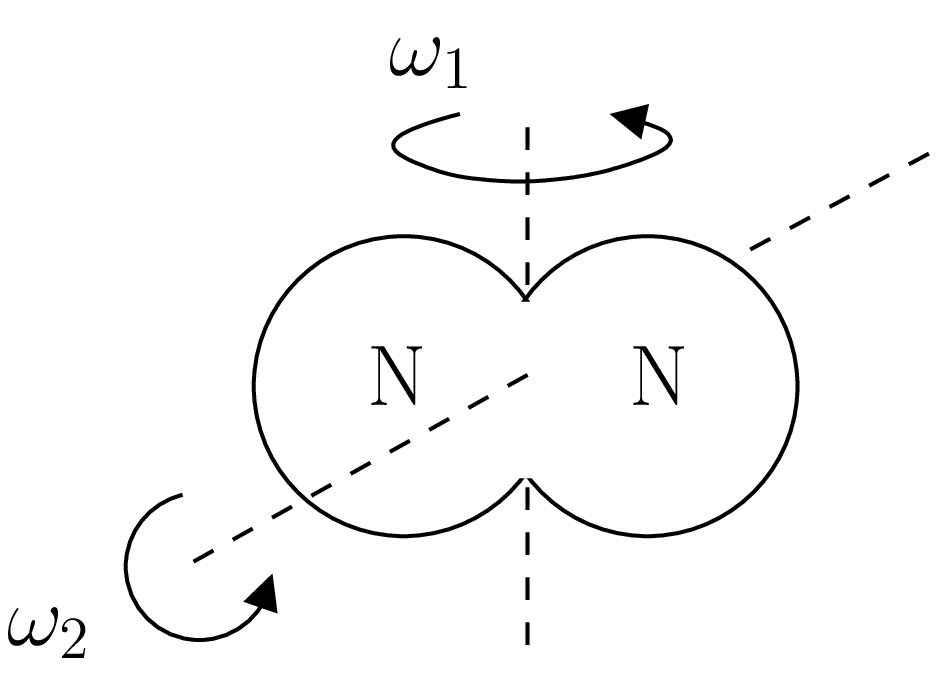
In the gas phase, most of the time the molecules are so far apart that they exert no force on each other. The exception is the brief molecular collision, where the pair potential plays a role in determining the forces that they exert on each other during the collision. However, after the collision the pair of molecules head off in their new directions with new speeds, moving rather quickly out of range of each other and feeling no force. The details of the molecular collisions are complicated, but we can avoid having to worry about them by making use of the equipartition theorem.
The total thermal energy for a gas is, to an excellent approximation, purely kinetic, as the molecules are too far apart to have an appreciable potential energy. However, the kinetic energy may consist of both translational and rotational kinetic energies. For a monatomic gas molecule, such as argon, there is no contribution to rotational kinetic energy and so
\begin{equation}
E_\text{molecule} = K_\text{trans} = {\textstyle\frac{1}{2}} m v_x^2 +
{\textstyle\frac{1}{2}} m v_y^2 + {\textstyle\frac{1}{2}} m v_z^2.
\text{ (monatomic ideal gas) }\tag{7.4.1}
\end{equation}
There are three quadratic contributions to the energy. The equipartition theorem says, therefore, that the average thermal energy per molecule is \(3(\textstyle\frac{1}{2}k_BT)\text{.}\) Therefore, the total thermal energy is
\begin{equation}
E_\text{therm} = N\langle
E_\text{molecule} \rangle =
{\textstyle\frac{3}{2}} N k_B T = {\textstyle\frac{3}{2}} n R T.
\text{ (monatomic ideal gas) }\tag{7.4.2}
\end{equation}
However, many gas molecules are diatomic, such as N\(_2\text{,}\) which makes up about 78% of our atmosphere, and O\(_2\text{,}\) which makes up most of the rest. These dumbbell-shaped molecules have significant rotational kinetic energy as well as translational kinetic energy, as shown in Figure 46. Their molecular energy is given by
\begin{equation}
E_\text{molecule} = {\textstyle\frac{1}{2}} m v_x^2 +
{\textstyle\frac{1}{2}} m v_y^2 + {\textstyle\frac{1}{2}} m v_z^2
+{\textstyle\frac{1}{2}} I_1 \omega_1^2 + {\textstyle\frac{1}{2}} I_2
\omega_2^2
\text{ (diatomic ideal gas) }\tag{7.4.3}
\end{equation}
where \(\omega_1\) and \(\omega_2\) are the angular frequencies of the molecular rotation about the two axes indicated in Figure 46. The details of the molecular mass or rotational inertia again do not matter, and the equipartition theorem now gives
\begin{equation}
E_\text{therm} = N\langle E_\text{molecule} \rangle
= {\textstyle\frac{5}{2}} N k_B T = {\textstyle\frac{5}{2}} n R T.
\text{ (diatomic ideal gas) }\tag{7.4.4}
\end{equation}
where \(f\) is the number of degrees of freedom, or the number of quadratic terms appearing in the energy of a molecule. So \(f=3\) for a monatomic ideal gas, and \(f=5\) for a diatomic ideal gas.
Here is an application: Argon gas is the most abundant monatomic gas in the atmosphere, and is technologically useful since monatomic gases conduct heat slower than diatomic gases, due to the smaller heat capacity. Modern double-glazed windows have argon gas between the two sheets of glass, to minimize the rate of heat transfer through the window.
In solids and liquids, sound waves move by molecules pushing on their neighbors. In a gas, the molecules are not in contact with each other to push and pull, and so sound propagation is fundamentally different: the molecules must travel from collision to collision for the sound wave to move. Thus, the speed of the sound wave is essentially the thermal speed of the molecules themselves, which makes for much slower speed of sound. While we will skip the derivation, one can show that the speed of sound in an ideal gas is given by
Notice that the speed of sound in a gas is dependent on the temperature, since the thermal speed depends on temperature, while for liquids and solids the speed of sound is essentially independent of temperature.
Estimate the speed of sound in air at room temperature of \(22^\circ\,\text{C}
= 295\,\text{K}\text{.}\) Use the average molar mass based on an approximate composition of 78% N\(_2\) and 22% O\(_2\text{.}\)