We now develop the ideas of the previous section in the context of a specific model. The simplest model to work with, it turns out, is not the ball-spring model or the ideal gas, but rather a variation of the ball-spring solid called the Einstein solid. Experiments on very cold metals showed that their specific heats could fall well below the value \(3R\text{,}\) suggesting something not contained in the ball-spring model was occurring at low temperatures. Einstein showed that a quantum mechanical version of the ball-spring model could explain this result. 1
The complete description of very cold metals requires an additional modification, worked out by a Dutch physicist named Peter Debye. We will not consider the Debye theory here.
To begin, notice that a three-dimensional oscillator, such as the molecule in the ball-spring model, can be written as a sum of three independent, one-dimensional oscillators:
In the second grouping, each term in parentheses is an oscillator moving in one particular direction and independent of the motion in the other perpendicular directions. Thus a set of \(N\) molecules in the ball-spring model is equivalent to \(3N\) one-dimensional oscillators. In what follows we will be working primarily with the one-dimensional oscillators so we let \(N\) represent the number of oscillators instead of the number of molecules. The number of molecules is then \(N/3\text{.}\)
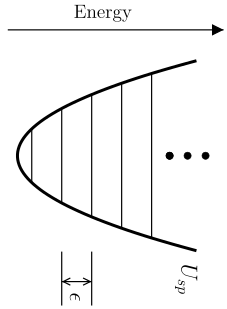
Einstein proposed to treat the one-dimensional oscillators quantum mechanically, which should be appropriate when the temperature is low enough. We will not discuss quantum mechanics here — that is a topic for PHYS 212 — but we will summarize the main results of interest to us. The energy levels of the quantum harmonic oscillator are not continuous but rather discrete (or quantized). This is illustrated in Figure 67. At very low energies we cannot vary the oscillator energy up or down by arbitrarily small amounts, but rather can only add energy in discrete chunks. Furthermore, for the quantum harmonic oscillator, these energy levels are equally spaced. Therefore we can write the energy level of an oscillator as
Here \(E_0\) is the lowest energy level possible, and we may increase the energy by adding an integer number of “energy units” of size \(\epsilon\text{.}\)
Figure67.The quantum harmonic oscillator has discrete energy levels, shown as horizontal lines. The energy difference between successive levels is \(\epsilon\text{.}\)
Now consider a system of two oscillators, with a total energy of three “energy units.” These oscillators bounce energy back and forth and so one of the oscillators may have at a given instant anywhere from zero to all three of the energy units. Let \(n_1\) be the number of energy units that the first oscillator has, and \(n_2\) the number of energy units for the second oscillator. Specifying \(n_1\) and \(n_2\) determines a particular microstate. The total energy of three units implies \(n_1+n_2=3\text{,}\) so the possible microstates, written as \((n_1,n_2)\text{,}\) are
Evidently, the multiplicity of the macrostate with two oscillators and a total of three energy units is \(\Omega =4\text{.}\) That is, there are four different microstates with this total energy.
It is feasible to determine the multiplicity directly by counting the microstates when the number of oscillators and energy units is small. But this becomes unwieldy very quickly as the number of oscillators and energy units is increased. Fortunately, we can derive the general result for \(N\) oscillators and \(q\) total energy units, which is
The factorial function is defined as \(n!=n(n-1)(n-2)\cdots 2\cdot 1\text{.}\) For example, \(5!=5\cdot 4\cdot 3\cdot 2\cdot 1=120\text{.}\) A special case is the factorial of the number zero: by definition, \(0!=1\text{.}\) The meaning of \(n!\) is that it is the number of distinct ways to order \(n\) objects. The number of ways to order zero objects is taken to be 1.
Verify the Einstein solid multiplicity formula, (9.3.2), for the cases of two oscillators with three energy units and three oscillators with two energy units.
Factorials become very large very quickly. For example, \(100!\approx
10^{157}\text{,}\) which is an amazingly large number. An Einstein solid with 100 oscillators and 200 energy units has a multiplicity \(\Omega =
2.8\times 10^{82}\text{.}\) Now you can appreciate having (9.3.2) to work with instead of counting all possible microstates. And imagine how large the result would be for Avogadro’s number of oscillators!