The value of \(W_\text{by}\) is positive, which makes sense because the gas is expanding (the volume is increasing). A short-cut to the result would be to recognize that \(W_\text{by}\) is the area under the \(p\,-V\) curve, which in this case is a rectangle:
Process \(2 \rightarrow 3\text{:}\) This is an isothermal compression, so \(W_\text{on} = -W_\text{by} = -nRT\ln (V_3/V_2)\text{.}\) We don’t know how many moles of gas there are, but we could figure it out using the Ideal Gas Law. But we aren’t going to do that, because we can replace the entire product \(nRT\) with either \(p_2V_2\) or \(p_3V_3\text{.}\) So,
Note that this is a positive number, which makes sense since it is a compression, and we know that \(W_\text{on}\) is positive for a compression. Note also that the work for the process \(2 \rightarrow 3\) has a larger magnitude than that for process \(1 \rightarrow 2\text{,}\) which also makes sense because there is a larger area under the curve \(2 \rightarrow 3\) than under the curve \(1 \rightarrow 2\text{.}\)
Process \(3 \rightarrow 4\text{:}\) This is a constant-volume process, so \(W_\text{on} = 0\text{.}\) This is also consistent with work as area under the curve, as the area under the curve for the process \(3 \rightarrow 4\) is zero.
A diatomic gas in a well-insulated container has an initial pressure, temperature, and volume of \(150\,\text{kPa}\text{,}\)\(300\,\text{K}\text{,}\) and \(3.5\,\text{L}\text{.}\) The gas is compressed to a volume of \(0.5\,\text{L}\text{.}\) Calculate the pressure and temperature of the gas after the compression.
Solution: Since the container is insulated, \(Q_\text{in} =0\text{,}\) and this is an adiabatic process. And since the gas is composed of diatomic molecules at a temperature that isn’t too high, there are 5 degrees of freedom for the gas and \(\gamma = \frac{f+2}{f} =
\frac{7}{5}\text{.}\) Since this is an adiabatic process, \(pV^{\gamma} = (\text{constant} )\text{,}\) so so \(p_iV_i^\gamma = p_fV_f^\gamma\text{,}\) which implies
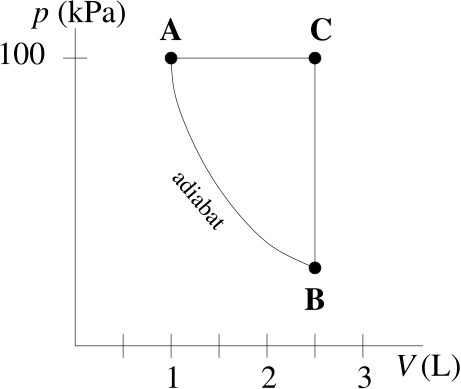
Consider a fixed amount of an ideal gas of diatomic molecules undergoing the processes shown in Figure 59. The gas starts at point A in the diagram and expands along the path \(\textbf{A}\longrightarrow{B}\) with no heat flowing into or out of the gas.
(a) Calculate the pressure of the gas at point B after the expansion. (b) Determine the net work done on the gas and the heat flow \(Q_\text{in}\) in one complete cycle (\(\textbf{A}\longrightarrow{B}\longrightarrow{C}\longrightarrow{A}\)).
Solution: (a) Since the process \(\textbf{A} \rightarrow \textbf{B}\) is adiabatic, \(pV^\gamma = (\text{constant} )\) and \(p_AV_A^\gamma = p_BV_B^\gamma\) so
(b) We will calculate the work done on the gas for each of the three processes and add up the results to get the net work. To figure out the total heat flow \(Q_\text{in}\) we could do something similar — i.e., calculate \(Q_\text{in}\) for each process and then add them up. But there is an easier way: since we know that \(\Delta E_\text{therm} = 0\) for the complete cycle, once we have determined the total \(W_\text{on}\) for the complete cycle, we can use the First Law of Thermodynamics to get \(Q_\text{in}\) for the complete cycle.
Let’s start with process \(\textbf{A} \rightarrow {B}\text{.}\) This is an adiabatic process, so \(Q_\text{in} = 0\text{.}\) Calculating work is tricky for adiabatic processes, so we’ll find \(\Delta E_\text{therm}\) first and then use the First Law to get \(W_\text{on}\text{.}\) This is a diatomic gas, so \(f = 5\) and \(\Delta E_\text{therm} = \frac{f}{2}nR\Delta T\text{.}\)\(\Delta E_\text{therm}\) can be found with the pressures and volumes given (see (8.2.3)):
So, the net work \(W_\text{on}\) done on the gas for the complete cycle \(\textbf{A} \rightarrow \textbf{B} \rightarrow \textbf{C} \rightarrow \textbf{A}\) is