Section 8.3 Special case gas processes
Subsection Constant-volume process (isochoric process)
Constant-volume processes occur in a rigid closed container whose volume can’t change. (Constant-volume processes are also known as isochoric processes.) The fact that the volume doesn’t change means that the work done on the gas, \(\int p\, dV\text{,}\) is zero, as is the work done by the gas. This is consistent with the fact that \(p\) -\(V\) diagrams for constant-volume processes are vertical lines — there is no area under a vertical line.
The fact that \(W_\text{on} =0\) greatly simplifies the First Law, Eq.(8.0.1).
Subsection Constant-pressure process (isobaric process)
For a process during which the pressure is constant, \(p\) can be taken out of the integral for work. (Such processes are also known as isobaric processes.) This gives
\begin{align*}
W_\text{on} =\mathstrut \amp -\int_{V_1}^{V_2} p\, dV\\
=\mathstrut \amp -p\int_{V_1}^{V_2} \, dV\\
=\mathstrut \amp -p\, (V_2 - V_1)\\
=\mathstrut \amp -p\, \Delta V\text{ (constant-pressure process) } .
\end{align*}
Again, this result is easy to see from a \(p\) -\(V\) diagram. For an isobaric process, \(p\) -\(V\) diagram is a horizontal line of length \(\Delta V\text{.}\) The area under the curve is the area of a rectangle: \(\text{height} \times\text{width} = p\, \Delta V\text{.}\) (You must insert the appropriate sign “by hand.”)
Subsection Constant temperature process (isothermal process)
If the temperature is held constant during a process, it is also known as an isothermal process. The first thing to note about a constant-temperature process is that \(\Delta E_\text{therm} = 0\text{,}\) because \(\Delta T=0\text{,}\) so one term in the First Law drops out.
As for the work term, the ideal gas law tells us that if the temperature is constant, than it’s the product of pressure and volume, \(pV\text{,}\) that’s constant, not \(p\) or \(V\) individually. This complicates the evaluation of the work integral slightly, but we can use the ideal gas law to rewrite the pressure in terms of the varying volume and constants, \(p = nRT/V\text{.}\) Then we can integrate:
\begin{align*}
W_\text{on} =\mathstrut \amp -\int_{V_i}^{V_f}p\,dV\\
=\mathstrut \amp -\int_{V_i}^{V_f}\frac{nRT}{V}\,dV\\
=\mathstrut \amp -nRT\,\left[\ln V\right]_{V_i}^{V_f}\\
=\mathstrut \amp -nRT( \ln V_f -\ln V_i)\\
=\mathstrut \amp -nRT\ln\left(\frac{V_f}{V_i}\right)
\text{ (constant-temperature process) } .
\end{align*}
And, as always, the work done by the gas is the negative of this result: \(W_\text{by} = -W_\text{on} = nRT\ln (V_f/V_i)\text{.}\)
Useful trick: note that since the ideal gas law states that \(pV = nRT\text{,}\) the work done by a gas during an isothermal process can also be written as \(W_\text{by} = pV\ln (V_f/V_i)\text{.}\) This is really useful if you know the pressure and volume at any moment during the isothermal process, but don’t know the temperature.
Subsection Straight-line process on a \(p\) -\(V\) diagram
Sometimes the \(p\) -\(V\) curve will be a straight line segment, although not vertical (constant volume) or horizontal (constant pressure). The work term in the First Law is easy to evaluate by determining the area of the trapezoid under the line segment.
Subsection Adiabatic processes
In many real gas processes there is no heat flow either into or out of the system; i.e., \(Q_\text{in} = 0\text{.}\) This occurs if (a) the system is completely isolated from its environment so there is no way for heat to be exchanged with its surroundings (e.g., if it is surrounded by insulation); or (b) if the process occurs so rapidly that there simply isn’t enough time for there to be an appreciable flow of heat into or out of the system. A process in which \(Q_\text{in} = 0\) is referred to as an adiabatic process. By their very definition, adiabatic processes are a special case in which one of the terms in the First Law vanishes.
To calculate \(W_\text{on}\) for an adiabatic process it is easier to use the First Law than it is to evaluate the integral \(\int p\, dV\text{:}\) simply find \(\Delta E_\text{therm}\) via (8.2.3) and then use the First Law to determine \(W_\text{on}\text{.}\) We’ll discuss examples of that technique in the next section.
First, however, we can quickly get an idea of how an adiabatic process looks on a \(p\) -\(V\) diagram. Since \(Q_\text{in} = 0\) for an adiabatic process, the First Law becomes: \(\Delta E_\text{therm} = W_\text{on}\text{;}\) i.e., any work done on the system goes into increasing the thermal energy. And recall that the thermal energy of a gas increases with the temperature of the gas. For an adiabatic compression, \(W_\text{on} > 0\) which means that \(\Delta E_\text{therm} > 0\text{.}\) This means that for any adiabatic compression, the gas heats up (i.e., the temperature increases). This makes sense: we are doing work on the gas to compress it, and that work goes into heating up the gas and increasing the temperature.
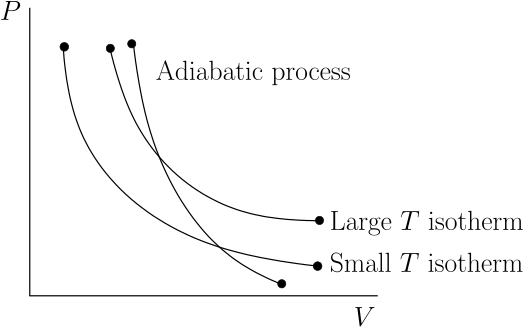
Since an adiabatic compression results in an increase in temperature, the curve on a \(p\) -\(V\) diagram for an adiabatic compression must go to larger and larger temperature, which means that an adiabatic process is associated with a curve (an adiabat) that is steeper than those for isothermal processes (i.e., “isotherms”) at any point where they would cross. This can be seen in Figure 58, which shows curves for both adiabatic and isothermal processes.
To make a quantitative statement about the functional form of the adiabatic curves, we need to consider the type of gas. As discussed in section 7.4, the thermal energy of a gas depends on the type of molecules in that gas. (See Eqs. (7.4.2), (7.4.4), and (7.4.5).) In particular, the behavior of the gas depends on the number of degrees of freedom \(f\) and the “adiabatic exponent” \(\gamma = \frac{f+2}{f}\text{.}\) (Recall that \(\gamma = \frac{5}{3}\) for a monatomic gas with 3 degrees of freedom, and \(\gamma = \frac{7}{5}\) for a diatomic gas with 5 degrees of freedom.) Without going through the full derivation, an adiabatic process has pressure and volume that are related by the relationship
1
The full derivation involves solving a differential equation, but differential equations are not required for PHYS 211.
\begin{equation}
pV^{\gamma} = \text{constant} \ \ \ (\text{ adiabatic process } ).\tag{8.3.1}
\end{equation}
From a practical perspective, this means that given three of the four quantities \(p_i\text{,}\) \(V_i\text{,}\) \(p_f\) and \(V_f\text{,}\) for an adiabatic process the fourth can be determined from the relation \(p_iV_i^{\gamma} = p_fV_f^{\gamma}\text{.}\)
Similarly, a relation can be found between the temperature \(T\) and volume \(V\) during an adiabatic process:
2
Simply combine (8.3.1) with the Ideal Gas Law.
\begin{equation}
TV^{\gamma - 1} = \text{constant} \ \ \ (\text{ adiabatic process } ).\tag{8.3.2}
\end{equation}

