Section 6.6 Temperature
We began the chapter mentioning that when mechanical energy gets converted to thermal energy, the temperature increases. But what is temperature? Everyone has an intuitive feel for it: we know that a high temperature corresponds to something that is “hot” and a low temperature corresponds to something that is “cold.” We also know from experience that “heat” — which we will define shortly — flows from hot (high temperature) to cold (low temperature) objects.
It is common in many introductory text books to define temperature as a measure of the average thermal kinetic energy \(K_\text{therm} /N\) of a material. This definition of temperature is not valid for all situations (we will provide a more rigorous definition of temperature in Chapter 9); however, there are many situations that can benefit from simple view of temperature as a measure of thermal kinetic energy.
1
Historically, this approach was used successfully in the \(18^\text{th}\) and \(19^\text{th}\) centuries to develop the first successful quantitative theories of thermodynamics, referred to as the kinetic theory of thermodynamics.
We must talk about temperature units. The Celsius temperature scale is defined so that water freezes at a temperature of \(0^\circ\,\text{C}\) and water boils at \(100^\circ\,\text{C}\text{.}\) Considering temperature as a measure of kinetic energy, we can define absolute zero as the temperature where all molecular motion stops. This occurs at \(-273.15^\circ\,\text{C}\) in the Celsius scale.
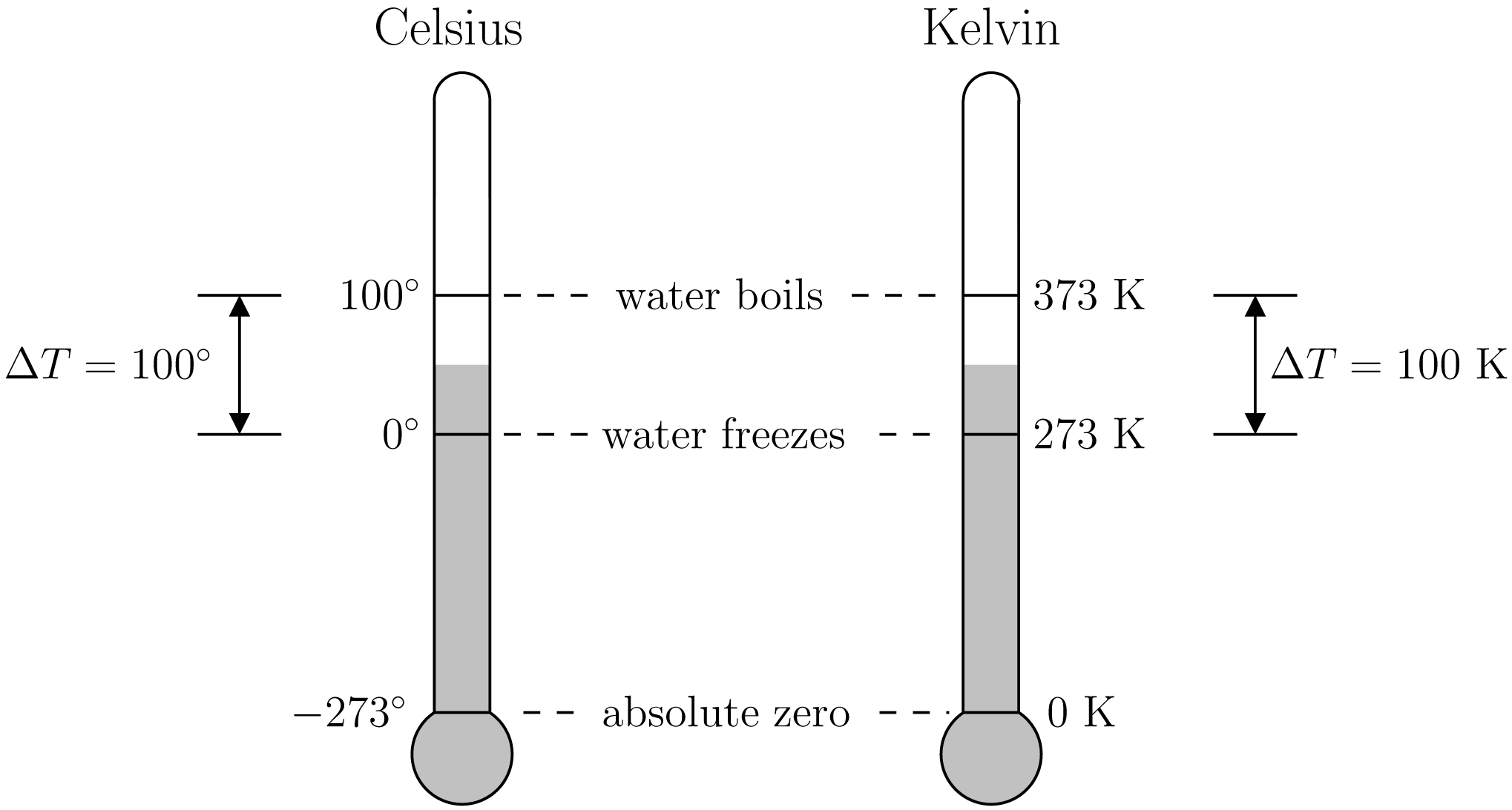
A important variation on the Celsius temperature scale is called the Kelvin scale, illustrated in Figure 42. The “size” of the degree is the same for Kelvin and Celsius, that is, a change in temperature of \(1\,\text{K}\) is the same as a change in temperature of \(1^\circ\,\text{C}\text{.}\) The boiling temperature of water is still \(100\,\text{K}\) higher than the freezing temperature. The difference in the scales is the location of zero: in the Kelvin scale, absolute zero corresponds to \(0\,\text{K}\text{,}\) water freezes at \(273\,\text{K}\) and boils at \(373\,\text{K}\text{.}\) The Kelvin temperature scale is the one best suited for most thermodynamics problems.

