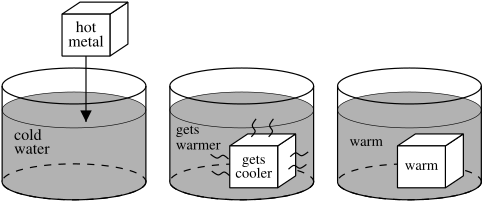
Consider the following process, illustrated in Figure 65: a hot piece of metal is placed into a container holding cold water. As time passes, thermal energy flows from the metal to the water, making the metal colder and the water warmer. Eventually, the two are at the same temperature and no more thermal energy is transferred. This is heat: the spontaneous thermal energy transfer due to the temperature difference, as we identified in section 6.10.
Figure65.A hot piece of metal is placed into cold water. Thermal energy is transferred from the hot metal to the cold water until they are in thermal equilibrium.
However, energy conservation would be equally well satisfied if the heat flowed the other way. Imagine putting the hot metal into cold water and finding that the metal becomes increasingly hotter while the water becomes increasingly cooler, beginning to freeze. Absurd! This is never observed to happen. And yet it would be perfectly consistent with the first law of thermodynamics.
What this process illustrates is that there must be an additional law of nature involved that determines the direction of heat flow. In a fit of creativity, physicists decided to call this the second law of thermodynamics. There are many equivalent ways to state the second law. We will begin with the Clausius statement of the second law, since it is the most intuitive.
Let’s examine this. First, note that the law is, at this point, empirical, which means it is a statement about the observed behavior of nature. The second law rules out the absurd scenario whereby heat flowed from the cold water to the hot metal. But, note that the second law makes no statement about whether the heat will actually flow from the metal to the water. According to the second law, this heat flow is allowed, but not required. That is exactly what we want from a general law, since after all the metal and the water may or may not be thermally coupled.
Temperature plays a crucial role in the second law, since the question of whether heat is allowed to flow from \(A\) to \(B\) or instead from \(B\) to \(A\) is answered by the temperatures \(T_A\) and \(T_B\text{.}\) Temperature plays the role of nature’s traffic cop, enforcing thermodynamic “one-way streets.” 1
However, nature needs no traffic court since its one-way streets, like its speed limit, are self-enforcing.
The primary topic of this chapter is the explanation of why temperature plays this role.
Another interesting aspect of the second law is the phenomenon of irreversibility. Many processes in nature are reversible. A movie of the flight of a ball thrown straight up into the air, turning around and coming back down, looks the same whether played forward or backward. This is because Newton’s law are reversible as long as friction is negligible. But once heat flows from the hot metal to the cold water, it will never spontaneously flow back again. A movie of the process (with some thermometers used to make the temperature visible) would look different played backward versus forward. Physicists believe the second law is the origin of any irreversibility observed in nature, which is to say, the second law of thermodynamics plays a crucial role in determining the direction of time flow.
Interestingly, the second law is unique among laws of physics. Most laws are simply inferred from the behavior of nature. We don’t know why energy conservation happens; we just know it does. The second law is different because we can essentially derive it. We know why it happens. It is ultimately a statement about probability: thermal energy flows spontaneously from hotter objects to colder objects because that brings the system to a state with a more likely arrangement of energy.