Section 10.6 Refrigerators
An interesting thing happens if we take a heat engine and run it backwards: we make a refrigerator. By refrigerator, we mean a device which requires work as input and is able to make heat flow from a colder object to a hotter object. This includes, of course, the refrigerator that keeps your milk from getting spoiled, but also includes air conditioners and even heat pumps (which is basically an air conditioner hooked up backwards to cool the outdoors and warm your house).
Making heat flow from cold to hot may sound like a violation of Clausius’s statement of the second law, but it is not as long as something else is going on in the process. Heat will not spontaneously flow from cold to hot; rather, we must cleverly engineer the refrigerator to make it happen and, most importantly, we must plug it in, to give the necessary work as input.
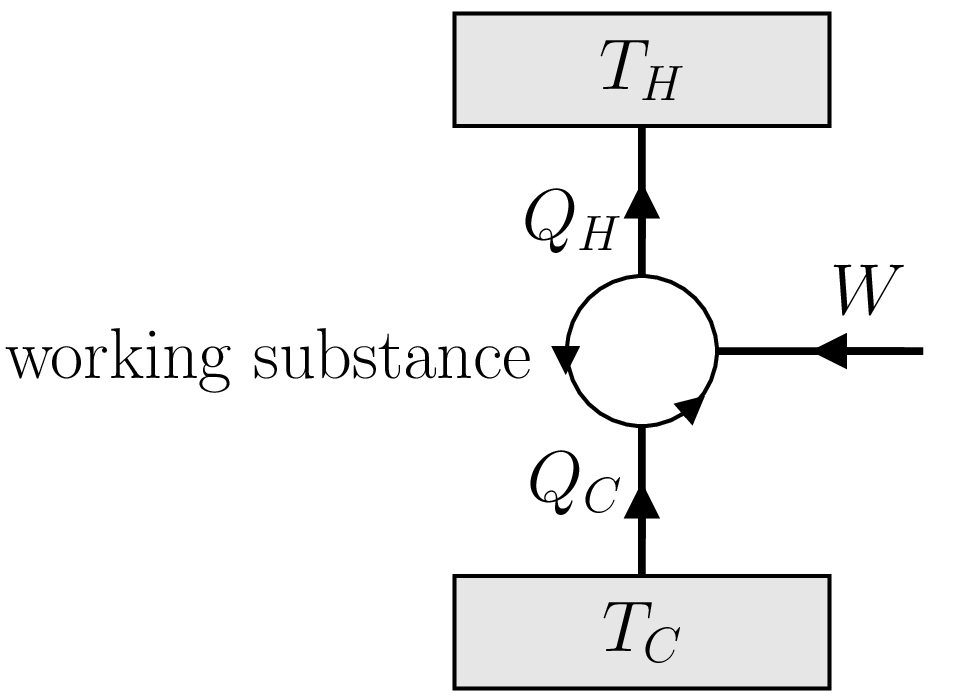
Let’s start with an engine diagram in reverse, as shown in Figure 80, and focus on the first and second laws. Energy conservation now requires
\begin{equation}
|Q_C| + |W| = |Q_H| \qquad\qquad\text{ (first law) }\tag{10.6.1}
\end{equation}
which is exactly the same equation as before, since we reversed all the arrows. Now the signs of the entropy change in the reservoir are reversed, so the second law says
\begin{equation}
\Delta S_\text{total} = \Delta S_H + \Delta S_C =
\frac{|Q_H|}{T_H} - \frac{|Q_C|}{T_C} \geq 0.\text{ (second law) }\tag{10.6.2}
\end{equation}
This now provides an upper bound on \(|Q_C|\text{,}\) namely
\begin{equation}
|Q_C| \leq \frac{T_C}{T_H}|Q_H|.\tag{10.6.3}
\end{equation}
What does this mean? It means we can run a heat engine backwards and satisfy the first and second laws and actually make some heat go from cold to hot. But there is a limitation on how much heat we can pull out of the cold reservoir, and this limitation depends on the reservoir temperatures and on how much work we provide. If we eliminate \(|Q_H|\) from the upper bound, (10.6.3), we can show
\begin{equation}
|Q_C| \leq \frac{T_C}{T_H-T_C} |W|,\tag{10.6.4}
\end{equation}
which you will derive in the homework. This expression says that we need work to pull heat out of the cold reservoir, and also that the effectiveness of pulling out heat will depend on the reservoir temperatures. We can quantify this “effectiveness” with what is called the coefficient of performance, \(CP\text{,}\) defined as the ratio of what we want (\(|Q_C|\)) to what we must pay (\(|W|\)):
\begin{equation}
CP = \frac{|Q_C|}{|W|} \leq \frac{T_C}{T_H-T_C}.\tag{10.6.5}
\end{equation}
As before, the maximum coefficient of performance is obtained from the borderline case of the second law \(\Delta S_\text{total} =0\text{.}\) Notice that reservoirs that are close in temperature yield a larger \(CP\text{.}\) This makes sense, since the closer \(T_H\) and \(T_C\) are, the less “uphill” we are making the heat flow.
In the refrigerator diagram the working substance now goes through a counterclockwise gas cycle. This allows for the heat to flow into the gas while it is at a lower temperature (lower than \(T_C\)) and heat to flow out of the gas while it is at a higher temperature (higher than \(T_H\)). But this counterclockwise cycle also means compression happens at higher pressure than the expansion. This will require some outside source of work to drive the gas through this cycle, which is exactly what we found from general first law and second law considerations: work input is necessary to make the refrigerator function. In other words, your refrigerator won’t function properly if you forget to plug it in.

