Use your results from Problem 6.2 to estimate the typical thermal displacement for atoms in a chunk of solid iron at room temperature. (Assume a room temperature of \(22^{\circ}\,\text{C}\text{.}\)) Compare your result to the typical lattice separation for the iron atoms. Based on this result and the Lindemann criterion, explain why it is reasonable that iron is a solid at room temperature.
Now, assuming that iron melts when the typical displacement is one-tenth the lattice separation (i.e., \(x_\text{therm} \approx
d/10\text{,}\) which is the Lindemann criterion), estimate the melting temperature of iron. Compare your result to the experimental value.
Write a sentence explaining in your own words why the melting temperature should be related to the typical thermal displacement \(x_\text{therm}\text{.}\) Don’t worry so much about the factor \(1/10\) in the Lindemann melting criterion, but your explanation should state why melting occurs when \(x_\text{therm}\) gets sufficiently large.
A \(100\,\text{g}\) piece of ice at \(0^\circ\,\text{C}\) is placed into a container holding \(200\,\text{g}\) of water, initially at temperature \(25^\circ\,\text{C}\text{.}\) Heat flows from the water to the ice, cooling the water and melting the ice.
Calculate how many moles of ice and how many moles of water are initially present.
Compare two containers of the same ideal gas; each container has the same volume and the same number of molecules. The temperature of the gas in the first container is twice the temperature in the second container, \(T_1=2T_2\text{.}\) Find the following ratios
One mole of water at \(20^\circ\,\text{C}\) has \(20\,\text{kJ}\) of thermal energy added. Calculate the number of moles which remain in the liquid state.
A fixed amount of ideal gas is at temperature \(25^\circ\,\text{C}\text{,}\) volume \(4.0\,\text{L}\) and pressure \(100\,\text{kPa}\text{.}\) The temperature of the gas is increased to \(80^\circ\,\text{C}\) while the volume is decreased to \(3.2\,\text{L}\text{.}\) Determine the new pressure.
For silver, the ball-spring parameters are \(m=1.79\times
10^{-25}\,\text{kg}\text{,}\)\(d=2.58\times 10^{-10}\,\text{m}\text{,}\) and \(k_{sp}=21.4\,\text{N/m}\text{.}\) Based on this information, estimate the melting temperature and latent heat of fusion for silver.
Let’s play microwave. This is just fun, and you’ve got to do it. Load up the molecular dynamics applet, select the solid preset, and click “Start”. Now we’re going to melt the solid without adding heat. 1
It’s interesting to note, actually, that microwaves actually aren’t effective at melting solid water — i.e., ice — because the frequency of a typical microwave oven is one that doesn’t resonate with ice. So, this problem is probably more relevant to melting of a stick of butter or a Jello mold.
This is exactly what a microwave oven does: the microwaves do work, pushing and pulling molecules around, and this gets converted to thermal energy. So let’s do the same thing. You can “pull” a molecule by clicking on it and dragging it. Reach in and pull on a molecule, and then wait and watch how the system responds. Now do it again. Keep doing it until you’ve fully melted the solid. (Notes: it might help to reduce the “Animation speed” so that you can see what is going on. You also might have to pull your mouse a large distance quickly before letting go when “pulling” a molecule.)
Describe what you observe in the simulation and what you had to do to melt the solid by pulling on individual atoms. Question: Why would pulling on just one or two individual atoms melt the entire solid?
Aquaman buys a balloon filled with a fixed amount of helium from a street vendor in New York City on a hot \(37^{\circ}\,\text{C}\) day. He measures the pressure inside the balloon to be \(110 \,\text{kPa}\text{.}\) When he arrives at the underwater city of Atlantis, he discovers that the balloon is now 0.40 times the original volume. His thermometer indicates that the ocean has a temperature of \(2^{\circ}\,\text{C}\text{.}\) Determine the pressure inside the balloon.
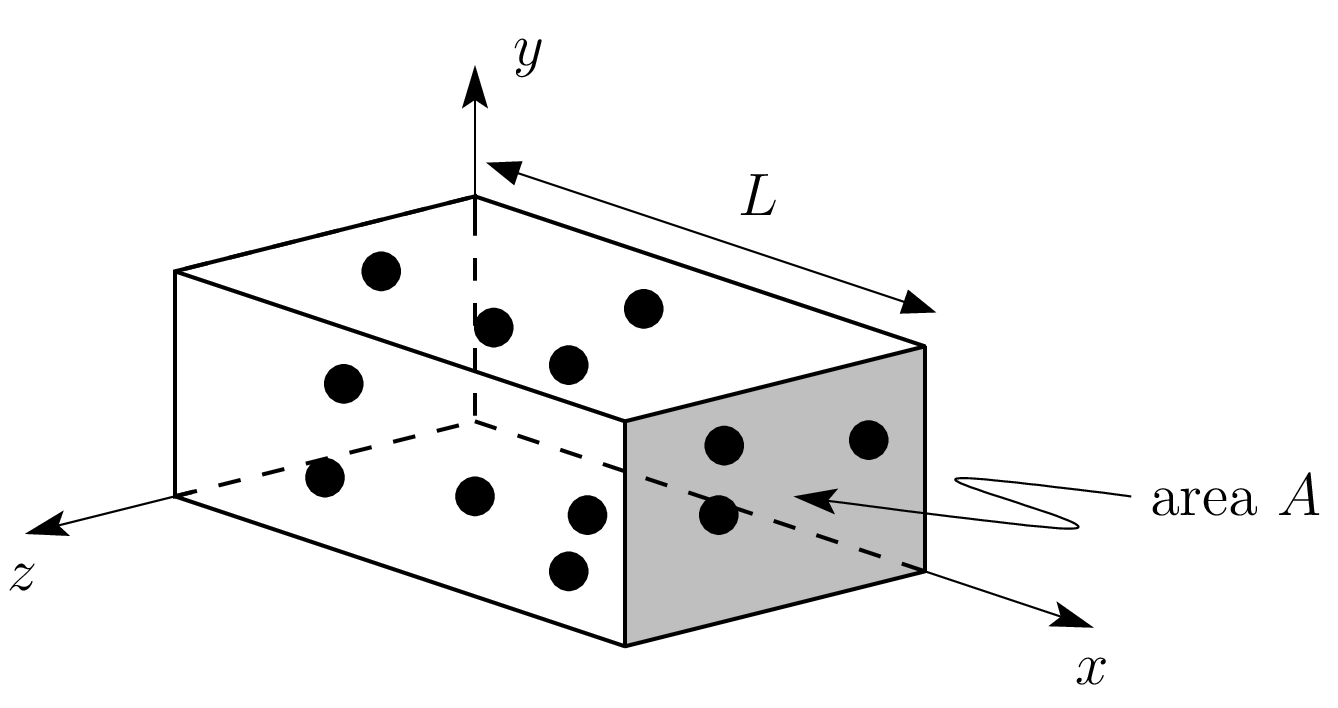
Let’s consider the ideal gas law \(pV = nRT\) qualitatively from a perspective of molecules of the gas hitting the shaded side of a container, as shown in Figure 53.
Considering collisions of gas molecules with the wall, explain qualitatively why the pressure of a gas increases if the temperature of the gas increases, with everything else constant. There are two different reasons why increasing the temperature increases the pressure.
Explain qualitatively why the pressure increases if the volume of the container holding the gas decreases, with everything else constant. There are actually two different reasons why decreasing the volume increases the pressure: one is a result of decreasing \(L\) and the other is a result of decreasing \(A\text{.}\)
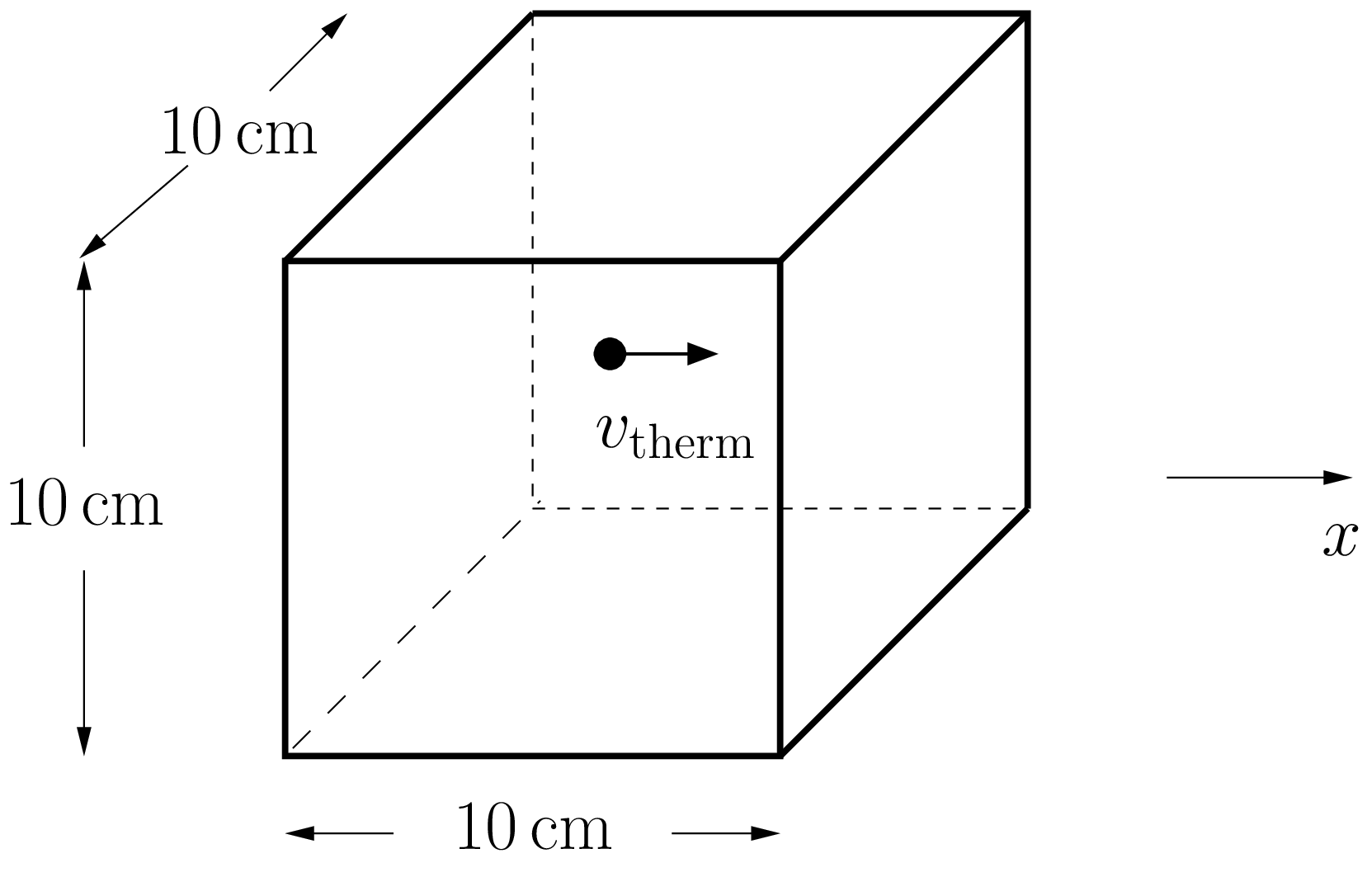
In this problem you will make some simplifying assumptions and estimate the pressure of a gas of nitrogen molecules from a microscopic picture of the gas. Assume that the gas is in a \(10\,\text{cm} \times
10\,\text{cm} \times 10\,\text{cm}\) box at room temperature, \(T = 22^\circ\,\text{C}\text{.}\) The assumptions are:
All the molecules travel at the speed \(v_\text{therm}\) derived in Example 7.2.1. This is not actually true — there is a spread in molecular speeds around the average — but \(v_\text{therm}\) is a typical speed.
One third of the molecules in the gas travel in the \(\pm x\)-direction, one third travel in the \(\pm y\)-direction, and one third travel in the \(\pm z\)-direction. This is obviously not true, but this assumption will simplify the calculations.
Calculate the numerical value of the change in the momentum of a single nitrogen molecule traveling in the \(x\)-direction after it collides elastically with the right wall of the container. (If you need help determining the speed of the nitrogen molecules, see Example 7.2.1.)
At room temperature and atmospheric pressure, the number density, (i.e., the number of molecules per unit volume) of nitrogen molecules is \(2.49\times 10^{19}\,\text{molecules/cm}^{3}\text{.}\) Use the second of our simplifying assumptions and calculate the average force on the right wall of the container due to all of the molecules in the gas.
Calculate the pressure that the gas exerts on the right wall of the container. Compare your answer to atmospheric pressure (\(1\,\text{atm} = 1.01\times 10^5\,\text{Pa}\)).