Now that we know how it is that a gas can exert a pressure, we can use these ideas — along with the previous discussion of thermal velocities of gas molecules — to calculate how the pressure relates to the temperature of the gas, the number of gas molecules (or moles) and the geometry of the container holding the gas. From this we will derive one of the most useful relations in thermodynamics: the ideal gas law.
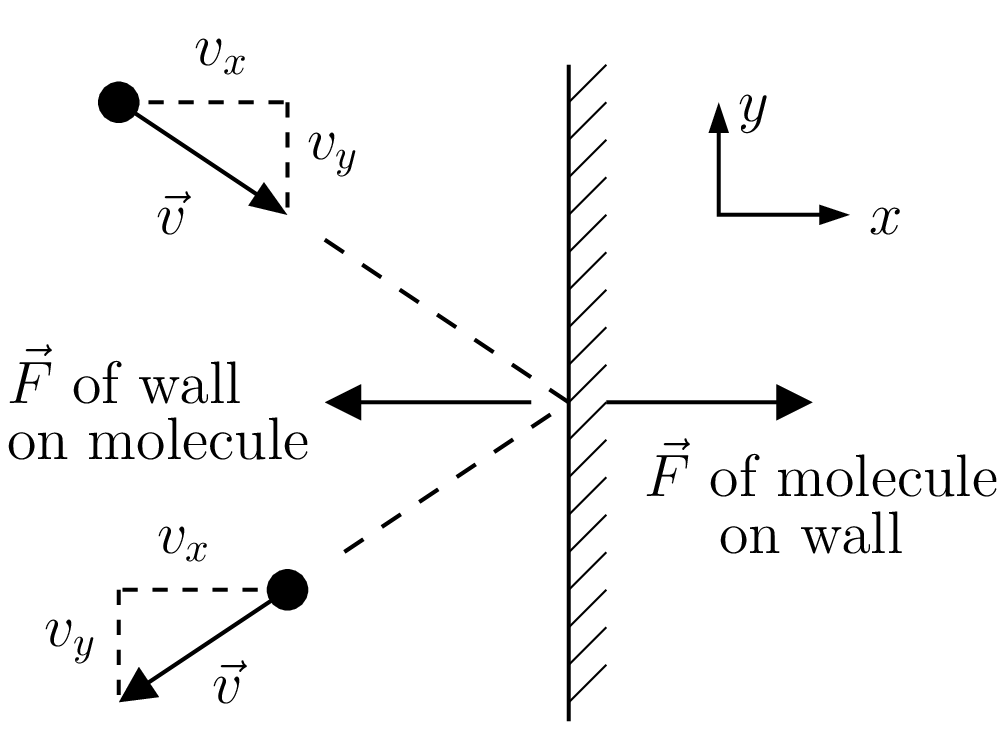
A collision with a wall is shown in Figure 52. Note that the \(x\)-component of velocity changed sign, while the \(y\)-component of the velocity was unchanged. If we focus on \(v_x\text{,}\) we can see that the molecules in Figure 51 will bounce off the shaded wall and change the sign of \(v_x\text{,}\) then a time \(L/v_x\) later they will bounce off the back wall and head back toward the shaded wall. They will likely bounce off the side walls en route, but this has no effect on \(v_x\text{,}\) so we can ignore it. Thus the time between collisions on the shaded wall is \(\Delta t = 2L/v_x\) (the factor of two coming from the trip away and then back).
The force on the wall due to the particle is zero in between collisions, and then very abruptly some non-zero value during the collision. Viewed as a function of time, the force would be a series of spikes, since each collision is short in duration, and then there is no force while the particle travels to the other side of the container and back again. What we feel as steady pressure is the time average of many collisions, so we would like to obtain an average of this force over time.
We can calculate this time averaged force first by noting that the force of the molecule on the wall is, by Newton’s third law, equal and opposite the force of the wall on the molecule. The force of the wall on the molecule causes a change in the \(x\)-component of momentum, \(p_x\) (see Figure 52). Note that the symbol \(p\) here, and in the next two equations, refers to momentum, not pressure. We apologize for the fact that the standard symbols for these quantities are the same (but there are only so many letters to use). The momentum change is given by
This momentum change happens once every time interval of \(\Delta t =
2L/v_x\) (the travel time between collisions), so we can conclude the average force of the wall on the molecule is
where \(v_{i,x}\) is the \(x\)-component of the velocity \(\vec v_i\) of the \(i\)th particle. We can appeal to the equipartition theorem, which tells us
\begin{equation}
\Bigl\langle\sum_i {\textstyle\frac{1}{2}} m v_x^2\Bigr\rangle = N
\bigl({\textstyle\frac{1}{2}}k_BT\bigr),\tag{7.7.4}
\end{equation}
and so the average force on the wall is given by
\begin{equation}
F_{\text{ on wall } ,x} = \frac{Nk_BT}{L}.\tag{7.7.5}
\end{equation}
Finally, we use the definition of pressure to conclude
\begin{equation}
p = \frac{F_{\text{ on wall } ,x}}{A} = \frac{Nk_BT}{AL} = \frac{Nk_BT}{V}\tag{7.7.6}
\end{equation}
where we have used \(V=AL\) (see Figure 51). This last relation holds regardless of the shape of the container, and we have thus derived the ideal gas law
This is another universal law where the details of the molecules are irrelevant: the molecular mass canceled out, and any interaction forces between the molecules negligible as long as the gas is dilute enough.
This is an extremely accurate law for most gases at room temperature and higher temperatures. Note also that it does not depend on the mass of the gas molecule, or whether it is diatomic or monatomic.
In (7.7.7), both sides of the equations have units of energy. If we use SI units, pressure should be measured in pascal, and volume should be measured in cubic meters. However, we may take advantage of the relation
Note that we had to convert temperature from Celsius to Kelvin in this calculation. This is important: you always have to use Kelvin for the temperature when using the ideal gas law.
An ideal gas at a temperature \(50^{\circ}\) C is in a car piston. The piston compresses the gas to 1/3 of its original volume. The pressure increases by a factor of 5 during this process. Calculate the new temperature of the gas in the piston.
Solution: We don’t know the volume, pressure or number of moles of gas at any point in this problem, so we will have to solve this problem using ratios.
First, we need to convert temperature to Kelvin: \(T = (50+273)
\,\text{K} = 323 \,\text{K}\text{.}\) Next, write down the ideal gas law: \(pV
= nRT\text{.}\) We are interested ultimately in the final temperature, so re-write this as:
\begin{equation}
T = \frac{pV}{nR}\tag{7.7.10}
\end{equation}
Note that when using ratios to determine a new value for the pressure or volume, it doesn’t matter what units we use for those quantities because the units will cancel between numerator and denominator. Though it is still always necessary to use Kelvin for temperature.