Section 11.4 Einstein’s Equivalence Principle
Now that we’ve discussed how mass curves spacetime, let us turn to the second half of general relativity: how does spacetime tell mass how to move? Einstein had a major insight early in his development of general relativity called the equivalence principle. The equivalence principle states that there should be no detectable difference between being in a gravitational field of strength \(g\) or being in a rocket in outer space that accelerates upward with magnitude \(g\text{.}\) In either case, if you hold out a ball and let it go, it will accelerate to the floor with acceleration \(g\text{,}\) as shown in Figure 88.
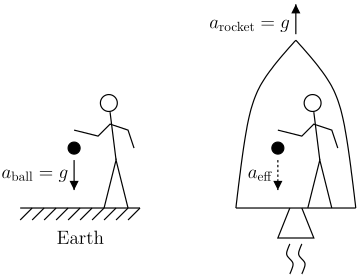
This idea, which Einstein has referred to as his “happiest thought,” stimulated his thinking in two ways.
-
He latched on to the idea that gravity might not be an actual force, but rather, as in the case of the astronaut in the accelerating rocket, it is an illusion of a force.
1
Physicists call this an “effective” force. -
He noted that the motion of an object in the presence of gravity would be independent of its mass. If instead of dropping a ball, the astronaut dropped her keys or dropped an elephant, the acceleration of the object would be the same. This suggested that there is some natural motionin spacetime that is totally independent of which object is moving, and this natural motion appears equivalent to a gravitational force acting.
2
Natural motion means the motion of an object in the absence of force.
Thus the equivalence principle provides an explanation for the equivalence of gravitational mass and inertial mass.

