One thing that will come up repeatedly in this unit is the fact that relativity breaks down the distinction between distance and time. In fact, in relativity, distance and time are really just flip sides of the same coin. And as we will see now, you can’t change our conception of time without making a similarly dramatic change in the way we view distances and length.
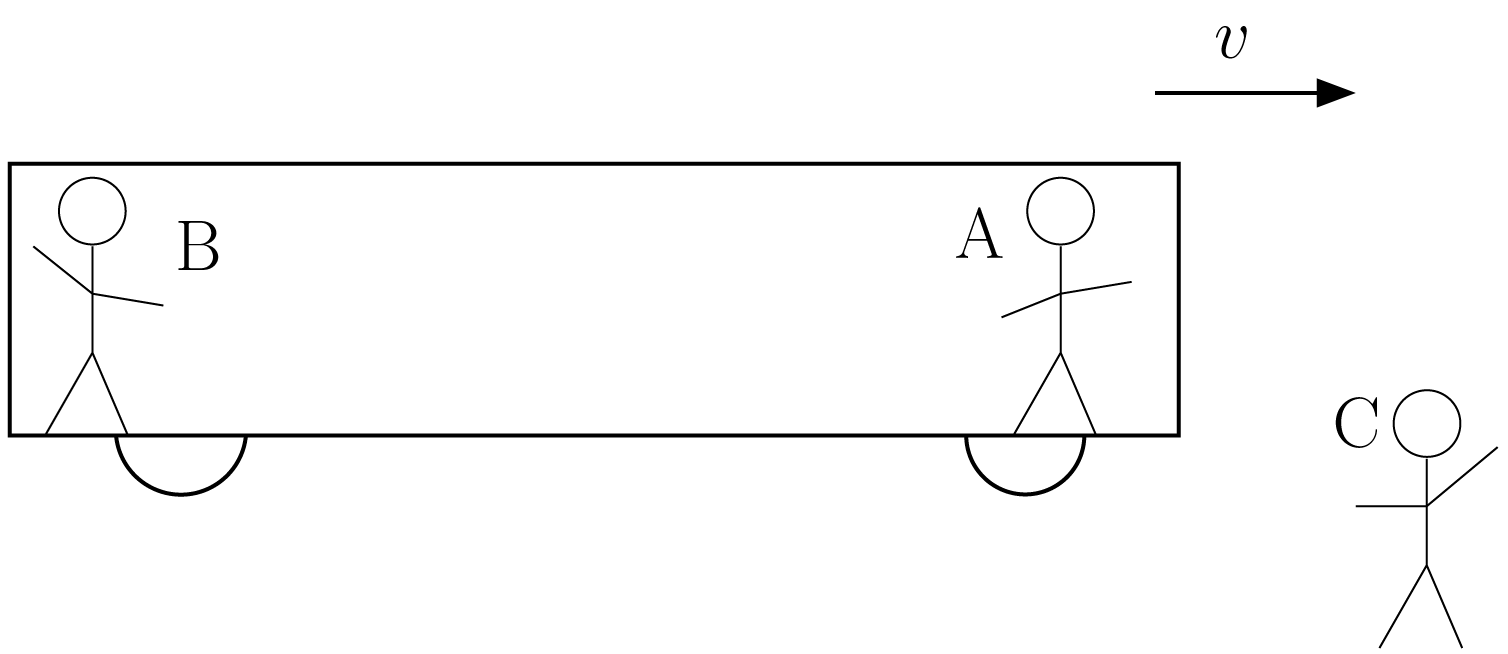
Consider the following thought experiment: a train is moving on a track, with Observers A and B at the front and back end of the train. A and B have measured the length of the train with a long tape measure that they carry with them on the moving train, and find the length to be \(L_{ train}\text{.}\) The train goes past Observer C who is standing next to the track with a stopwatch (see Figure 17). Relative to C in the “ground reference frame,” the train is moving with a speed \(v\text{.}\) From the train’s reference frame, of course, it is C and the ground that are moving at a speed \(v\) in the opposite direction.
Let’s say that Observer C wants to measure the length of the train. He can use his stopwatch to do this: since distance = (speed) × (time), the length of the train is simply the speed \(v\) times the time interval between when the front of the train passes and when the back of the train passes. Let’s consider two events: Event A \(=\) front of train passes C; Event B \(=\) back of train passes C. According to people on the train, the time between the two events \(\Delta t_{
train} = L_{ train}/v\text{,}\) where \(L_{ train}\) is the previously-measured length of the train — this is how far Observer C moves between the events according to train observers. But, as we saw in the previous section, C measures the proper time (since this observer is at both events), which is a smaller time interval:
The length of the train as measured by an observer by the side of the track is less than the length of the same train as measured by people moving with the train.
where \(L_{ rest}\) is the length of an object as measured by observers in a reference frame where that object is at rest, and \(L_{ other}\) is the length as measured by observers in a different reference frame. Note that an object is always largest when viewed from its own reference frame, and shrinks when it is viewed as moving.
You can’t have time dilation without length contraction — the two necessarily go hand-in-hand. This is a recurring theme of relativity — Einstein’s theory can’t be taken “à la carte”; rather, it is all or nothing. Einstein realized that if any single prediction of relativity were ever refuted, then the entire theory would have to be discarded.
The arguments in this section apply to length components along the direction of the relative motion. Components of a length in directions perpendicular to the relative motion are not contracted.
Length contraction is not an illusion or merely a matter of perception. In the example, the train doesn’t just appear to be smaller from C’s reference frame; rather, it really is smaller in that reference frame. Some of the homework problems and drill questions will investigate some of the curious properties of length contraction.