Section 5.2 Changes of Rest Energy
Much of the light you see comes from changes in rest energy of atoms. Examples are sunlight, light from a candle flame, a lightning flash, light emitted by a fluorescent lamp, light from the phosphor coating on the screen of a television set or a video monitor, and laser light. In all these examples, the basic mechanism is that an atom in an “excited” state releases kinetic energy in the form of a photon, with the atom going into its ground (lowest possible) state, or into an excited state of lower energy. We can represent the emission process by the simple reaction equation
\begin{equation}
\textbf{A}^\ast \rightarrow \textbf{A} + \gamma.\tag{5.2.1}
\end{equation}
Here \(\textbf{A}^\ast\) represents the excited atom, \(\textbf{A}\) the atom in its ground or lowest state, and \(\gamma\) (Greek gamma) the photon.
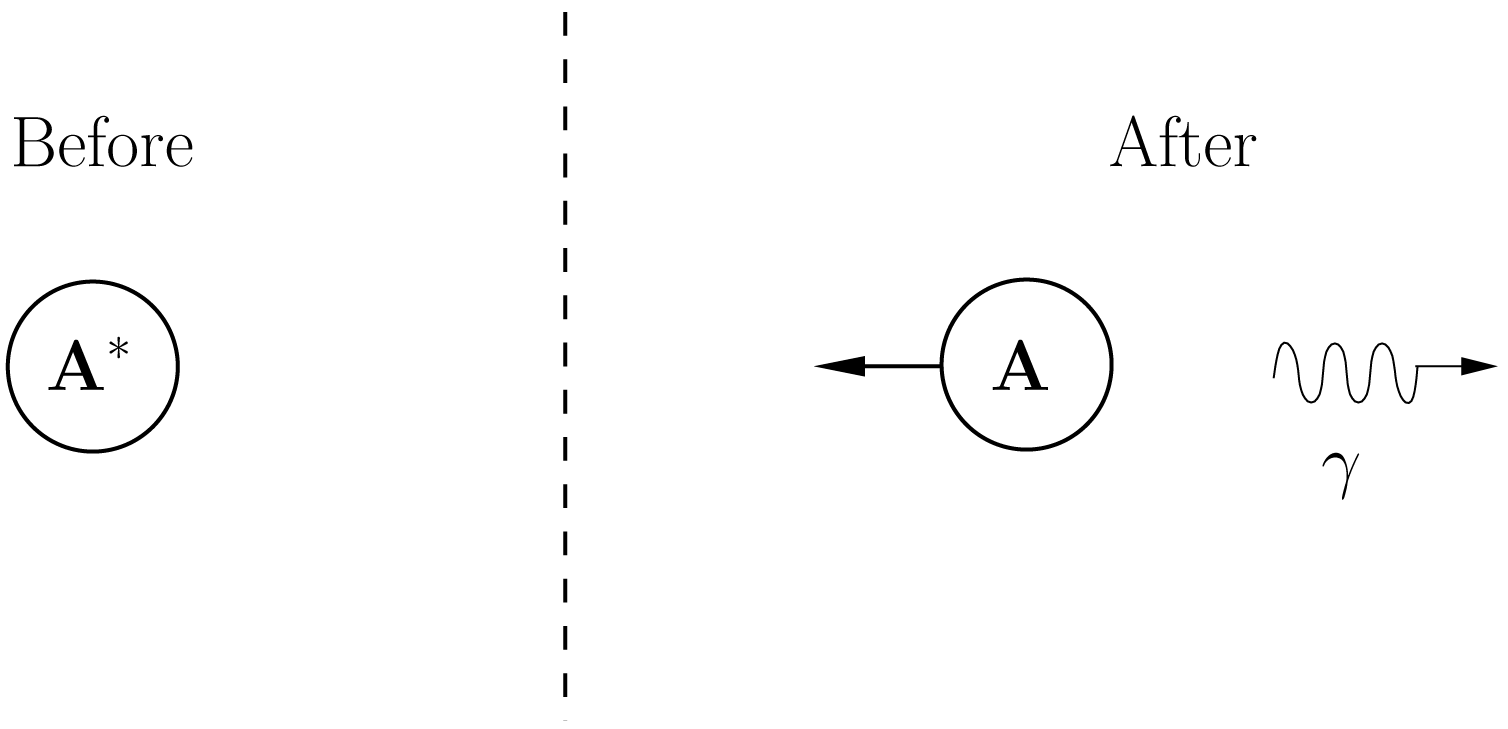
In Figure 35, the excited atom is shown at rest, so all of its energy is rest energy and it has no momentum. But the photon has energy, and from the relation \(E = pc\text{,}\) it also has momentum. And because momentum must be conserved, the atom recoils. We can write the conservation of energy equation for the reaction in (5.2.1) as follows
\begin{equation}
\text{Rest Energy of \(\textbf{A}^\ast\)} = \text{Energy of \(\textbf{A}\)}
+ \text{ Energy of photon } .\tag{5.2.2}
\end{equation}
Because both the kinetic energy of \(\textbf{A}\) and the photon energy are positive numbers, the rest energy (i.e., the mass) of the excited-state atom must be greater than that of the ground-state atom. Therefore, in the emission process rest energy, i.e., mass, is converted to kinetic energy.
When light is absorbed by an atom, exactly the opposite effect occurs. The atom begins in its ground state, absorbs the photon energy and goes into an excited state. Again, by conservation of energy, the excited atom must have more rest energy than the ground-state atom.
Another everyday example of changing rest energy occurs in chemical reactions. For example, the reaction for the oxidation of a carbon atom
\begin{equation}
\text{C} + \text{O} _2 \rightarrow \text{CO} _2\tag{5.2.3}
\end{equation}
is known to release kinetic energy in the form of one or more photons. Therefore the sum of the masses of C and O\(_2\) must be greater than the mass of the carbon dioxide molecule. The change in rest energy in the case of chemical reactions is typically on the order of \(1\,\text{eV}\) (or \(1.6\times 10^{-19}\,\text{J}\)). Much larger energies, on the order of \(1\,\text{MeV}\text{,}\) are involved in nuclear reactions. An example of a nuclear reaction is the decay of a neutron into a proton, an electron, and an electron antineutrino:
\begin{equation}
n \rightarrow p + e^- + \bar{\nu}_e.\tag{5.2.4}
\end{equation}
Here the excess mass of the neutron over the mass of the proton plus electron (the electron antineutrino has very small mass) is converted to the kinetic energy of the three reaction products.
Another important example of changes in mass is the production of new particles in a high energy particle accelerators. In these accelerators high-speed particles are shot at target particles and some of the kinetic energy of the incoming particles is converted to rest energy. In this way hundreds of new particles, most with lifetimes between \(10^{-10}\) and \(10^{-23}\,\text{s}\text{,}\) have been produced. You’ll learn more about these new particles next semester in PHYS 212.

