Of all the paths that an object could take from point \(A\) to point \(B\) through curved spacetime, the physical path will be the one that maximizes proper time.
Section 11.5 Law of Motion for a Freely Falling Body
After a busy decade of work, Einstein finally sorted out how to turn the equivalence principle into a definition of natural motion in curved spacetime. Here’s the rule:
That reproduces the effect of gravity! Really? Let’s examine this.
Subsection Remaining Stationary in the Absence of Gravity
Imagine being in space far away from any masses, so there is no gravity acting. And let’s consider a really boring trip: you start at the spacetime point \(x = 0\text{,}\) \(t = 0\,\text{s}\) and end at the spacetime point \(x = 0\text{,}\) \(t = 1\,\text{s}\text{.}\) Since there are no forces acting on you, you must have simply remained stationary at \(x=0\) the whole time, according to Newton’s First Law.
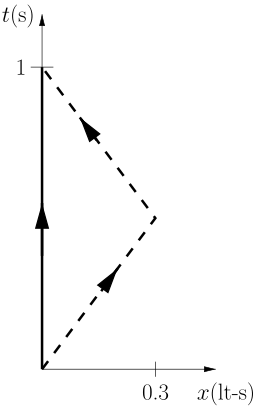
Now let’s see that we get the same result from the principle of maximum proper time. We could imagine other ways to start and end at the correct spacetime points. For example, as shown in Figure 89, you could take off at velocity \(v = 0.6 c\) for half a second and travel \(0.3\,\text{lt-s}\text{,}\) and then suddenly reverse direction and travel for another half second back to \(x = 0\) at a velocity of \(-0.6 c\text{.}\) This hyperactive approach gets you to your destination with an elapsed time on your watch of
\begin{equation}
\Delta t_{ proper} = \Delta t \sqrt{1 - v^2/c^2} =
1.0\,\text{s} \times \sqrt{1 - 0.6^2} = 0.8\, \mbox{s} .\tag{11.5.1}
\end{equation}
That is, this trip would result in less proper time elapsed than the stationary trip. Of all the ways of making the trip, the one taken at zero velocity will give the longest proper time. This is because any non-zero velocity during any part of the trip reduces the proper time required for the trip.
So indeed it works: the principle of maximum proper time says that the natural motion from \(x=0\text{,}\) \(t=0\,\text{s}\) to \(x=0\text{,}\) \(t=1\,\text{s}\) in the absence of any forces is simply to sit still.
Subsection Moving at Constant Speed in the Absence of Gravity
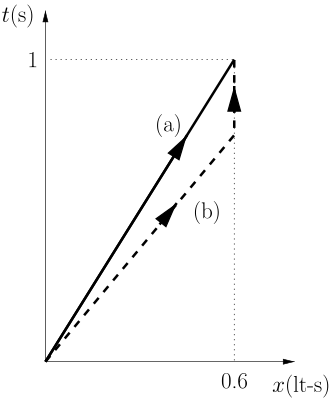
Now suppose we want to go from the point \(x = 0\text{,}\) \(t = 0\,\text{s}\) to the point \(x = 0.6\,\text{lt-s}\text{,}\) \(t = 1\,\text{s}\text{.}\) If our principle of maximum proper time is correct then we should expect that the way to take the trip in the greatest proper time is to go the ‘natural’ way, i.e., at a constant velocity \(v = 0.6 c\text{,}\) shown as route (a) in Figure 90. We already know that the proper time for this constant velocity trip is \(1\,\text{s} \sqrt{1 -0.6^2} = 0.8\, \mbox{s}\text{.}\) Can we find a way that gives a longer proper time?
Figure 90 shows an alternate route to get to \(x =
0.6\,\text{lt-s}\text{,}\) \(t = 1\,\text{s}\text{,}\) labeled as path (b). In homework problem 11.8, you will calculate the proper time for this route. What you should find is that the total proper time is less for the two-step trip, route (b), than the 0.8 second ‘natural’ trip at a single velocity, route (a). In fact there is no other route that gives a longer proper time than the natural route. Our principle shows an encouraging ability to “explain” Newton’s first law, the law of inertia.
Subsection Moving in the Presence of Gravity
The principle of maximum proper time works in curved spacetime as well. The path between two events actually taken by a freely falling body is that path that MAXIMIZES the elapsed proper time. This rule answers the question: How is it that “spacetime tells mass how to move”?
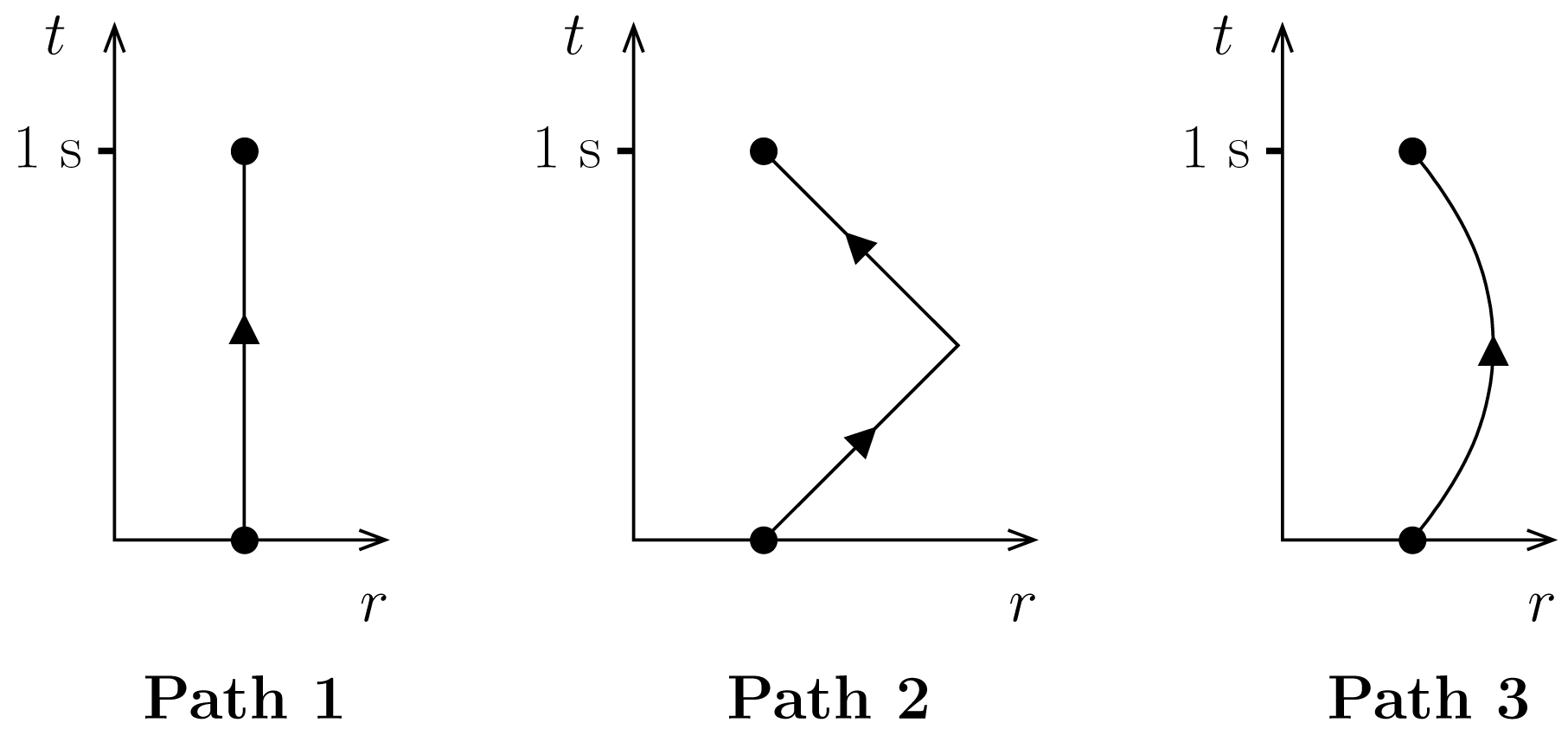
Here is a qualitative example. Throw a ball straight up and catch it one second later at the same original height. What is the “naturally chosen” path through spacetime that maximizes proper time? We have just seen that, because of time dilation, paths that speed up, slow down, or reverse direction tend to decrease proper time. On the other hand, we’ve learned that clocks at higher altitudes measure more elapsed proper time than those at lower altitudes. So now consider these three paths, shown in Figure 91:
-
Path 1.
The ball stays just above your hand the whole time. No speeding to decrease proper time — BUT also not taking advantage of increasing proper time by going high where clocks run faster. Not the best.
-
Path 2.
Zoom high at almost light-speed, zoom back down. This gets the ball high where clocks run fast, but time dilation at near light speed means almost no elapsed proper time! No good.
-
Path 3.
Spend most of the trip at a higher place where proper time elapses rapidly. But don’t go very fast or change speed quickly, so the time dilation is not too severe.
Result: Best path for maximizing proper time is parabolic motion — fast up, slow and stop smoothly at the top, faster on the way down. This is the motion we actually observe!

