Write out the triplet for each possible microstate. For example, the microstate where the first oscillator has all the units of energy can be written as \((4,0,0)\text{.}\) Confirm that you find the correct number of microstates.
For two Einstein solids with \(N_A=3\) and \(N_B=3\) and six energy units, how many times more probable is the macrostate with equally shared energy than the macrostate where system \(A\) has all the energy? Use Table 68.
Is it really true that the entropy of an isolated system consisting of two Einstein solids never decreases? Consider a pair of very small solids. Explain why this statement is more accurate for large systems than for small systems.
A large object’s entropy is observed to increase by \(0.15\,\text{J/K}\) when we add \(45\,\text{J}\) of thermal energy. Assume that this causes a negligible increase in the temperature of the object. Determine the approximate temperature of the object.
The idea of “diminishing returns” says that while the entropy does increase with increasing thermal energy, the slope is decreasing (see Figure 70). The Einstein solid multiplicity, like most materials, shows this behavior. Here is how to see it:
For an Einstein solid with 10 oscillators and 5 energy units, calculate how much the entropy increases, i.e. \(\Delta S\text{,}\) if you add one more energy unit (you may leave your answer in terms of \(k_B\)).
where \(E_A\) and \(E_B\) are the thermal energies of systems \(A\) and \(B\text{.}\) If the two solids are brought to thermal equilibrium, what relation, if any, can be made between the final energies \(E_{A,f}\) and \(E_{B,f}\text{?}\)
Consider a very strange system whose multiplicity is \(\Omega_A=1\) regardless of how much energy it has. Imagine starting this system with some amount of energy and bringing it into thermal contact with system \(B\text{,}\) an Einstein solid.
In which direction will the energy flow, or will no energy flow?
What can you say about the energies of the final state? For example, will they be equal? If they are unequal, which is larger? Is there anything more you can conclude?
A substance has entropy \(S=c\sqrt{E_\text{therm} }\text{,}\) where \(c\) is some constant. Use the definition of temperature to find \(E_\text{therm}\) as a function of \(T\text{.}\)
Consider two Einstein solids with \(N_A=3\) and \(N_B=3\) and eight energy units.
Make a table like Table 68. Note that many of the multiplicities you will need are already in Table 68, so there is no need to re-calculate everything.
System \(A\) and system \(B\) are both large. For system \(A\text{,}\) adding \(250\,\text{J}\) of thermal energy causes an entropy increase of \(0.80\,\text{J/K}\text{.}\) For system \(B\text{,}\) adding \(250\,\text{J}\) of thermal energy causes an entropy increase of \(0.60\,\text{J/K}\text{.}\)
Without mentioning temperature, use probability arguments to determine which way thermal energy will flow when systems \(A\) and \(B\) are thermally coupled.
Entropy applies to more than just heat flow. We can use entropy and the second law of thermodynamics to discuss movement of air in a room.
Consider a room with only 100 gas molecules. Theoretically, the gas molecules can move anywhere in the room. Calculate the probability that all 100 of the molecules will be found on one particular side of the room.
Now, consider a real room with a realistic amount of gas in it — let’s say that there are \(10^{26}\) gas molecules in the room. Calculate the probability that all of these gas molecules will be found in one particular side of the room. (Note: the probability is so small that your calculator or computer might simply give “0” for the answer.)
Now, write a couple of sentences explaining why it is (from a probability perspective) that when a perfume bottle is opened, the scent of the perfume will spread throughout the room.
After the perfume smell has spread throughout the room, would you expect all of the perfume molecules to go back into the bottle? Discuss this using the entropic form of the second law of thermodynamics.
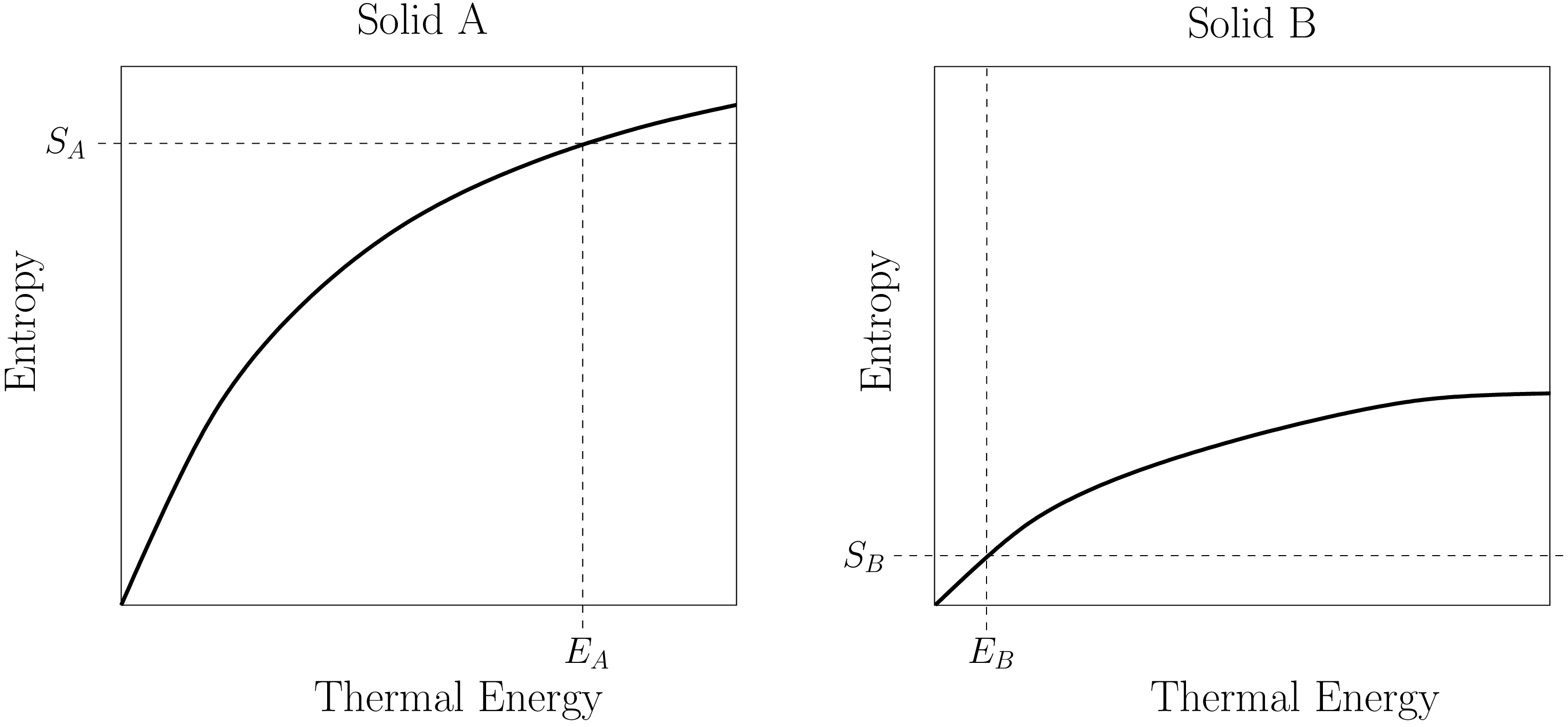
The graphs in the figure below give plots of entropy \(S\) vs. \(E_\text{therm}\) for two different solids, A and B. Solid A starts with indicated energy \(E_A\) and entropy \(S_A\text{,}\) and Solid B starts with \(E_B\) and \(S_B\text{.}\) When Solid A has energy \(E_A\text{,}\) the slope of the entropy vs. energy curve is \(dS_A/dE= 0.2\,\text{K}^{-1}\text{,}\) and when Solid B has energy \(E_B\text{,}\) the slope of the entropy vs. energy curve is \(dS_B/dE = 0.4\,\text{K}^{-1}\text{.}\)
Now let’s get quantitative. Calculate the approximate entropy changes \(\Delta S_A\) and \(\Delta S_B\text{,}\) and \(\Delta S_\text{total}\) if \(3\,\text{J}\) of energy flow between the two solids in the direction that you chose in part (a).
By what factor has the multiplicity for the total system increased from this energy transfer? In other words, calculate the ratio of multiplicities \(\Omega_\text{after} /\Omega_\text{before}\text{.}\) Note: The answer you get will be a ridiculously, mind-boggling, impossible-to-put-into-words-just-how-huge-it-really-is number that you will not be able to calculate — you’ll have to express it as \(e^\text{ something really big }\text{.}\) To give you and idea of just how large this number is, if you were to write it as a digit followed by a bunch of zeros, and if each digit were \(5\,\text{mm}\) wide, the number would fill up several light years.
Explain in your own words why heat flows in this system when the two solids are brought into contact. Don’t use the words “entropy” or “second law” but rather explain it based on probabilities.
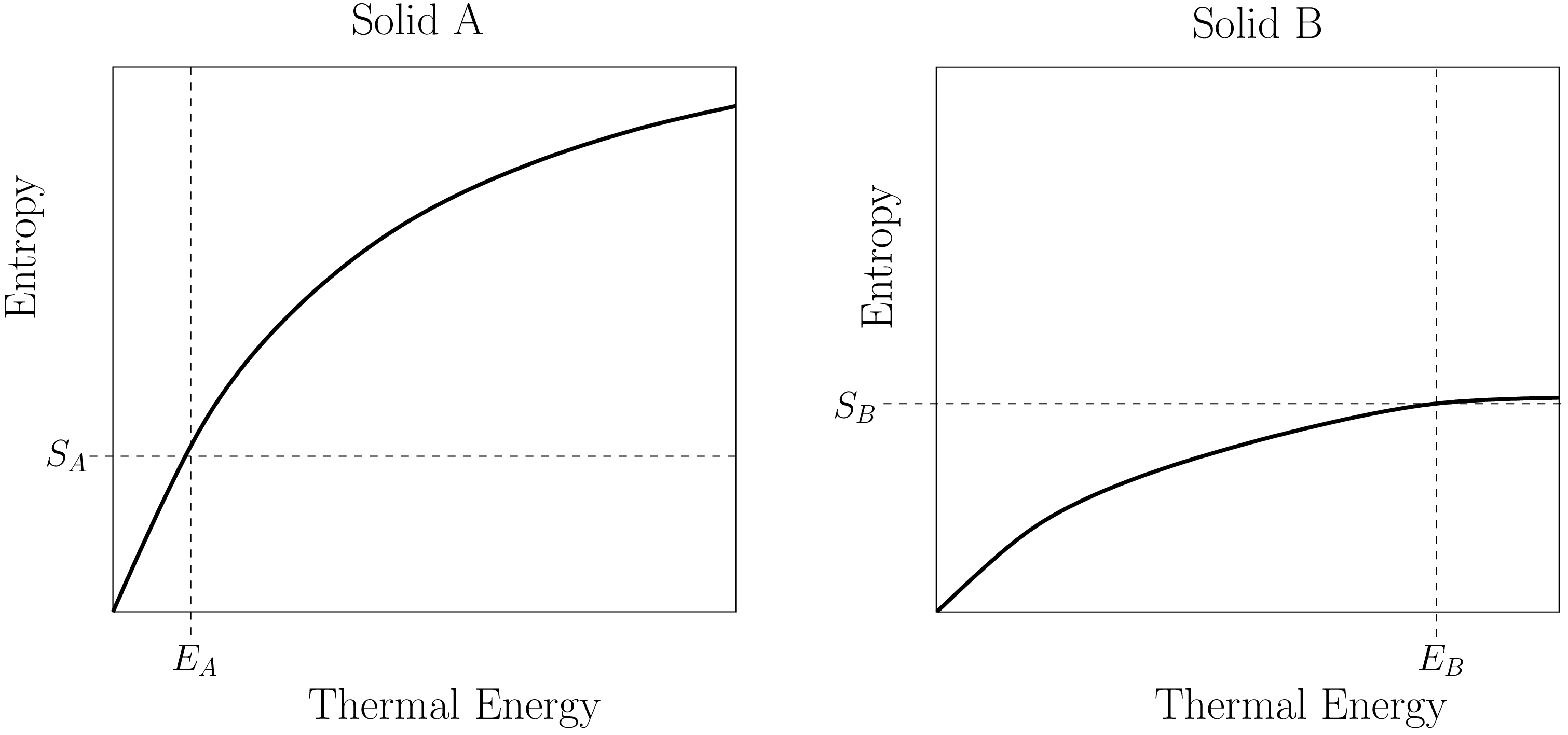
The graphs in the figure below give plots of entropy \(S\) vs.\ \(E_\text{therm}\) for two different solids, A and B. Solid A starts with indicated energy \(E_A\) and entropy \(S_A\text{,}\) and Solid B starts with \(E_B\) and \(S_B\text{.}\) When Solid A has energy \(E_A\text{,}\) the slope of the entropy vs.\ energy curve is \(dS_A/dE= 0.5\,\text{K}^{-1}\text{,}\) and when Solid B has energy \(E_B\text{,}\) the slope of the entropy vs. energy curve is \(dS_B/dE =
0.1\,\text{K}^{-1}\text{.}\)
Now let’s get quantitative. Calculate the approximate entropy changes \(\Delta S_A\) and \(\Delta S_B\text{,}\) and \(\Delta S_\text{total}\) if \(2\,\text{J}\) of energy flow between the two solids in the direction that you chose in part (a).
By what factor has the multiplicity for the total system increased from this energy transfer? In other words, calculate the ratio of multiplicities \(\Omega_\text{after} /\Omega_\text{before}\text{.}\) Note: The answer you get will be a ridiculously, mind-boggling, impossible-to-put-into-words-just-how-huge-it-really-is number that you will not be able to calculate — you’ll have to express it as \(e^\text{ something really big }\text{.}\) To give you and idea of just how large this number is, if you were to write it as a digit followed by a bunch of zeros, and if each digit were \(5\,\text{mm}\) wide, the number would fill up several light years.
Explain in your own words why heat flows in this system when the two solids are brought into contact. Don’t use the words “entropy” or “second law” but rather explain it based on probabilities.
System A and System B are brought into thermal contact when the energy in A is \(E_A= 1000\,\text{J}\) and the energy in B is \(E_B=1100\,\text{J}\text{.}\) Using the table below, listing energies and corresponding entropies of the two systems, determine whether heat will flow from A to B, or from B to A. Show all your work.