Three identical gas-cylinder systems are compressed from the same initial state to final states that have the same volume, one isothermally, one adiabatically, and one isobarically. Which system has the most work done on it? The least?
The relation between thermal energy and temperature depends on the type of gas molecule: for a monatomic gas, \(\Delta E_\text{therm} =
\frac{3}{2}nR\Delta T\) and for a diatomic gas, \(\Delta E_\text{therm} =
\frac{5}{2}nR\Delta T\text{.}\) In your own words — and discussing explicitly the microscopic picture of gases — explain why it is that you need to put more thermal energy into a diatomic gas than for a monatomic gas to raise the temperature by \(1\,\text{K}\text{.}\)
Consider a piston in a car engine that is compressing an air-gasoline mixture before ignition, all in the gas state.
Under what circumstances would the compression be adiabatic? (There are a couple of ways to get an adiabatic compression, one of which is more relevant to a car engine.)
Use the First Law of Thermodynamics to argue that the gas temperature increases if the compression is adiabatic. Where does that additional thermal energy come from during this process?
A gas with \(n\) moles of molecules starts with a temperature \(T_1\text{,}\) pressure \(p_1\) and volume \(V_1\text{.}\) Draw a \(p\) -\(V\) diagram for the following multi-step processes (and label each process with its letter a, b, or c):
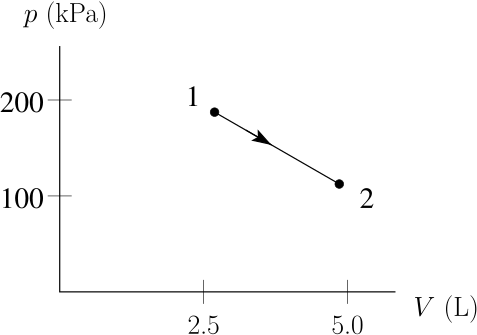
The gas expands at a constant pressure to twice its initial volume.
A gas with \(n\) moles of molecules starts with a temperature \(T_1\text{,}\) pressure \(p_1\) and volume \(V_1\text{.}\) Draw a \(p\) -\(V\) diagram for the following multi-step processes:
The gas is heated up at constant volume, doubling its initial temperature.
A piston initially contains \(1.2\,\text{mol}\) of a monatomic gas at a pressure of \(210\,\text{kPa}\text{,}\) and a volume of \(0.25\,\text{L}\text{.}\) The gas expands at constant pressure to a volume of \(0.47\,\text{L}\text{.}\) Calculate the work done on the gas during this process.
A piston initially contains \(0.35\,\text{mol}\) of a diatomic gas at a pressure of \(105\,\text{kPa}\text{,}\) a temperature \(350\,\text{K}\) and a volume of \(9.7\,\text{L}\text{.}\) The gas is ignited, raising the temperature rapidly to \(550\,\text{K}\) without a significant change in the volume. Calculate the work done on the gas during this process.
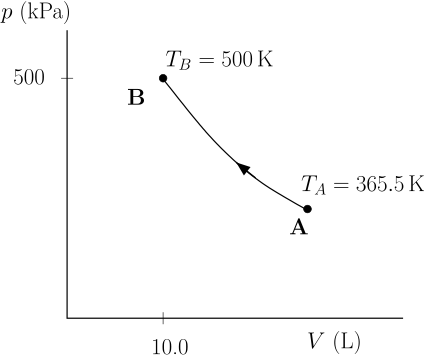
A monatomic ideal gas undergoes an isothermal compression from an initial volume of \(7.0\,\text{L}\) and pressure \(100\,\text{kPa}\) to a final volume and pressure of \(2.0\,\text{L}\) and \(350\,\text{kPa}\text{,}\) respectively. The temperature along the isotherm is \(120^\circ \,\text{C}\text{.}\)
Use the Equipartition Theorem to determine a relation between the thermal energy change \(\Delta E_\text{therm}\) and the temperature change \(\Delta T\) for a monatomic flattium gas where the molecules can move only in two dimensions.
In problem 8.2 you explained the different factors, \(\frac{5}{2}\) vs. \(\frac{3}{2}\text{,}\) that appear in thermal energy expressions for diatomic and monatomic gases. The expressions differ because of the additional rotational degrees of freedom for the diatomic molecules, which adds terms to the energy used in the equipartition theorem. But if the gas is really hot, it is also possible to excite vibrations in the diatomic molecules, resulting in two more terms in the equation for the energy of a diatomic molecule: one for the kinetic energy of the vibration and one for the potential energy of the vibrating molecule. What would you expect for the relation between \(\Delta E_\text{therm}\) and \(\Delta T\) for such a hot diatomic gas?
A piston contains 0.65 moles of diatomic nitrogen gas (N\(_2\)), with an initial pressure and volume of \(110\,\text{kPa}\) and \(0.15\,\text{L}\text{,}\) respectively. The piston compresses the gas adiabatically to a volume of \(0.062\,\text{L}\text{.}\) Calculate the pressure of the gas after this compression.
A piston contains \(0.45\,\text{mol}\) of monatomic helium gas, with an initial volume and temperature of \(0.12\,\text{L}\) and \(285\,\text{K}\text{,}\) respectively. The piston expands the gas adiabatically to a volume of \(0.31\,\text{L}\text{.}\) Calculate the temperature of the gas after this expansion.
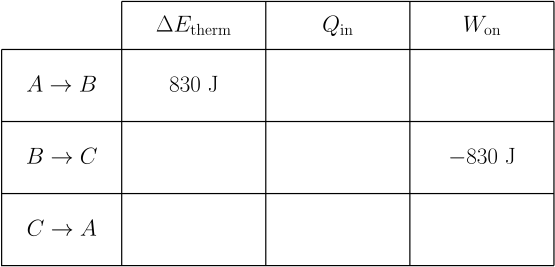
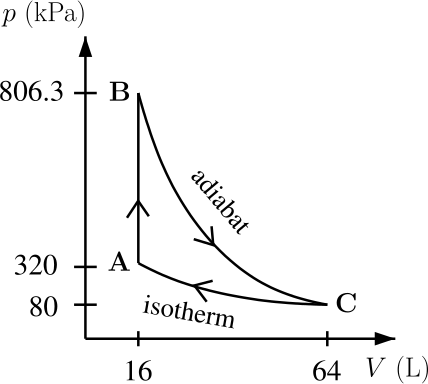
Fill in the chart below for the change in thermal energy, heat flow in, and work done on the gas for each of the processes and for the complete cycle. Show all work.
\(0.20\,\text{mol}\) of diatomic ideal gas undergoes the processes shown in the \(p\) -\(V\) diagram of Figure 63. The table below has boxes for the change in thermal energy of the gas, the heat added to the gas, and the work done on the gas, all in joules. Energy values have already been entered in two of the boxes. Fill in the remaining entries with values accurate to three significant digits. Be sure to show your work for each entry.