Let’s say that two spaceships leave Earth. The USS Zaphod leaves the Earth going in one direction with a speed \(0.8c\) relative to Earth. The USS Beeblebrox leaves Earth going in the opposite direction with a speed \(0.8c\) relative to Earth. What is the speed of the Zaphod from the reference frame of the Beeblebrox? Based on classical assumptions, you might expect the answer to be \(1.6c\text{.}\) But this conflicts with Einstein’s theory of relativity which states that no object can travel faster than the speed of light relative to any other observer. It is clear that it is necessary to replace classical laws for addition and subtraction of velocities with a more general, relativistic transformation.
A relativistic approach to velocity addition and subtraction was already hinted at earlier in Chapter 2. The principle of invariance of the speed of light requires that all observers (in any reference frame) measure the same speed for a pulse of light — we can’t simply add and subtract velocities. On the other hand, common experience shows us that for non-relativistic speeds, simple addition and subtraction work fine. So, we need a velocity transformation relation that reduces to the classical result for small speeds, but which prevents anything from traveling faster than the speed of light. It turns out that this can be accomplished by taking the classical result and dividing by a relativistic correction that becomes significant (i.e., not just 1) for speeds close to \(c\text{.}\)
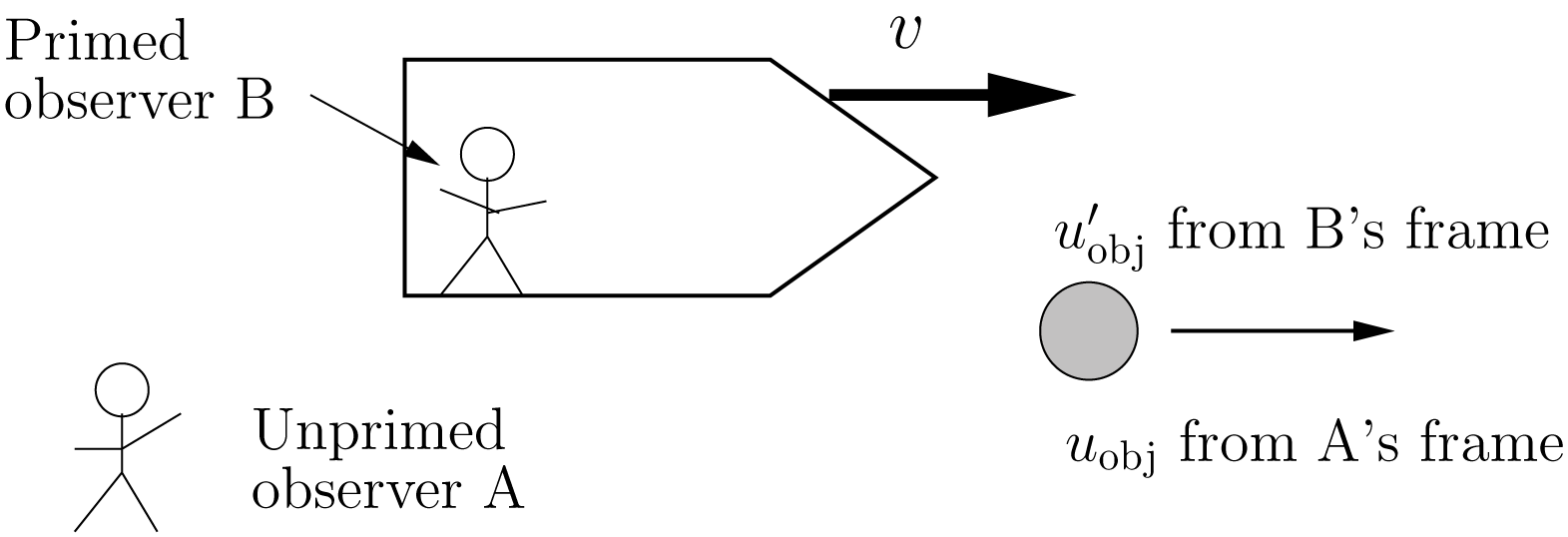
Figure 28 shows the scenario that we are discussing. Two reference frames are defined: an unprimed frame denoted by observer A and a primed frame denoted by observer B on a spaceship moving with a speed \(v\) relative to observer A. They are both measuring the speed of the same object. Observer A says the object is moving with a speed \(u_{ obj}\) while observer B says the ball is moving with a speed \(u_{ obj}^\prime\text{.}\)
Figure28.An object moving in the \(x\)-direction relative to both unprimed and primed frames. The speed of the object is measured to be \(u_{ obj}\) from the reference frame of observer A and \(u_{ obj}^\prime\) from the reference frame of observer B.
We won’t derive (4.2.1) rigorously here. Rather, note that if the object is a pulse of light, then \(u_{ obj}^\prime
= c\text{,}\) and (4.2.1) reduces to
Note that the numerator in (4.2.1) is the result that you would get classically, whereas the denominator is a relativistic correction. Also, note that if either the object or the primed observer are traveling at speeds that aren’t a significant fraction of the speed of light, then the denominator of (4.2.1) is very nearly 1, so we recover the classical result for “everyday” speeds.
Bucknell Bison baseball pitcher Christy Mathewson throws a blazing fastball while riding on a really fast train. From his reference frame (i.e., the train’s frame) the ball moves toward the front of the train with a speed \(u_{ ball}^\prime = 0.7c\text{.}\) The train itself is moving relative to the ground with speed \(v =
0.8c\text{.}\) How fast is the ball moving relative to someone on the ground?
Solution: Classically, the speed as viewed from the ground would be \(u_{ ball}^\prime + v\) or \(1.5c\text{.}\) (This is the numerator of (4.2.1).) But, of course, this isn’t possible in a relativistic universe where nothing goes faster than \(c\text{.}\) Using (4.2.1) we find
Exercise: What if the ball were a beam of light? How fast would it be moving from the train’s reference frame? How fast from the ground’s reference frame? Show that (4.2.1) gives the correct result for this case.
If the problem gives you the speed as measured by the unprimed observer, you can use the following inverse transformations to get the speed as measured by the primed observer:
You don’t really need to write down these relations or try to figure out which speed is \(v\text{,}\) which speed is \(u_{ obj}\text{,}\) and which speed is \(u_{ obj}^\prime\text{.}\) There is a very simple way of handling all of these problems. No matter which velocity you are looking for, the answer is always:
where the relativistic correction is simply “\(1+\)(product of other two speeds divided by \(c^2\))” or “\(1-\text{ (product of other two speeds
divided by \(c^2\)) }\text{.}\)”. You will be given two velocities, and you’ll be looking for the third one. Just figure out the answer classically, then divide by the correction. The only question then is whether to use the “\(+\)” or “\(-\)” in the correction. The rule: if you added magnitudes of velocities in the numerator, then you use the “\(+\)” in the denominator, and if you subtracted magnitudes in the numerator, then you use the “\(-\)” in the denominator. This will take care of any velocity addition or subtraction that you need.