Heat up an ice cube and it melts. Heat up a chunk of copper and it melts also, albeit at a much higher temperature. What is melting, and what determines the temperature at which a substance melts? Our ball-spring model, taken literally, cannot exhibit melting, because no matter how energetically the molecules vibrate, they are still connected to the same neighbors. But we should recall that the spring was only an approximation to the molecular pair potential, valid when the thermal energy was low enough that the molecules were mostly near the minimum of their potential well. Once a pair of molecules is stretched far enough apart, their interaction differs from a spring in that the attractive force between them weakens and ultimately becomes negligible (see Figure 38). So we need a mental picture of a “spring” that weakens and “gives up” under too much stretching.
We can use the ball-spring model to make a rough estimate of when melting should occur. The equipartition theorem tells us how far the molecules move in their vibrations. Let \(x\) be the displacement of a molecule from its equilibrium position in the \(x\)-direction. The average value of \(x\) is zero, because the molecule is displaced equal amounts of time in the \(+x\) and \(-x\) directions. But the average value of \(x^2\) is not zero and is given by (using the equipartition theorem)
Copper is a solid at room temperature, \(T=295\,\text{K}\text{.}\) As the copper atom oscillates about its equilibrium position, what is the typical magnitude of its displacement in the \(x\)-direction?
Is this answer reasonable? Recall that the equilibrium distance between copper atoms is \(d=2.28\times 10^{-10}\,\text{m}\text{,}\) which is about 20 times larger. So at room temperature, copper molecules are vibrating somewhere around 5% of the distance of their separation. That sounds plausible.
Melting occurs when the molecular excursions become an appreciable fraction of the bond length \(d\text{,}\) an idea known as the Lindemann criterion. Lindemann found empirically 1
i.e., simply by looking at the experimental data
that a reasonable estimate for the melting temperature can be obtained by setting \(x_\text{therm}
\approx d/10\text{.}\) Note that if \(x_\text{therm} \approx d/10\text{,}\) it does not mean that each atom in the solid is vibrating precisely \(d/10\) from the equilibrium; some are going further, and some are going less. The Lindemann criterion implies
This is not an highly accurate estimate, but it does capture some general features. For example, lead has a relatively low melting temperature, which is evidently due to its weak spring constant. An estimate for copper, based on the ball-spring parameters, is
which is comparable to the measured value of \(1358\,\text{K}\text{.}\) Iron has a stronger spring constant than copper, and correspondingly a higher melting temperature.
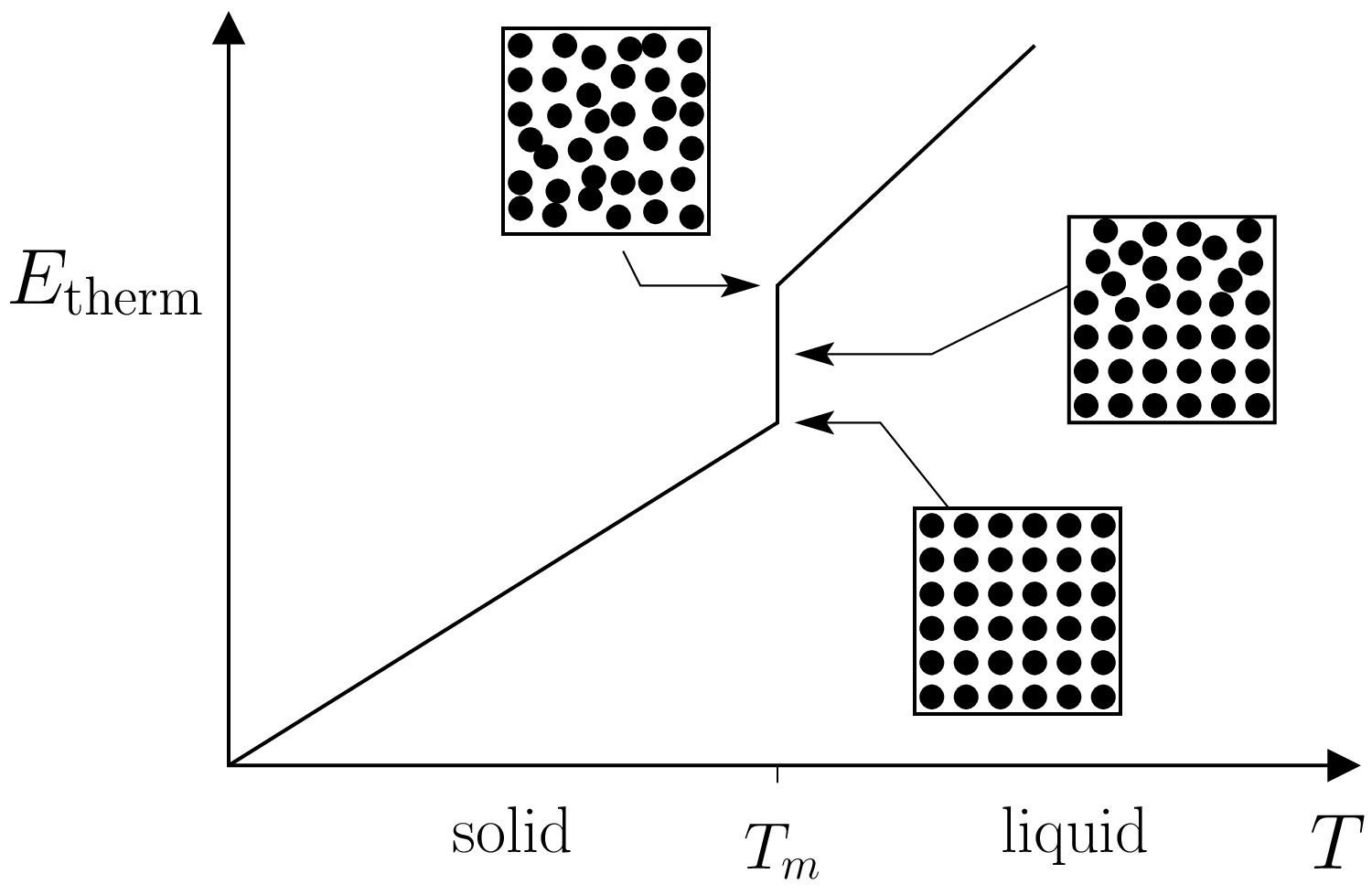
In the solid state, whenever thermal energy is added to an object, the temperature increases. However, when the temperature of a solid reaches the melting temperature, additional thermal energy no longer causes temperature increase but rather phase change. Adding a little thermal energy to a solid at the melting temperature causes a few of the molecules to break from the lattice structure and become liquid. Adding more thermal energy causes even more molecules to become liquid. While this is happening, the temperature of the material is not changing. Rather, a solid with temperature \(T_m\) is being converted to a liquid at temperature \(T_m\text{,}\) as shown in Figure 49. The amount of thermal energy required to convert one mole of a solid to a liquid is called the latent heat of fusion, and denoted by the symbol \(L_f\text{.}\) Given the latent heat of fusion for a material, it is straightforward to determine how much energy is needed to melt a certain amount of that material:
where \(n\) is the number of moles of the material. This same relation can be used to determine how much energy is released when a certain amount of a liquid is frozen into solid form. Energy must be added to melt something, and energy is released when something freezes. Latent heats for a few materials are given in Table 48.
Figure49.Shown is \(E_\text{therm}\) versus \(T\) for one mole of a typical material. The slopes in the solid phase and liquid phase are the molar specific heats, which are not typically equal to each other. The vertical jump at \(T_m\) represents the latent heat of fusion, i.e., the amount of thermal energy required to change phase.
Solution: This is a two-part process. First the temperature of the solid lead solid must be raised to its melting temperature. Then the lead can be melted.
In the first part of the process the temperature of all of the lead increases to \(600\,\text{K}\text{.}\) The thermal energy change corresponding to this is given by
In this calculation, we used the measured value for the molar specific heat for lead (see Table 43). We could have used the Dulong-Petit (ball-spring) approximation (\(C
= 3R\)) which would have given us a result very close to the value that we calculated here.
Note also that if we wanted to start with 2 moles of liquid lead and 1 mole of solid lead both at \(600\,\text{K}\text{,}\) and cool it down to a solid at room temperature, the same calculation would tell us how much thermal energy we would need to remove. It would also be \(33.8\,\text{kJ}\text{.}\)
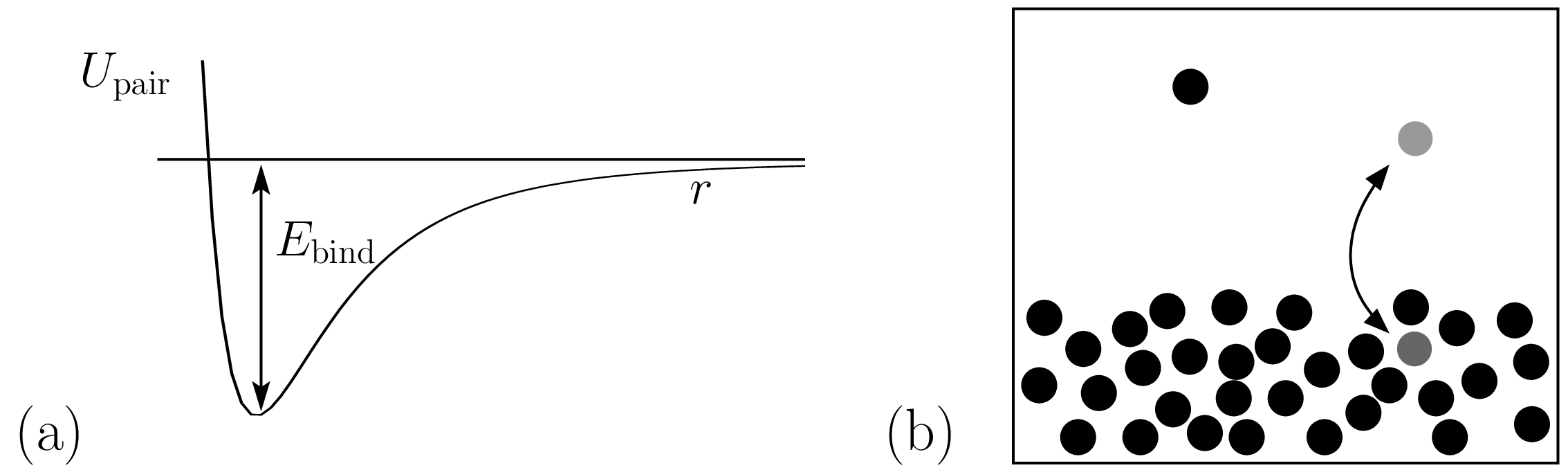
For most substances, there exists a boiling point separating a liquid phase from a gas phase. At the molecular level, the liquid state has nearly solid-like density, with molecules packed close together and fairly near the minimum of the potential well. The transition to the gas phase requires pulling these molecules apart and setting them free, where they have no neighbors. Let \(E_\text{bind}\) be the depth of the potential well, that is, \(E_\text{bind}\) is the amount of energy needed to bring a pair of molecules from their equilibrium separation to far apart from each other (see Figure 50(a)). Vaporization (or boiling) occurs roughly when \(k_BT\approx E_\text{bind}\text{,}\) so we can estimate the boiling temperature as
Figure50.(a) The pair potential depth \(E_ bind\text{.}\) (b) Removing a particle from the liquid state requires an energy of about 10–12\(E_ bind\text{.}\)
Like with melting, vaporization requires an input of thermal energy. As thermal energy is added, the temperature remains fixed at the vaporization temperature, while an increasing amount of liquid gets converted to gas. The amount of energy required to convert a mole of a substance from liquid to gas is called the latent heat of vaporization. This is used much the same way as the latent heat of fusion:
As before, \(\Delta E_\text{therm}\) is positive if we are adding thermal energy to vaporize, and it is negative if we are removing thermal energy to condense.
One final comment about latent heat and phase transitions: the amount of heat needed to melt or boil most common materials is quite large. Just looking at Tables 43 and Table 48, you can see that it is necessary to add a “k” to the units for latent heats \(L_f\) and \(L_v\) (versus the units for molar specific heat \(C\)) because we are usually talking about thousands of Joules of energy to cause a phase transition for each mole of the substance. This is a very important result with lots of practical applications. For example, this is the reason why ice is so good at cooling your drink; it isn’t the low temperature of the ice that is important, rather it is the large amount of energy that the ice absorbs when it melts that does such a good job of cooling your drink. Phase transitions are used all the time in cooling and heating applications. A standard air conditioner or refrigerator typically uses some substance (e.g., freon) whose condensation and vaporization play a key role in the cooling process. And your body uses phase transitions to keep cool on hot summer days. Sweat (water) on your skin vaporizes, and most of the energy needed for this phase transition comes from your body. This is how you can manage not to overheat even if the surrounding air temperature is greater than your body temperature. So, we would all be dead were it not for phase transitions.