Section 7.1 Phases of Matter
Since the dawn of human existence, people have noticed that matter could be solid, liquid, or gas. What cavewoman Thag and her contemporaries did not realize is that these quite different phases are made up of the same stuff: molecules that are pushing and pulling on each other, sometimes in a solid phase, sometimes a liquid and sometimes a gas. She was not the only one who didn’t understand this. Plato didn’t know about molecules. Nor did Dante, or even Newton. Only after the seminal work of Boltzmann and Einstein around the turn of the 20\(^{ th}\) century did our process of scientific discovery lead us to understand the molecular form of matter.
This discovery is one of the crowning achievements of our species, and is also very practical, having provided the basis for most of our modern technology. The great 20\(^\text{th}\) century physicist Richard Feynman once remarked
1
You’re going to be hearing more about him in PHYS 212.
“If, in some cataclysm, all scientific knowledge were to be destroyed, and only one sentence passed on to the next generation of creatures, what statement would contain the most information in the fewest words? I believe it is the atomic hypothesis … that all things are made of atoms — little particles that move around in perpetual motion, attracting each other when they are a little distance apart, but repelling upon being squeezed into one another. In that one sentence you will see an enormous amount of information about the world, if just a little imagination and thinking are applied.”
Let us now follow Feynman’s suggestion and apply a little imagination and thinking.
We have been discussing the solid phase of matter, where the particles are arranged in a regular lattice pattern, and the forces between the particles can be well-modeled as springs attached between neighbors. But we know from everyday experience that a solid can be melted when heated enough. Consider a lattice of vibrating molecules. Once the molecular excursions become large enough, the molecules start slipping past one another. As a result, the regular arrangement of the molecules in the lattice breaks down and the molecules are now disordered. They are still very closely packed and the density is comparable to the solid state, but the object has no rigidity. This is a liquid.
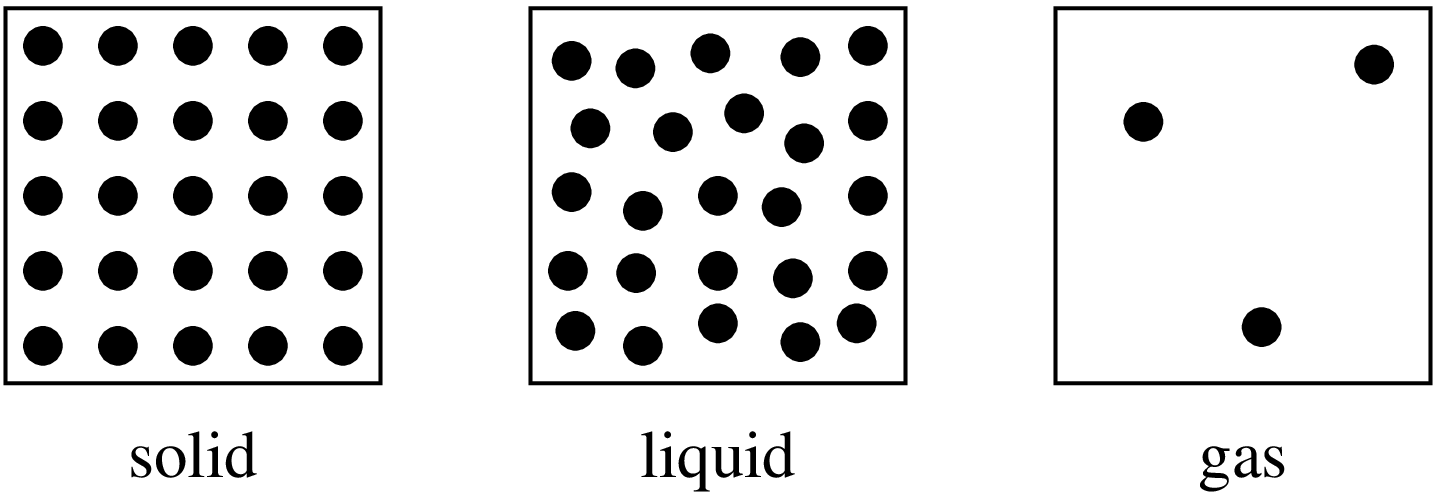
For most substances, there exists a boiling point separating a liquid phase from a gas phase. The picture you should have for the gas state is molecules moving about freely, far from their neighbors, and moving in a straight line until they collide with another molecule or with the walls of the container. Like a liquid, the gas phase is disordered. But the density of gases is much lower than liquids. Another difference between liquids and gases that we can understand immediately from the molecular viewpoint is their compressibility. Because the gas is dilute, we can compress a gas if we push the walls of the container inward. The molecules end up a bit closer together and bounce around a little faster, but otherwise they don’t object. Liquids are essentially incompressible: you can’t squeeze water to fit into a smaller volume. The liquid molecules are already packed together, albeit in a messy way, and any further squeezing is resisted by the repulsive forces of the pair potential.
Our basic understanding of the thermal energy of matter, developed in sections 6.2 and Section 6.3 for solids applies for liquids and gases as well: in particular, thermal kinetic energy is associated with motion of the molecules. And the potential energy associated with the forces between the molecules — i.e., the pair potential — provides the thermal potential energy. However, there are significant differences in the thermal potential energy for the different phases:
-
in the solid phase the molecules are very near their equilibrium separation, allowing us to approximate their forces with springs,
-
in the liquid phase, however, the potential energy is complicated, since the molecules are pushed closer together and pulled farther apart as the molecules squeeze by each other, making the spring approximation invalid, and
-
in the gas phase, the molecules are so far apart that, except for very brief collisions, there the potential energy is negligible.
In contrast to these differences, the thermal kinetic energy is identical in form in all three phases. This allows us to develop the notion of thermal speed.

