Section3.4Ordering of events — the relativity of simultaneity
Every event has a set of space and time coordinates. In Example 3.3.1 above, we would say that the event A (girl sneezes) occurs at time \(t=0\) and location \(x =
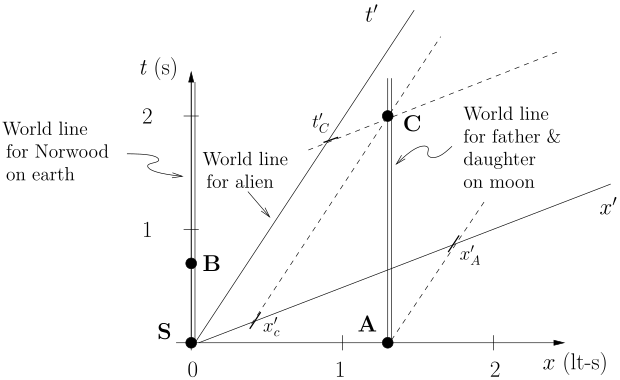
1.3\,\text{lt-s}\text{.}\) Similarly, we can determine the location and times of events B and C, all as measured by observers in the Earth-Moon reference frame. Let’s add one more event to the scenario: let’s say that at time \(t=0\text{,}\) the kicker Scott Norwood, Jr., takes a step just before attempting the fateful kick. In Figure 22 we have added this event and labeled it S. In the Earth-Moon frame, we can say quite definitively that A and S are simultaneous and come first, then B, then C. Also, A and C happen at the same location, and S and B happen at the same location.
Special relativity helps us answer the following question: how does an observer moving in a different reference frame view these same events? We won’t worry here about the actual numerical values of \(x^\prime\) and \(t^\prime\) (the position and time as measured by a different observer), but we can say quite a lot about the ordering of events in space and time by looking at the spacetime diagrams.
We have added another world line to Figure 22, namely, the world line for a hypothetical alien flying past the Earth just as Scott Norwood, Jr., takes a step before attempting the kick. This alien is monitoring the game to try to understand human culture. We assume the alien is traveling at a speed \(0.5c\text{;}\) hence, the world line has a slope of 2.
We have already commented that the world line of an observer in a primed frame is simply the \(t^\prime\) axis for that frame, so we have labeled the alien’s world line \(t^\prime\text{.}\) But where should we put the \(x^\prime\)-axis and what scale should we put on it? It turns out that to satisfy the invariance of the speed of light, we must draw the \(x^\prime\)-axis at the same angle relative to the \(x\)-axis as the angle of the \(t^\prime\)-axis relative to the \(t\)-axis. This means the slope of the \(x^\prime\)-axis is equal to the speed \(v\) of the primed frame relative to the unprimed frame.
Recall that the \(t^\prime\)-axis represents points where \(x^\prime =
0\text{.}\) It turns out that \(x^\prime\) is constant along any line parallel to the \(t^\prime\)-axis. In other words, lines parallel to the \(t^\prime\)-axis are equal-location lines for the primed frame of reference, just as the \(t\)-axis and all lines parallel to it are each lines of equal location for the unprimed frame of reference. The same ideas work for events on lines parallel to the \(x\) or \(x^\prime\) axes; events on a line parallel to the \(x\)-axis are simultaneous in the unprimed frame, and events on a line parallel to the \(x^\prime\)-axis are simultaneous in the primed reference frame.
We can use these ideas to “read off” coordinates for events in both reference frames. As an example, let’s look at event C in Figure 22. We have already commented that in the unprimed frame, its \(x\) location is \(1.3\,\text{lt-s}\) and its time is \(2\,\text{s}\text{.}\) The coordinates of this event in the alien’s reference frame are determined by drawing lines parallel to the \(x^\prime\) and \(t^\prime\) axes (shown as dotted lines in Figure 22). The intersections of these construction lines with the opposing primed axis gives the \(x_C\) and \(t_C\) coordinates. The rules for determining coordinates can be summarized as follows:
To find \(x_C\text{,}\) draw a straight line through C parallel to the \(t\)-axis and read off where it crosses the \(x\)-axis.
Using this type of construction, we can see that although events A and C occur at the same place in the unprimed (Earth-Moon) reference frame, event C happens to the left of the event A in the primed (alien) reference frame. This is easy to understand: the alien is far from the Moon when event A happens, so A is far “to the right,” whereas the alien is close to the Moon when event C happens, so from the alien’s perspective, C isn’t so far to the right, i.e., smaller \(x^\prime\) coordinate.
But what about the ordering of events in time? We have commented that the invariance of the spacetime interval says that if two observers disagree about distances, then they will have to disagree about time intervals as well.
In preparation for class: Look at the \(t^\prime\) coordinates for events S and A. In the Earth-Moon reference frame, these events are simultaneous. What about in the alien reference frame?
We have said that any two events on a line parallel to the \(x^\prime\)-axis are simultaneous in the primed frame of reference. Similarly two events that lie on a line parallel to the \(x\)-axis are simultaneous in the unprimed frame. However two different events cannot lie both on a line parallel to the \(x\)-axis and parallel to the \(x^\prime\)-axis. Thus two events that are simultaneous in one frame cannot be simultaneous in the other frame. We explore this idea in the following example.
Einstein showed, with the following thought experiment, that two events which occur at the same time but at different places in one frame, occur at different times in another frame.
Imagine a train moving past a station. By chance, lightning happens to strike the front and back of the train at the same time according to observers on the station platform. Light pulses from these strikes travel toward the middle of the train, where a passenger observes their times of arrival. Do the light pulses arrive simultaneously or does one arrive before the other, and if so, which one?
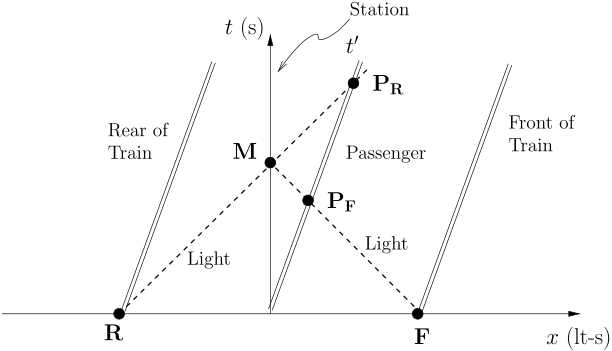
Solution: Use a spacetime diagram, Figure 23, with the station at rest in the unprimed frame and the train at rest in the primed frame. The \(x\)- and \(x^\prime\)-axes both lie along the track. (Note: this does not mean that the \(x\)- and \(x^\prime\)-axes are the same thing on a spacetime plot. The \(x^\prime\)-axis is not shown in Figure 23, but remember that it is the mirror image of the \(t^\prime\)-axis about a \(45^\circ\) line; i.e., the angle between the \(t\)- and \(t^\prime\)-axes is the same as the angle between the \(x\)- and \(x^\prime\)-axes.) The world line for the middle of the station is shown as the \(t\)-axis.
Because all parts of the train are at rest in the primed frame, we draw the world lines for the front and the rear ends of the train parallel to the \(t^\prime\)-axis. Also, in Figure 23, we have chosen the world line for the passenger riding in the exact middle of the train to be the \(t^\prime\)-axis. In the primed frame the front and rear world lines are then equidistant from the passenger, by definition.
The lightning strikes occur at points R and F on the world lines of the rear and front of the train. Because each strike represents an event and because these two events occur simultaneously in the station frame, R and F must be drawn on the same horizontal line. We arbitrarily choose this line to be at \(t = 0\text{.}\)
The light pulses produced by the lightning strikes travel with speed \(c = 1\,\text{ lt-whatever per whatever }\) from the event F back toward the passenger and from R forward toward the passenger. The pulse from F is represented by a world line of slope \(-1\) and the pulse from R is represented by a world line of slope \(+1\text{.}\)Figure 23 shows that the pulse from F arrives at the passenger’s world line (at P\(_\text{F}\)) earlier (i.e., at a smaller value of \(t^\prime\)) than does the pulse from R, which arrives at P\(_\text{R}\text{.}\)
The passenger must conclude that the front strike occurred before the rear strike because she is sitting in the middle of the train, equidistant from R and F, and she knows the light pulses must have taken the same time (in her frame) to reach her. By the same argument, an observer on the station platform who was at the exact middle of the train at \(t = 0\) when the strikes occurred, sees the pulses at the same time. This is shown on the spacetime diagram by the fact that the world lines of the pulses cross the world line of the middle of the station at \(x = 0\) (event M) at the same time.