A \(36\,\text{g}\) ice cube at \(0^\circ\,\text{C}\) is dropped into \(90\,\text{g}\) of water at \(22^\circ\,\text{C}\text{.}\) Heat flows from the water to the ice, bringing both to equilibrium at \(0^\circ\,\text{C}\text{.}\)
Determine the number of moles of ice melted in cooling the water to \(0^\circ\,\text{C}\text{.}\)
Consider a pair of \(5.0\,\text{mol}\) ideal solids. Solid \(A\) initially has a temperature of \(500\,\text{K}\text{,}\) while solid \(B\) has a temperature of \(200\,\text{K}\text{.}\) The solids are brought into thermal contact, and heat flows until the system reaches equilibrium. Determine the entropy change of each solid, and the total entropy change.
A heat engine draws \(600\,\text{J}\) of heat per cycle from a hot reservoir at \(800\,\text{K}\text{,}\) and dumps \(300\,\text{J}\) of heat per cycle into a cold reservoir at \(200\,\text{K}\text{.}\) Determine the efficiency of this engine.
Consider a \(10\,\text{mol}\) brick of ideal solid initially at temperature \(500\,\text{K}\text{.}\) This brick is used as the heat source for a heat engine, which is dumping heat to a room-temperature reservoir at \(295\,\text{K}\text{.}\)
Determine the entropy change of the brick as it cools to room temperature.
Consider the two-brick heat engine of Example 10.4.3. Calculate the maximum amount of work that could be obtained from this engine. For this problem, assume that the bricks are each an ideal solid with \(2.0\,\text{mol}\text{.}\)
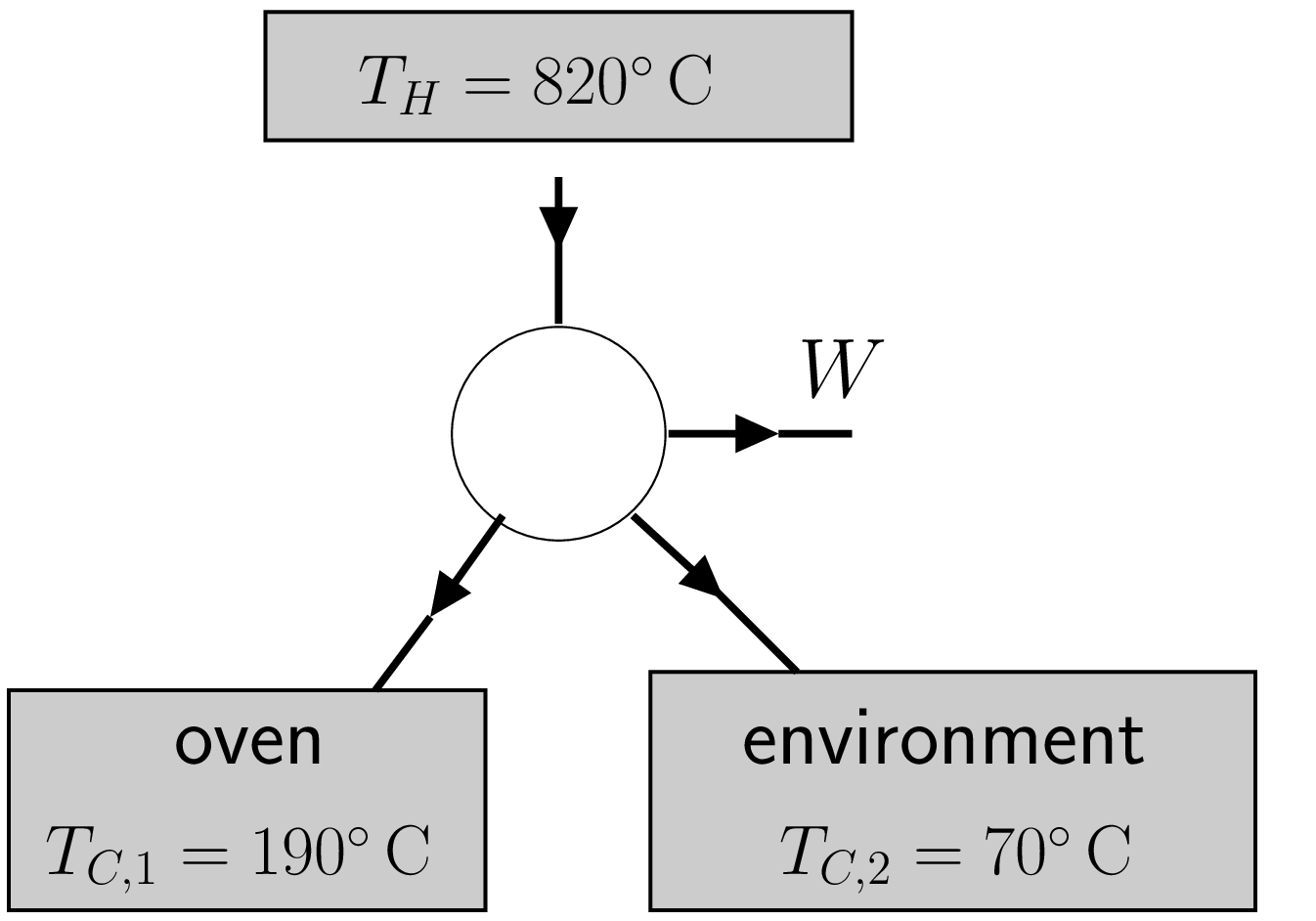
Susquehanna Valley Limousine has modified their automobile engine to provide heat for an oven to bake fresh chocolate chip cookies while you cruise Lewisburg. 1
Not really.
For each gallon of gas, \(12\,\text{MJ}\) of heat is dumped from the engine into the oven at a temperature of \(190^\circ\,\text{C}\text{,}\) and the remainder of the heat coming from the engine is dumped to the environment at \(70^\circ\,\text{C}\text{,}\) as described in Example 10.4.2. Calculate the maximum work possible from a gallon of gas for this engine. As in Example 10.4.2, assume that the hot reservoir has a temperature of \(820^{\circ}\,\text{C}\) and the heat coming from the burning gas totals \(120\,\text{MJ}\text{.}\)
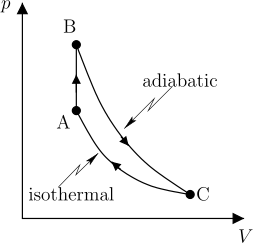
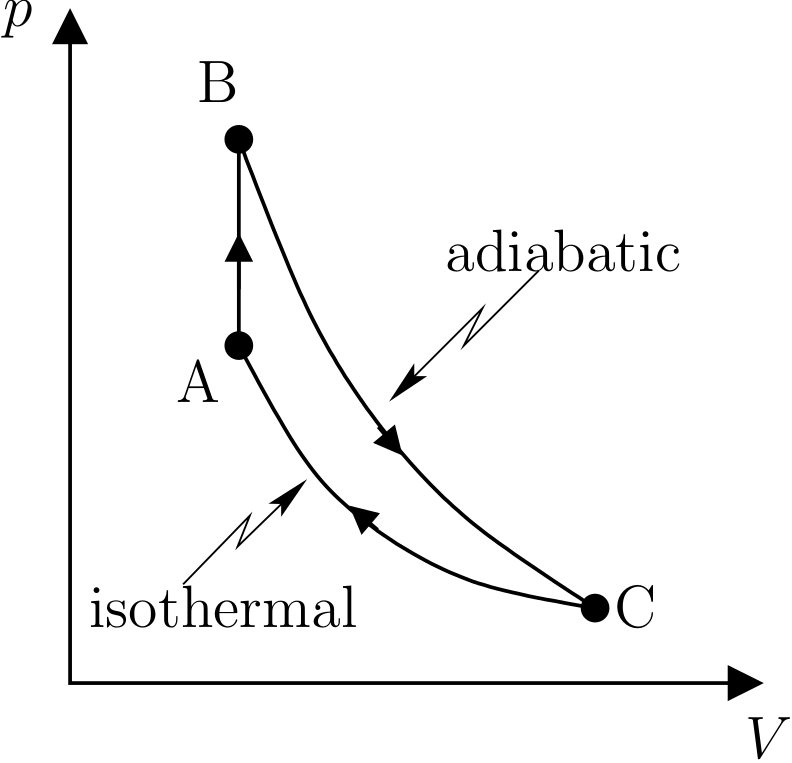
In the cycle shown below, \(1.0\,\text{mol}\) of a monatomic ideal gas is initially at a pressure of \(p_A=100\,\text{kPa}\) and a temperature of \(T_A=0^\circ\,\text{C}\text{.}\) The gas is heated at constant volume to \(T_B = 150^\circ\,\text{C}\) and is then expanded adiabatically until its pressure is back to \(p_C=100\,\text{kPa}\text{.}\) Finally, the gas is compressed at constant pressure until it is back to its original state \(A\text{.}\) Find
the pressure, volume and temperature for each of the three labeled points (A, B and C),
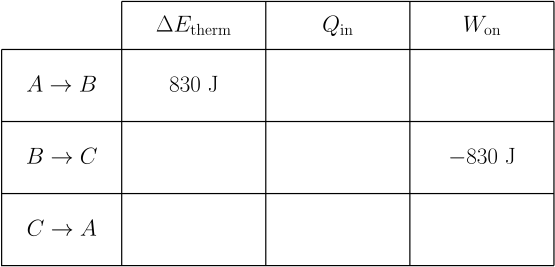
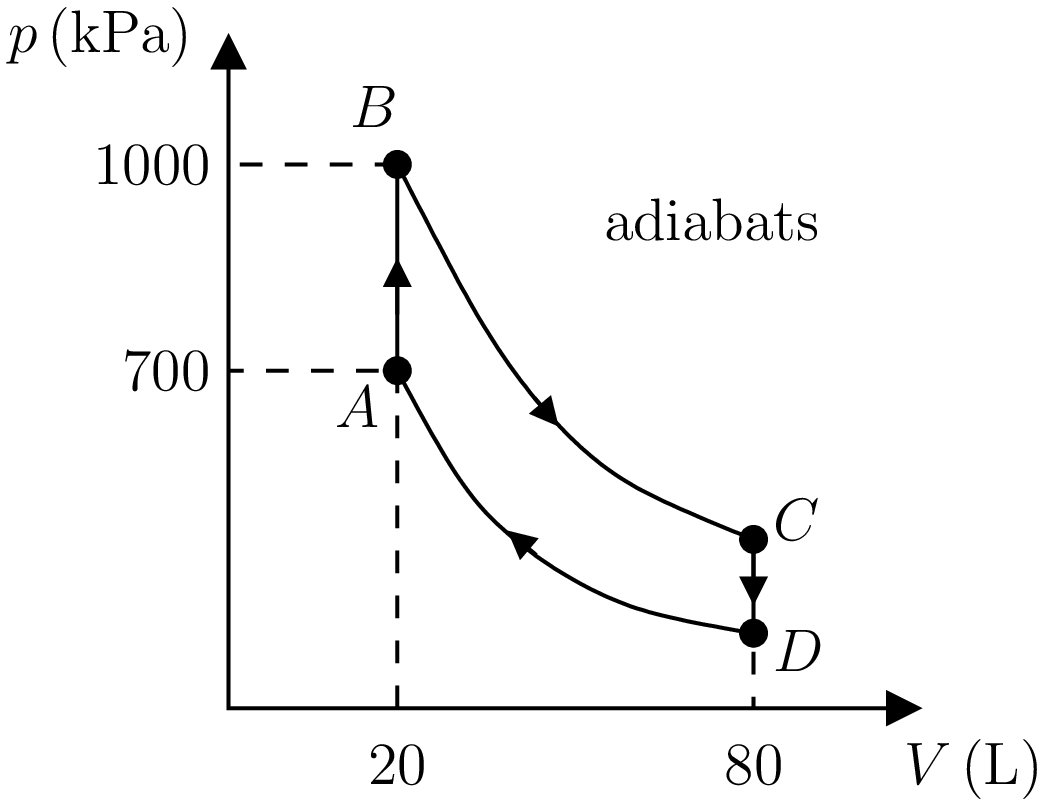
The \(p\) -\(V\) diagram (Figure 83) shows a complete cycle for an engine. The table below shows the thermal energy change for the first process (\(A \rightarrow B\)) and the work done on the engine for the third process (\(C \rightarrow A\)).
Fill in numerical values for the energies (with correct signs) for every empty box in the table. Hint: fill in the easiest ones first, and there is a particular law that you should be using liberally (it rhymes with the Worst Claw of Schermodynamics).
A refrigerator is designed to keep its interior at a constant \(5^\circ\,\text{C}\) while dumping heat into a room temperature environment at \(22^\circ\,\text{C}\text{.}\) The interior of the refrigerator may be regarded as a cold reservoir, while the air around it is a hot reservoir. Now suppose a pitcher containing \(1800\,\text{g}\) of room-temperature water is put into the refrigerator. We can break down what happens next into two steps: (1) the water will cool down to the temperature of the cold reservoir (fridge interior) as its heat flows into cold reservoir, and (2) the refrigerator will turn on and do work (run a compressor, circulate refrigerant, etc.) to extract this heat from the cold interior and dump it to the air outside.
Now we must get rid of the extra heat in the cold reservoir by transferring it to the hot reservoir. Calculate the change in the entropy of the cold reservoir (refrigerator) as the excess heat from step #1 is removed from the refrigerator’s interior.