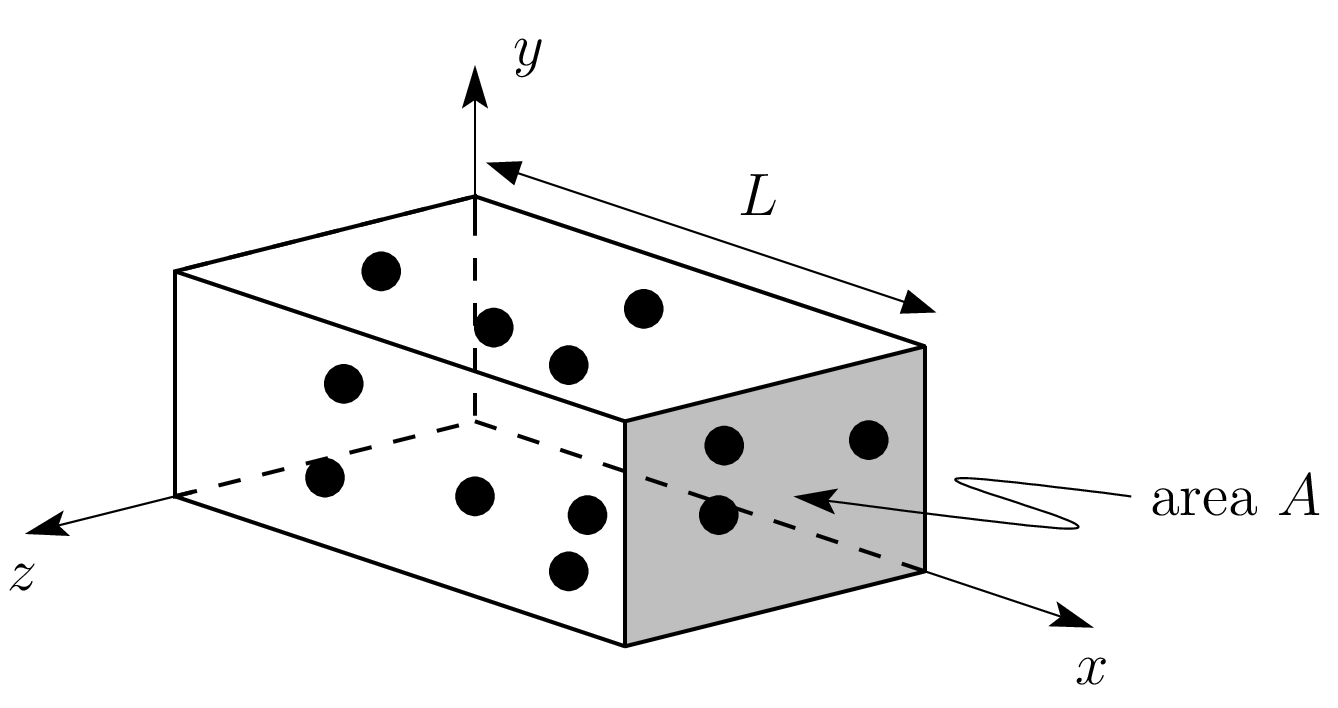
Liquids and gases push outwardly on their surroundings. To describe this push we introduce the concept of pressure. Consider a liquid or a gas enclosed in some container, and focus on one wall of the container with area \(A\text{,}\) such as shown in Figure 51. The fluid pushes on the wall in the perpendicular direction with a force of magnitude \(F\text{.}\) Pressure is then the force per area
and has units N/m\(^2\text{.}\) This combination of units is given the name pascal (Pa), that is, \(1\,\text{Pa} = 1\,\text{N} /\text{m} ^2\text{.}\) Atmospheric pressure is given by
Note that pressure applies to more than just liquids and gases. Any time that there is a force exerted on a surface, you can define a pressure simply by dividing that force by the surface area. Conceptually, the pressure indicates how “spread out” the force is, i.e., if the same force is exerted over a larger surface area, then there is less force per unit area (smaller pressure) and each part of the surface experiences a smaller force. That is why, for example, it is useful to wear snowshoes with a large surface area when walking over fresh snow — the downward force you exert on the ground is spread over a larger area, resulting in a smaller pressure on the snow, so the snow doesn’t collapse.
Pressure does not have a direction. If we consider some point in the fluid, pressure is an outward push in all directions. This outward push is balanced by an identical outward push from a neighboring region of the gas. Only at the boundaries of the gas is there an imbalance — here the enclosed gas is only pushing from inside — and that is where we can measure the pressure. And note: a gas can ONLY push on a surface; it NEVER pulls!!!
We can use our picture of the gas state to derive the pressure of a gas. In the ideal gas approximation we ignore collisions between the molecules entirely, and treat each molecule as bouncing back and forth between the walls of the container. The particles bouncing off the walls exert a force on the wall, and this is precisely the origin of pressure.
Solution: When a balloon is inflated, the rubber is stretched in all directions, resulting in an increased tension. At every point along the surface of the balloon fabric, the tension pulls in all directions along the surface. Because of the curvature of the balloon, these tension forces add up to give a net inward tension force.
The inward components of the tension do not cause the balloon to collapse because there is an outward force due to air molecules trapped within the balloon bouncing off the inner surface of the balloon. Each time a molecule bounces off a piece of the balloon, it gives that piece a small outward kick. Of course, there are also molecules outside the balloon, and each time one of these bounces off the balloon, it gives a small inward kick. If the outward and inward forces were balanced, which is what happens with an open balloon, then the net force would be the tension force, and the balloon would rapidly shrink.
But what if the collisions from the inside molecules are more frequent and/or harder collisions? Consider that there are around \(10^{23}\) gas molecules in a typical balloon, and they are moving quite fast at typical room temperatures (see Example 7.2.1). There are a lot of collisions occurring each second between gas molecules and the inside of the balloon. The result of all of these collisions is an outward force exerted on the balloon fabric by the gas molecules. This outward gas force opposes the inward components of the tension and the inward force due to the collisions of all the gas molecules on the outside, and as a result the balloon does not collapse.