Example 5.3.1 Emission of a photon by a nucleus.
An excited atomic nucleus, of mass \(5.00\,\text{GeV} /c^2\) and at rest, as in Figure 36, decays to its ground state by emitting a photon of energy \(2.00\,\text{GeV}\text{.}\) Calculate the recoil velocity and mass of the ground-state nucleus.
Solution: First draw a picture, and label each particle with its value of energy and momentum. Before the decay the excited nucleus has zero momentum because it is at rest. And from \(E^2 = p^2c^2 + m^2c^4\text{,}\) with \(p =0\text{,}\) we know its energy is the same as its rest energy, namely \(5.00\,\text{GeV}\text{.}\)
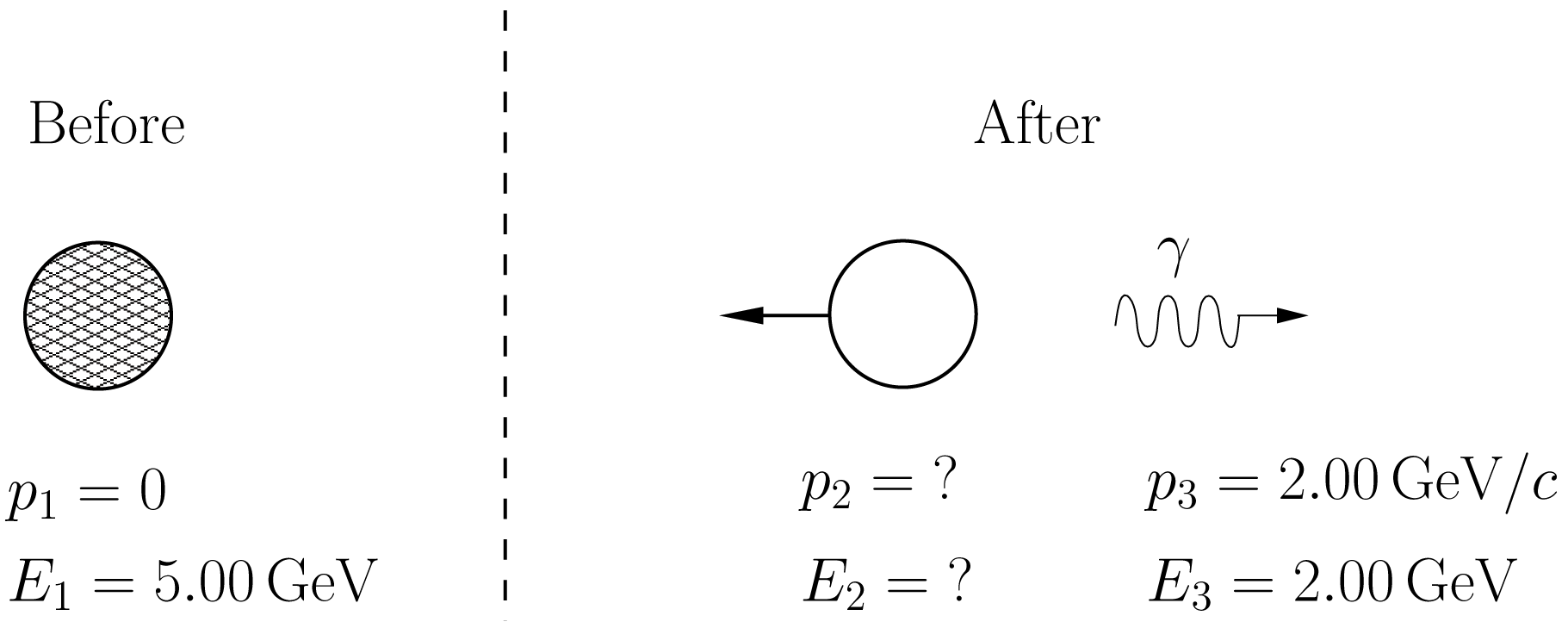
After the decay the ground-state nucleus recoils with unknown energy and momentum, \(E_2\) and \(p_2\text{.}\) Also, the emitted photon has an energy of \(2.00\,\text{GeV}\text{,}\) as specified in the problem. And because the photon’s mass is zero its momentum has the same numerical value as its energy. Notice that in the diagram there are two unknowns, the energy and momentum of the recoiling ground-state nucleus. We plan to solve for these two unknowns with two equations, the energy and momentum conservation equations.
Looking at the diagram, we write down the energy conservation equation in terms of the symbols and numerical quantities shown in the diagram:
\begin{equation*}
5.00\,\text{GeV} = E_2 + 2.00\,\text{GeV} .
\end{equation*}
Similarly, we write the momentum conservation equation in terms of symbols and numerical quantities shown in the diagram:
\begin{equation*}
0 = p_2 + 2.00\,\text{GeV} /c.
\end{equation*}
From these conservation-law equations we easily solve for the energy and momentum of the recoiling nucleus to obtain \(E_2 = 3.00\,\text{GeV}\) and \(p_2 = -2.00\,\text{GeV} /c\text{.}\) Now that we’ve obtained expressions for the energy and momentum of the recoiling ground-state nucleus, we can find its speed using a formula from Problem 4. Problem 4.6 (and from Table 33):
\begin{equation*}
u_2 = \frac{p_2c^2}{E_2} = \frac{(-2.00\,\text{GeV} /c)\times c^2}
{3.00\,\text{GeV} } = -\frac{2}{3}c,
\end{equation*}
and its mass from
\begin{align*}
m_2c^2 =\mathstrut \amp \sqrt{E_2^2 - p_2c^2}\\
=\mathstrut \amp \sqrt{(3.00\,\text{GeV} )^2 - (2.00\,\text{GeV} /c)^2 \times
c^2}\\
=\mathstrut \amp \sqrt{5}\,\text{GeV} ,
\end{align*}
so the mass is \(m_2 = \sqrt{5}\,\text{GeV} /c^2\simeq 2.24\,\text{GeV} /c^2\text{.}\)
Notice that even though we were asked to find the velocity and mass of the recoiling nucleus, we didn’t use these variables in our analysis until the very end, after we solved for its energy and momentum.

