Let’s return to the question at the beginning of the chap: how can we harness some of the thermal energy of some object and convert it to mechanical energy? We know how to spontaneously decrease the thermal energy of an object: put it into contact with something at a lower temperature. So we can extract thermal energy as heat, but that doesn’t yet give us mechanical energy, which is what we are after. We need somehow to transform heat to work: start with the spontaneous energy flow due to a temperature difference, but convert it to something that will turn a crank or generate electricity or lift a weight. Once we have energy available in the form of work, we can use it to manipulate mechanical energy however we like.
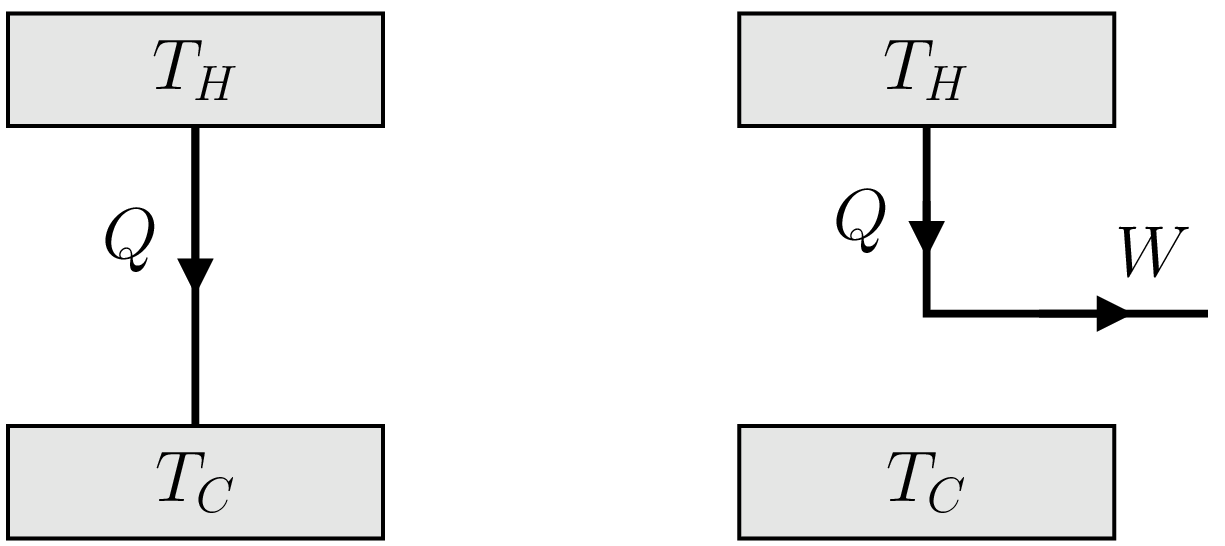
Figure74.On the left, heat flows from a hot reservoir at temperature \(T_H\) to a cold reservoir at \(T_C\text{.}\) On the right, how the diagram would be altered if we could convert the heat \(Q\) into work \(W\text{.}\)
Can we simply convert all the heat to work? The first law of thermodynamics, a.k.a. energy conservation, would have no problem with this. This hypothetical engine is illustrated in Figure 74. In both scenarios in this figure, the hot reservoir is giving off heat \(Q\text{,}\) and so has negative entropy change. Since we are dealing with a reservoir, we use the constant temperature approximation, (10.2.6), to find
(We use absolute value bars so that there no confusion about the sign of \(Q\)). For the figure on the left, this negative entropy change is allowed, because it is offset by the positive entropy change of the cold reservoir, \(\Delta S_C=|Q|/T_C\text{.}\) But for the figure on the right, there is no compensating positive entropy change. And so if we could convert all heat to work, then
But, you may have noticed that we could still satisfy the second law in the previous example even if we didn’t dump all of the heat \(Q\) into the cold reservoir. Suppose we only dumped enough heat to make the positive \(\Delta S_C\) large enough to compensate for the negative \(\Delta S_H\text{.}\) That would leave a little energy that we could conceivably convert to work, while satisfying the second law (and the first, for that matter).
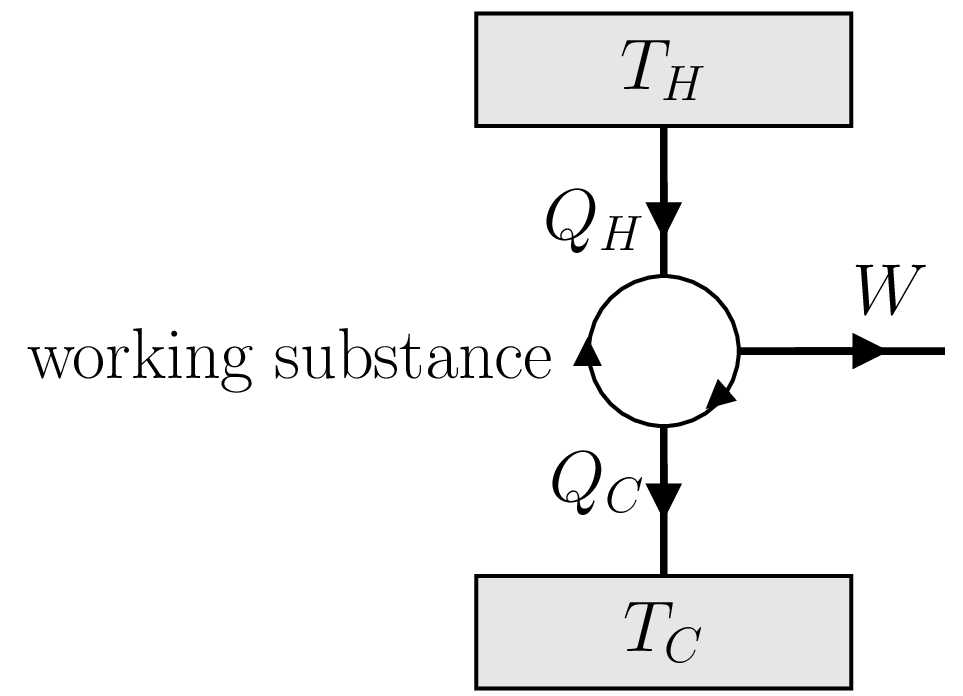
A schematic diagram of this process — called an engine diagram — is shown in Figure 75. An amount of heat \(Q_H\) is pulled from the hot reservoir, and an amount \(Q_C\) is dumped into the cold reservoir. In between, some device which we’ll call the working substance intercepts this heat and produces work. For now, don’t worry about how this might actually be accomplished; we’ll discuss that in detail in the next section. Instead, focus on the big picture: such a device will be consistent with the first law as long as we conserve energy. Looking at the arrows for energy flow, this tells us
Again, we have used absolute value bars everywhere to avoid ambiguity about whether the symbol \(Q_H\) represent the heat flow out of the hot reservoir (in which case it is a negative value), or the heat flow in to the work substance (in which case it is positive).
And continuing with the big picture: such a device will be consistent with the second law as long as the total entropy doesn’t decrease. So where do entropy changes happen? Certainly in the reservoirs. The hot reservoir has an entropy decrease (since heat leaves the reservoir) and the cold reservoir has an entropy increase (since heat is added to the reservoir). But what about the working substance? This gets at an essential point: in order to be a heat engine, the working substance is not a source of energy. It’s not a battery stuck in between the reservoirs, or anything else consuming chemical energy. Rather, it must be returned back to the same state it started from, so the process can be repeated indefinitely. But if this is the case, if the working substance undergoes some cyclic process, then we can use (10.2.11), which tells us \(\Delta
S_\text{w.s.} =0\text{,}\) since the final and initial states are the same.
That lower bound isn’t zero, so we must dump some heat. This is an important result: any heat engine must dump some of its heat into a cold reservoir. It is impossible to turn all heat into usable mechanical energy.
But the good news is that the lower bound on the dumped heat \(|Q_C|\) is smaller than \(|Q_H|\text{,}\) so we do get to “skim off” some of the energy and generate some work. Notice that the bound on how much heat we have to dump becomes smaller for very large \(T_H\) or small \(T_C\text{.}\) Evidently, the more extreme the difference in temperature between the reservoir, the more work we will be able to extract.
Let’s quantify that. Let’s introduce a dimensionless quantity called the efficiency, which is simply the fraction of heat pulled out of the hot reservoir that we are able to convert to work:
Obviously, the efficiency can’t ever be greater than 1; that would correspond to an engine that produces more mechanical energy than the amount of heat that flows into it, and that would violate the first law of thermodynamics. But since \(|Q_C|\) can never be zero in a real engine — we must always dump some heat — the efficiency can never reach 1. That would violate the second law of thermodynamics. We’ll say more about this in a bit, after we have done a simple example using efficiency.
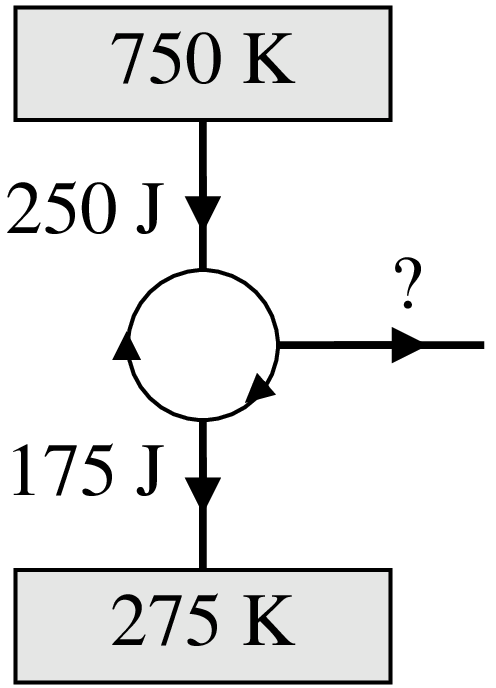
Solution: We can straightforwardly find the work done by this engine using the first law of thermodynamics, i.e., energy conservation. The energy going into the working substance is equal to the energy going out of the working substance, so
Okay, so we have a definition for efficiency, which can never be greater than one (that would violate the first law of thermodynamics). But it can never be equal to 1 either. 1
This is important: if you ever calculate an efficiency equal to or greater than one, then it is wrong.
The maximum value of \(\epsilon\) corresponds to \(|Q_C|\) being at its minimum (since it is being subtracted). Evidently,
Warning: do not confuse this result for the maximum efficiency \(\epsilon_\text{max}\) with the similar looking expression (10.4.7) for efficiency \(\epsilon\) in general. Also, this is only valid if heat is drawn from and dumped into isothermal reservoirs.
VERY IMPORTANT NOTE: It is worth keeping in mind that (10.4.10) for the maximum efficiency is a special case formula that is ONLY valid for an engine operating between two thermal reservoirs. In other words, (10.4.10) will give you a VERY WRONG, HIDEOUSLY INCORRECT 2
One of the most common mistakes that students make in PHYS 211 is to use (10.4.10) for a problem that doesn’t involve two isothermal reservoirs, resulting in anguish, despair and significant point deductions on exams.
answer for any other engine (i.e., if not operating between two isothermal reservoirs). A more general approach to finding the most efficient engine is to use the first and second laws of thermodynamics. The first law says balance the energy in and the energy out, and the second law says
Ultimately, that’s the one equation you need to remember to solve problems involving a maximally efficient engine. (And, in fact, starting with ``maximum efficiency \(\rightarrow
\Delta S_{total}=0\) will give you (10.4.10) in the case with two thermal reservoirs.)
The internal combustion engine of an automobile is a heat engine. Yes, there is gas being consumed, but that’s being burned to provide the high temperature of the hot reservoir. From there on, the engine functions as a heat engine.
The hot reservoir is about \(820^\circ\,\text{C}\) and the cold reservoir is almost air temperature, but typically more like \(70^\circ\,\text{C}\text{.}\) Burning a gallon of gasoline provides about \(120\,\text{MJ}\) of heat. What is the upper limit on how much work can be extracted from a gallon of gas, and how much heat must be dumped?
Solution: The moment you see the words “upper limit” (or similar language), then you can pull out the second law of thermodynamics: \(\Delta S_\text{total} = 0\text{.}\) For this problem, \(\Delta S_\text{total}
= \Delta S_H + \Delta S_C\text{,}\) since the reservoirs are the only parts of this system whose entropy changes.
To calculate \(\Delta S\) for the reservoirs, we need to convert the temperatures to Kelvin, so \(T_H=820+273=1093\,\text{K}\) and \(T_C=70+273=343\,\text{K}\text{.}\) The entropy change of the hot reservoir is
In reality, the work output is only about 1/3 of this amount, due to (i) design choices to get the work out faster, i.e. to get more power, (ii) friction, and (iii) imperfect combustion of the fuel.
We could have solved the previous example by using the equation for \(\epsilon_\text{max}\) for engines with thermal reservoirs (although there was no need to do so). The following is an example where the \(\epsilon_\text{max}\) approach would not work; i.e., you must start from the second law of thermodynamics:
A hot brick initially at temperature \(T_H=400\,\text{K}\) is used as the source for a heat engine. An equal sized cold brick made of the same material, initially at temperature \(T_C=300\,\text{K}\text{,}\) is used to dump the waste heat. As the heat flows, the two bricks come to thermal equilibrium. Assuming the heat engine was maximally efficient, what is the final temperature?
Solution: You might think the final temperature should just be \(350\,\text{K}\text{,}\) but that would be true only if we didn’t intercept any of the heat and convert it to work.
There is a lot we aren’t given. We don’t know the amounts or the composition of the bricks, but we know they are identical. The hotter brick is going to cool from \(400\,\text{K}\) down to some \(T_f\text{,}\) so its entropy change will be \(\Delta S_H = nC\ln(T_f/400)\text{,}\) which is negative since \(T_f/400\lt 1\text{.}\) The colder brick will warm from \(300\,\text{K}\) to \(T_f\text{,}\) so its entropy change will be \(\Delta
S_C=nC\ln(T_f/300)\text{.}\) For maximum efficiency, then,
We see that the bricks end up slightly cooler than \(350\,\text{K}\text{,}\) which makes sense since we skimmed off some of the energy as it was flowing from hot to cold.