A spaceship moving at constant speed \(0.80\,\text{lt-s/s}\) travels between two planets A and B in \(1000\,\text{s}\text{,}\) as measured by synchronized clocks on the planets. Calculate the elapsed time according to a clock carried on board the spaceship.
How fast does a particle have to travel relative to clocks A and B, which are at rest relative to each other, in order that its elapsed time as read on a clock moving with the particle is one-tenth the elapsed time measured on clocks A and B? Express your answer both in lt-s/s and in m/s.
A meteorite is observed to travel a distance \(1.00 \times
10^5\,\text{lt-s}\) relative to the Earth in a time of \(6.00 \times
10^5\,\text{s}\) as measured by Earth observers. Calculate the elapsed time for this trip as measured by a clock carried along on the meteorite.
A crew of astronauts travels at a speed of \(0.60c\) from Earth to the nearest star, Proxima Centauri, a distance of \(4.0\,\text{lt-yr}\) (as determined by observers on Earth).
Calculate how long the trip takes according to observers at rest relative to the Earth.
Based on your answer to b), calculate the distance from Earth to Proxima Centauri as determined by the astronauts using the relation “distance” \(=\) “speed” × “time”, where distance, speed and time are all measured from the astronauts’ reference frame.
Calculate the Earth-Proxima Centauri distance from the astronauts’ reference frame, but this time use length contraction. You should end up with the same result as for c).
Think about the results from parts c) and d). This should convince you that length contraction and time dilation are really the same thing (i.e., you can’t have one without the other).
Another spaceship crew wants to make the trip from Earth to Proxima Centauri in only 2.0 years as measured by clocks on board their spaceship. (Recall from the previous problem statement that the distance between Earth and Proxima Centauri is \(4.0\,\text{lt-yr}\) as determined by observers on Earth.)
How long does the trip take according to Earth-frame observers?
Hint: First, do the first two parts together. Also, you will need to express the speed in terms of the unknown travel time according to Earth-frame observers.
You are in a metallic red VW bug stopped at a traffic light. You see the traffic light turn green, and \(2.5\,\mu\,\text{s}\) later you hear the car behind you honk its horn. What is the time between you seeing the light change to green and your hearing of the horn honk as measured by an alien passing by in a ship at a speed \(0.9c\text{?}\)
Betelgeuse is a supergiant star located in the constellation Orion. It is very cool because it could go supernova anytime in the next million years, and that will be quite a show for us when it does.
which (in the Earth’s reference frame) is \(80\,\text{lt-yr}\) away.
A crew of astronauts is traveling toward Betelgeuse, traveling at a speed \(0.8c\) relative to the Earth-Betelgeuse reference frame. What is the separation between Earth and Betelgeuse in the astronauts’ reference frame?
Another crew traveling toward Betelgeuse measures the Earth-Betelgeuse distance to be \(23\,\text{lt-yr}\text{.}\) How fast is this second crew traveling relative to the Earth?
Betty is standing by the side of a train track when a really long train approaches traveling at a ridiculously fast speed of \(0.9c\text{.}\) Thinking quickly, she pulls out her stopwatch, clicks it on when the front of the train passes and clicks it off when the back of the train passes. After standing back up and smoothing down her hair, she notes that her stopwatch reads \(0.0025\,\text{s}\text{.}\) (She has really good reflexes.) Betty now makes some calculations.
According to Betty, how long is the moving train? (Assume that she was warned in advance that the train was going at a speed \(0.9c\text{.}\))
Later that day (not much later), the train reaches its destination and stops. What is the length of the train according to people standing next to the (now motionless) train?
During migration, two fast Arctic terns fly one behind the other over London at speed \(0.8 c\text{.}\) A tourist sees the birds pass by while looking at the Big Ben clock tower. She notes that a time of \(12.0\,\text{ms}\) elapsed on the clock between the first bird’s passing and the second bird’s passing.
How much time elapsed between these two events, according to the birds?
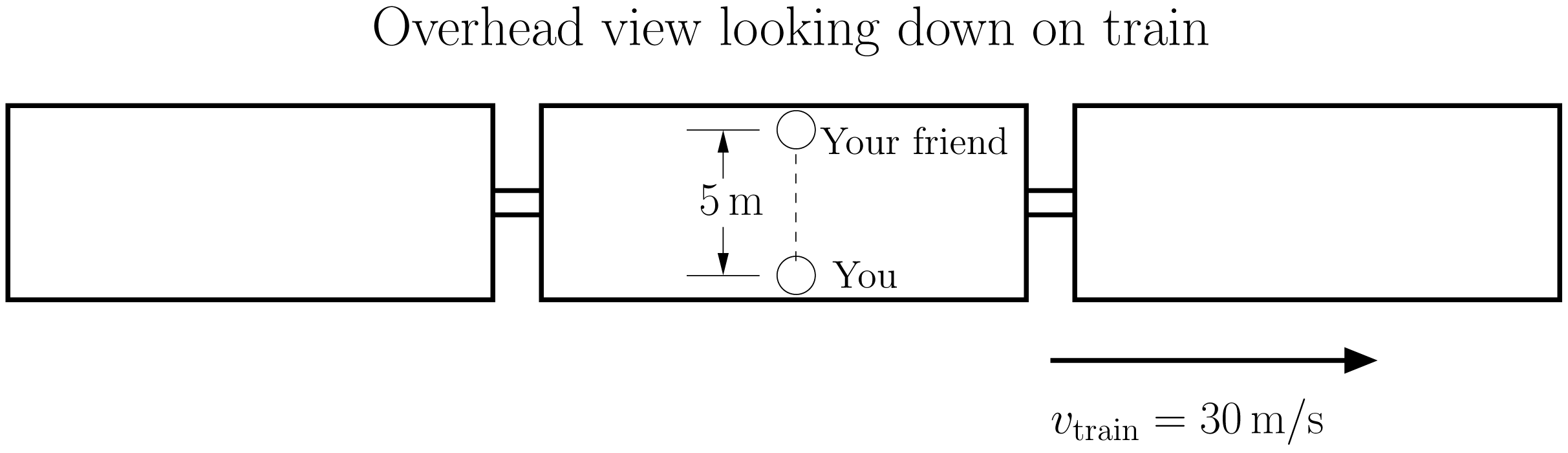
You are riding in a box car of a train that is traveling along the tracks at \(30\,\text{m/s}\text{.}\) You are bored, so you start to play catch with your friend who is standing on the opposite side of the box car, \(5\,\text{m}\) away from you. You throw the ball at a speed of \(10\,\text{m/s}\) straight to your friend, who catches the ball; the given speed and direction are determined in your reference frame. You may ignore any vertical motion of the ball.
How long does it take for the ball to reach your friend according to an observer standing at rest on the ground? (This is a dumb question in classical physics — if the answer isn’t obvious, you’re thinking too hard!)
You are riding in a box car of a train that is traveling along the tracks at an undetermined speed. Once again, you are bored, so you start to play catch with your friend who is standing on the opposite side of the box car \(5\,\text{m}\) away from you. (See figure in previous problem.) You throw the ball in a horizontal plane at a speed of \(10\,\text{m/s}\) straight to your friend, who catches the ball. According to an observer on the ground, the ball travels a distance of \(13.93\,\text{m}\) between the time you throw it and the time your friend catches it. Calculate the speed of the train along the tracks.
Alice is riding in a box car of a train that is traveling along the tracks at a speed \(v=0.6\,\text{lt-ns/ns}\text{.}\) She just happens to have a light-clock with her (just like the one illustrated in Figure 15 in Chapter 2). Alice aligns the clock so that the light is aimed horizontally directly across the train car, perpendicular to the motion of the train. Alice sends a light pulse across the train, and notices that the light returns to the detector \(2\,\text{ns}\) later. Alice’s friend Bob is standing at rest on the ground as Alice and her light-clock speed by. Bob measures the round-trip time for the pulse of light in Alice’s light clock to be \(\Delta t_{ Bob}\text{.}\)
What is the speed of the light pulse according to Alice?
What is the speed of the light pulse according to Bob? (This is a dumb question in relativistic physics — if the answer isn’t obvious, you’re thinking too hard!)