Section 6.3 Thermal Potential Energy
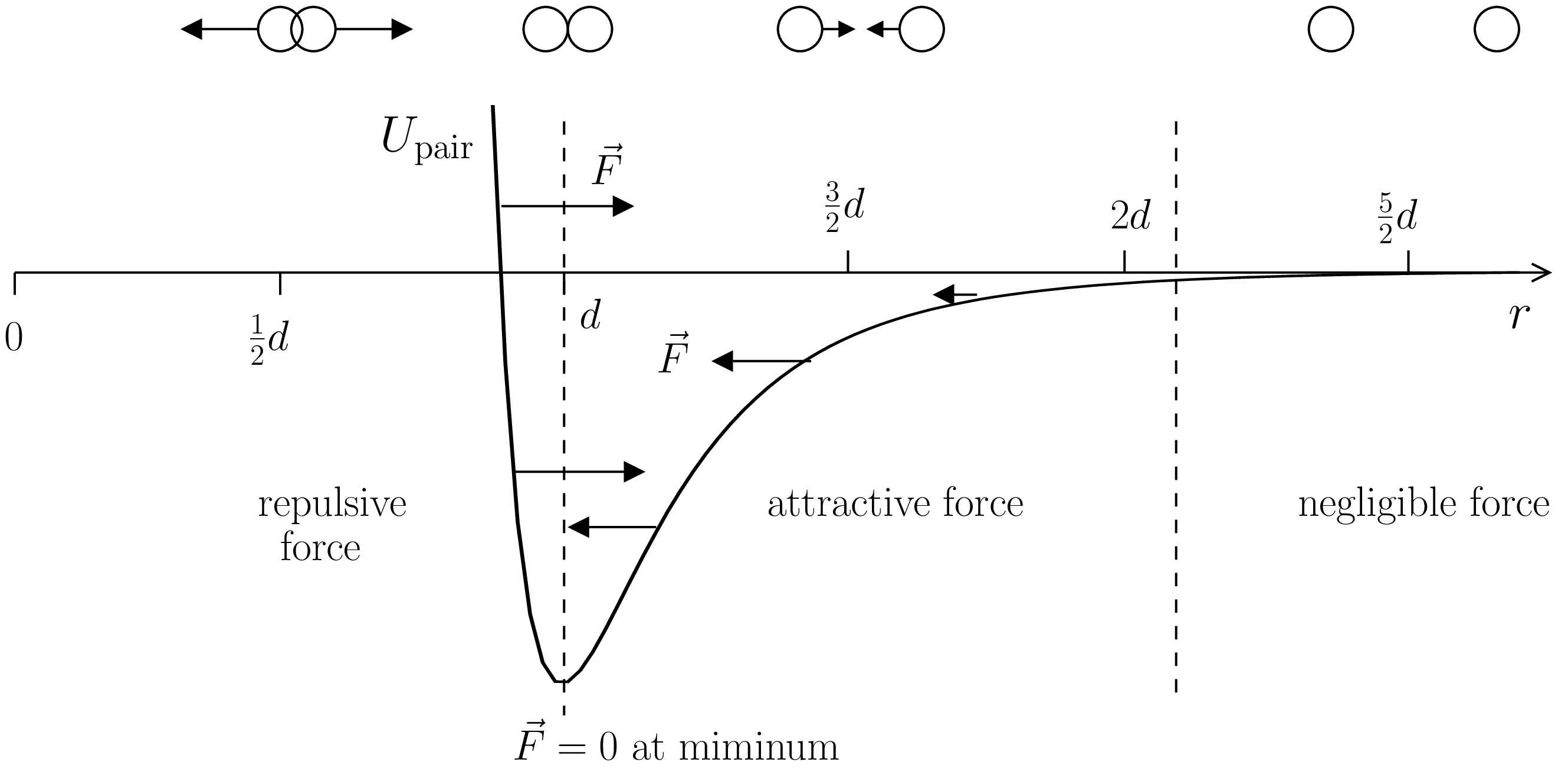
Thermal energy is not just kinetic, but also involves potential energy. Molecules exert forces on each other, pushing and pulling. These forces are conservative, so there is a potential energy associated with each pair of molecules. To understand this potential energy, we must first consider the force between an isolated pair of molecules. There are three distinct regimes, depending on how far apart the two molecules are.
1
The origin of these forces is the electric force interactions between the charges of the atoms combined with quantum mechanics, which governs the location of the charges. Both of these topics will be covered in PHYS 212.
-
When the molecules are closer than a molecular diameter, they exert a strong repulsive force on each other.
-
When the molecules are within a few molecular diameters, they exert attractive forces on each other.
-
When the molecules are more than a few molecular diameters away from each other, the force becomes negligibly small.
This behavior is captured by what is called the pair potential, shown in Figure 38, which is the potential energy \(U_\text{pair} (r)\) due to a pair of molecules separated by a distance \(r\text{.}\) The diagram illustrates the three regions. Notice that at a separation \(r=d\text{,}\) where \(d\) is the molecular diameter, there is an equilibrium point dividing the regions of attractive and repulsive forces.
As we shall see in the next two chapters, this pair potential explains the existence of solid, liquid, and gas phases, and many details of the phases and of the transitions between the phases. It is one of the remarkable triumphs of the atomic theory of matter that so much behavior can be explained by such a simple model of the forces between atoms!
In principle, the system potential energy for a system of \(N\) molecules contains the pair potential energy for every single pairing of the molecules. This is a very large number of pairs! Fortunately, only those molecules which are immediate neighbors are close enough to have an appreciable force and potential energy, so we only need to consider the potential energy due to neighboring molecules.
What about other sources of potential energy besides the intermolecular forces? For example, gravitational potential energy. When a ball is thrown upwards, the gravitational potential energy of each molecule increases. But the height of each molecule is increased by the same amount that the height of the center of mass is increased. Therefore this change in potential energy has the form
\begin{equation}
\Delta U_\text{grav} = M_\text{object} g\Delta y_{cm},\tag{6.3.1}
\end{equation}
where \(M_\text{object}\) is again the total mass of the object. This is the familiar mechanical potential energy. Therefore, gravitational potential energy is always part of the mechanical energy, whereas the molecular interaction energy makes up the thermal potential energy.
In summary, here is the big picture for thermal energy:
-
For both potential energy and kinetic energy, it is the ‘organized’ motion that makes up the mechanical energy, such as all molecules increasing their height together or all molecules having a net alignment of their velocities.
-
The remaining disorganized motion, such as the wiggling of the molecules and their individual pushes and pulls on each other, corresponds to the thermal energy.
-
Friction is an agent that takes organized motion and disorganizes it, taking away mechanical energy and increasing thermal energy.
-
Going the other way — taking away thermal energy and increasing mechanical energy — is more difficult, since molecules are not likely to spontaneously start moving together. Nevertheless, we can capture some amount of thermal energy and convert it to mechanical energy with a device called a heat engine, which is the topic of Supplementary Reading Chapter 10.

