Section 11.6 Gravitational Lenses
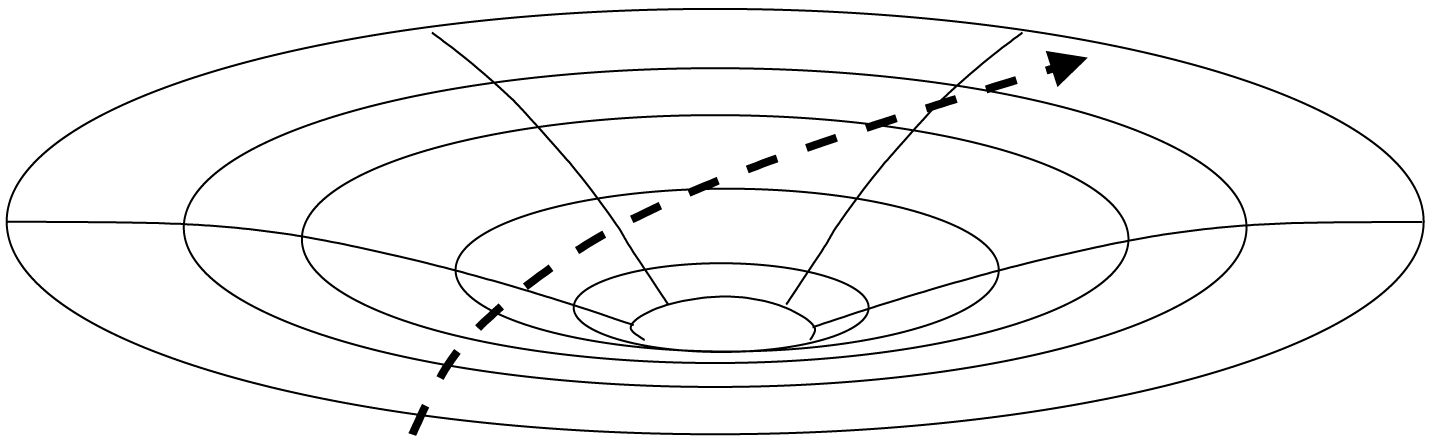
Now consider the motion of an object in the curved space of our spherical mass \(M\text{,}\) as shown in Figure 92). The maximum proper time path gets bent as illustrated, regardless of the mass of the object. That makes sense: we know this is reproducing gravity, and that with gravity the acceleration of, say, the Earth due to the gravitational pull of the Sun is independent of the mass of the Earth.
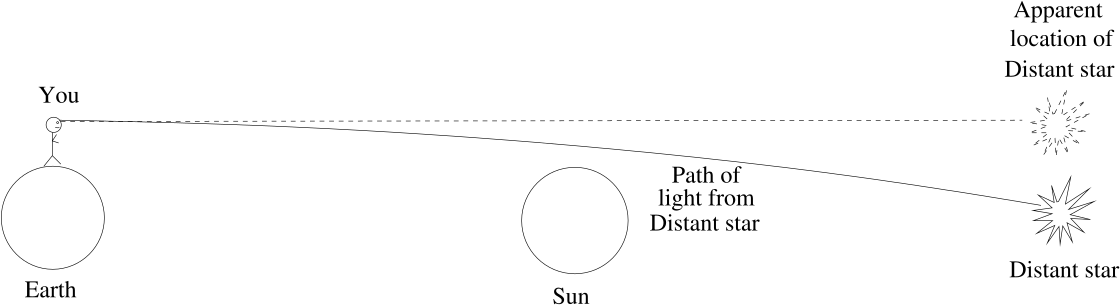
But this leads to an astounding prediction: even a beam of light, which has no mass, will be bent by gravity! This phenomenon — called gravitational lensing — has observational implications. Shortly after Einstein published his theory of general relativity, astronomers used the idea of gravitational lensing to predict an observational shift in the position of a distant star if its light passes close to our Sun. The idea is shown in Figure 93: if the light from a distant star passes very close to the Sun on its way to your eye on the Earth, it will be bent very slightly by the Sun’s gravitational field. When you see that light, your eye doesn’t know that its path has been bent; consequently, you perceive the light to be coming from a different location in the sky. In other words, the star appears to be shifted slightly in the sky.
The problem with this prediction is that it is very difficult to see a star if its light passes right by the Sun because, well, there is a really bright Sun there blinding you if you want to look at the star. But during an eclipse in 1919, some scientists were able to measure this lensing effect on the apparent location of the star Kappa Tauri (in the constellation Taurus). The shift in the apparent location agreed precisely with the predictions made by Einstein.
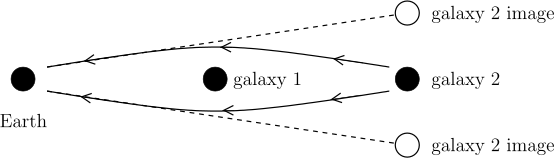
The observation of gravitational lensing in 1919 was the first experimental test of relativity, and its success made Einstein an international celebrity. But this was certainly not the last test of gravitational lensing. There are numerous examples of gravitational lensing when looking at distant galaxies. Not only can gravitational lensing shift the apparent location of a distant celestial object, but it can cause double images (as sketched in Figure 94) or even apparent arcs or rings. See the
https://hubblesite.org/news/18-gravitational-lensing website for a gallery of images of gravitational lenses of distant galaxies.