Section 8.2 Useful tools for applying the First Law
In this section we will treat in order the three terms that appear in the First Law of Thermodynamics, as written in (8.0.1).
Subsection Changes in thermal energy (\(\Delta E_ therm\))
In Chapter 7 you learned that the thermal energy of an ideal gas is
\begin{equation}
E_\text{therm} = \frac{f}{2}\, nRT,\tag{8.2.1}
\end{equation}
where \(f\) is the number of degrees of freedom of a molecule in the gas. From this, it’s straightforward to see that
\begin{equation}
\Delta E_\text{therm} = \frac{f}{2} nR\, \Delta T.\tag{8.2.2}
\end{equation}
So if we know the number of moles, and the temperature difference, we can calculate the thermal energy difference without knowing anything about the pressure and the volume.
There will be times when you know the pressure and the volume, but not the number of moles. There is a convenient simplification of this kind of calculation that obviates the need to explicitly calculate \(n\text{.}\) Consider a gas with an unspecified number of moles that undergoes a process starting at \(p_1\) and \(V_1\text{,}\) and ending at \(p_2\) and \(V_2\text{.}\) The change in the thermal energy of the gas is
\begin{align}
\Delta E_\text{therm} =\mathstrut \amp \frac{f}{2}n R (T_2 - T_1)\notag\\
=\mathstrut \amp \frac{f}{2}n R \left(\frac{p_2V_2}{nR} -
\frac{p_1V_1}{nR} \right)\notag\\
=\mathstrut \amp \frac{f}{2}(p_2V_2 - p_1V_1)\notag\\
=\mathstrut \amp \frac{f}{2}\, \Delta(pV).\tag{8.2.3}
\end{align}
We have found the thermal energy difference in a way that eliminates the need to know \(n\) or \(T\text{!}\)
Sometimes you won’t have enough information about \(p\text{,}\) \(V\text{,}\) \(T\text{,}\) or \(n\) to calculate \(\Delta E_\text{therm}\) directly. In those situations you might be able to use the First Law, (8.0.1), if you know enough about the other terms, \(Q_\text{in}\) and \(W_\text{on}\text{.}\)
Subsection Heat flow in gas processes (\(Q_ in\))
Direct calculation of the heat flowing into or out of a gas is, in general, a difficult problem, and a topic of study in mechanical engineering. For most of the problems we will study in PHYS 211 you can calculate \(Q_\text{in}\) indirectly, using the First Law, (8.0.1), because there will be enough information about the other terms, \(\Delta E_\text{therm}\) and \(W_\text{on}\text{.}\)
There is one kind of gas process for which determination of \(Q_\text{in}\) is easy: adiabatic compression or expansion. That’s because the term adiabatic is simply the name given to those processes in which \(Q_\text{in} =0\text{.}\) Adiabatic processes are the idealized versions of processes in which the gas is very well insulated so that it doesn’t interact thermally with the external world. We will talk more about adiabatic processes later in this chapter.
Subsection Work done during gas processes (\(W_ on\text{,}\) \(W_ by\))
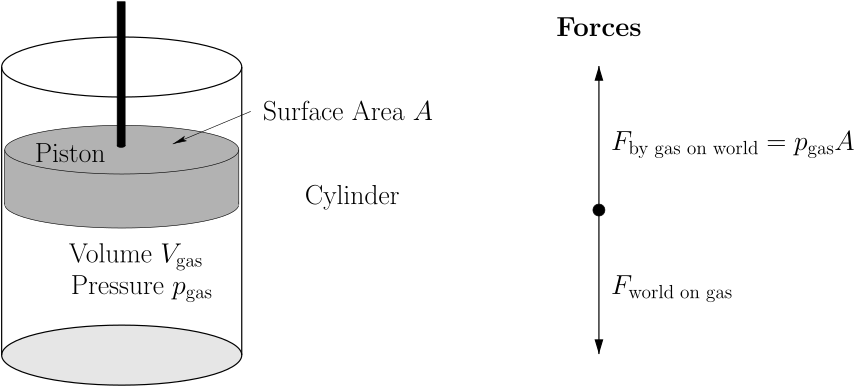
A simple system for analyzing the work done on a gas, or by a gas, is illustrated in Figure 57. A fitted piston (the shaded disk) with mass \(m\) and surface area \(A\) is free to slide up and down the frictionless walls of the cylinder, and seals a fixed amount of gas trapped in the volume below. In equilibrium the force of the gas pushing up on the piston is balanced by the net force of the external world pushing down (the combined forces of gravity, the force due to atmospheric pressure, and any additional force that you might be applying to keep the piston in place).
Imagine that the forces change ever so slightly so that the piston experiences a small upward displacement \(\Delta\vec{r}\text{,}\) increasing the volume of the gas. The work done by the gas is
\begin{align*}
W_\text{by} =\mathstrut \amp \vec{F}_\text{ by gas on world } \cdot \Delta\vec{r}\\
=\mathstrut \amp F_\text{ by gas on world } \, \Delta r \cos(0^\circ)\\
=\mathstrut \amp p_\text{gas} \, A\, \Delta r\\
=\mathstrut \amp p_\text{gas} \, \Delta V.
\end{align*}
The work done on the gas will be the negative of this, because the angle between the vector force \(\vec{F}_\text{ world on gas }\) and the displacement \(\Delta \vec{r}\) is\(180^\circ\text{.}\)
For infinitesimally small changes, \(\Delta V \longrightarrow dV\text{,}\) allowing us to use integration to calculate the work for processes during which the pressure does not remain constant:
\begin{equation}
W_\text{on} = -\int_{V_1}^{V_2} p\, dV\mbox{and}
W_\text{by} = \int_{V_1}^{V_2} p\, dV,\tag{8.2.4}
\end{equation}
Although these results have been derived for expansion of a gas in the cylinder, they can be generalized to expansion and compression of arbitrarily shaped volumes.
Since work has been expressed as an integral of pressure with respect to volume, we see that the magnitude of the work done in a process is equal to the area under the curve of the \(p\) -\(V\) diagram for the process between the initial and final volumes.
NOTE: the sign of the work is critically important. For an expanding gas, the gas is lifting the piston, and \(W_\text{by}\) is positive, but \(W_\text{on}\) is negative. For a contracting gas the opposite is true. For a car engine, a positive value of \(W_\text{by}\) means that the car is able to drive, whereas a negative value for \(W_\text{by}\) means that you have to push the car to get it to go.
NOTE about units: in standard units, if pressure is in N/m\(^2\) (i.e., Pa) and volume is in m\(^3\text{,}\) the resulting calculated work will be in J. But in many realistic problems, the pressure is given in kPa and the volume is given in L. Since \(1\,\text{L} = 10^{-3}
\,\text{m}^3 \) and 1 kPa = \(10^3\) Pa, a calculation of work using L and kPa also gives an answer in J. So, it isn’t necessary to convert to Pa and \(\text{m}^3\) when doing these calculations.

