The second law of thermodynamics is a result of a system prepared in an improbable initial state then moving to a vastly more probable final state.
Section 9.4 Coupled Einstein Solids
Our original goal was to understand heat flow. That is, why thermal energy spontaneously goes from hotter objects to colder objects. To that end, we will now consider two Einstein solids, solid \(A\) with a number \(N_A\) oscillators and \(q_A\) energy units, and solid \(B\) with \(N_B\) oscillators and \(q_B\) energy units. If solids \(A\) and \(B\) are brought into thermal contact, then they will be able to pass energy units back and forth while maintaining a fixed total \(q_\text{tot} =q_A+q_B\text{.}\) But which way will the energy go, on average? And when will it come to thermal equilibrium? Let us try to address these questions.
Once the two Einstein solids are thermally coupled and exchanging energy, \(A\) and \(B\) should be regarded as subsystems of the combined system. For a particular division of energy among the two subsystems, we have a multiplicity \(\Omega_A\) that depends on \(N_A\) and \(q_A\text{,}\) and a multiplicity \(\Omega_B\) that depends on \(N_B\) and \(q_B\text{.}\)
How do we calculate the combined multiplicity of the system? If you have three pairs of pants and five shirts, then you have \(3\cdot 5=15\) possible combinations you can make, at least in polite company. Similarly, subsystem \(A\) may be in any of the number \(\Omega_A\) microstates and subsystem \(B\) in any of \(\Omega_B\) microstates, so the number of paired microstates we can make is the product \(\Omega_{AB} =
\Omega_A\Omega_B\text{.}\) This is the combined multiplicity of the system.
Let’s consider a specific case. Let \(N_A=3\) and \(N_B=3\text{,}\) and \(q_\text{tot} =q_A+q_B=6\text{.}\) The two systems may divide up the six energy units a variety of ways, as shown in Table 68. For each choice, the multiplicities \(\Omega_A\) and \(\Omega_B\) and the combined multiplicity \(\Omega_{AB}\) are given. Note that the most probable arrangement of energy, the one with the largest multiplicity, is the one with three energy units in each subsystem. If subsystem \(A\) started with zero energy units and subsystem \(B\) with six units, then simple random energy exchanges would move the coupled systems toward the more probable state with \(q_A=q_B=3\text{.}\) This is a clue about the origin of the second law.
| \(q_A\) | \(q_B\) | \(\Omega_A\) | \(\Omega_B\) | \(\Omega_{AB}\) |
| 0 | 6 | 1 | 28 | 28 |
| 1 | 5 | 3 | 21 | 63 |
| 2 | 4 | 6 | 15 | 90 |
| 3 | 3 | 10 | 10 | 100 |
| 4 | 2 | 15 | 6 | 90 |
| 5 | 1 | 21 | 3 | 63 |
| 6 | 0 | 28 | 1 | 28 |
From Table 68 we see that the most probable situation is only slightly more probable than the other possibilities. This changes dramatically as the system size is increased. In Figure 69 we plot the combined multiplicity as a function of \(q_A\) for various numbers of oscillators and energy units. As the figure shows, when the numbers become larger, say in the thousands, the multiplicity function becomes sharply peaked. Some particular division of energy between the two subsystems is vastly, hugely, awesomely, mind-bogglingly more probable than all others. This we identify as the equilibrium division of energy. Now imagine what occurs when you approach Avogadro’s number of energy units. The multiplicity function becomes completely sharp. There is some particular division of the energy between subsystems \(A\) and \(B\) that is ridiculously, overwhelmingly, staggeringly more probable than any other.
1
I.e., it isn’t just a little more probable, it is a lot more probable.
2
“… vastly, hugely, awesomely, mind-bogglingly, ...” and that doesn’t even begin to cover it!
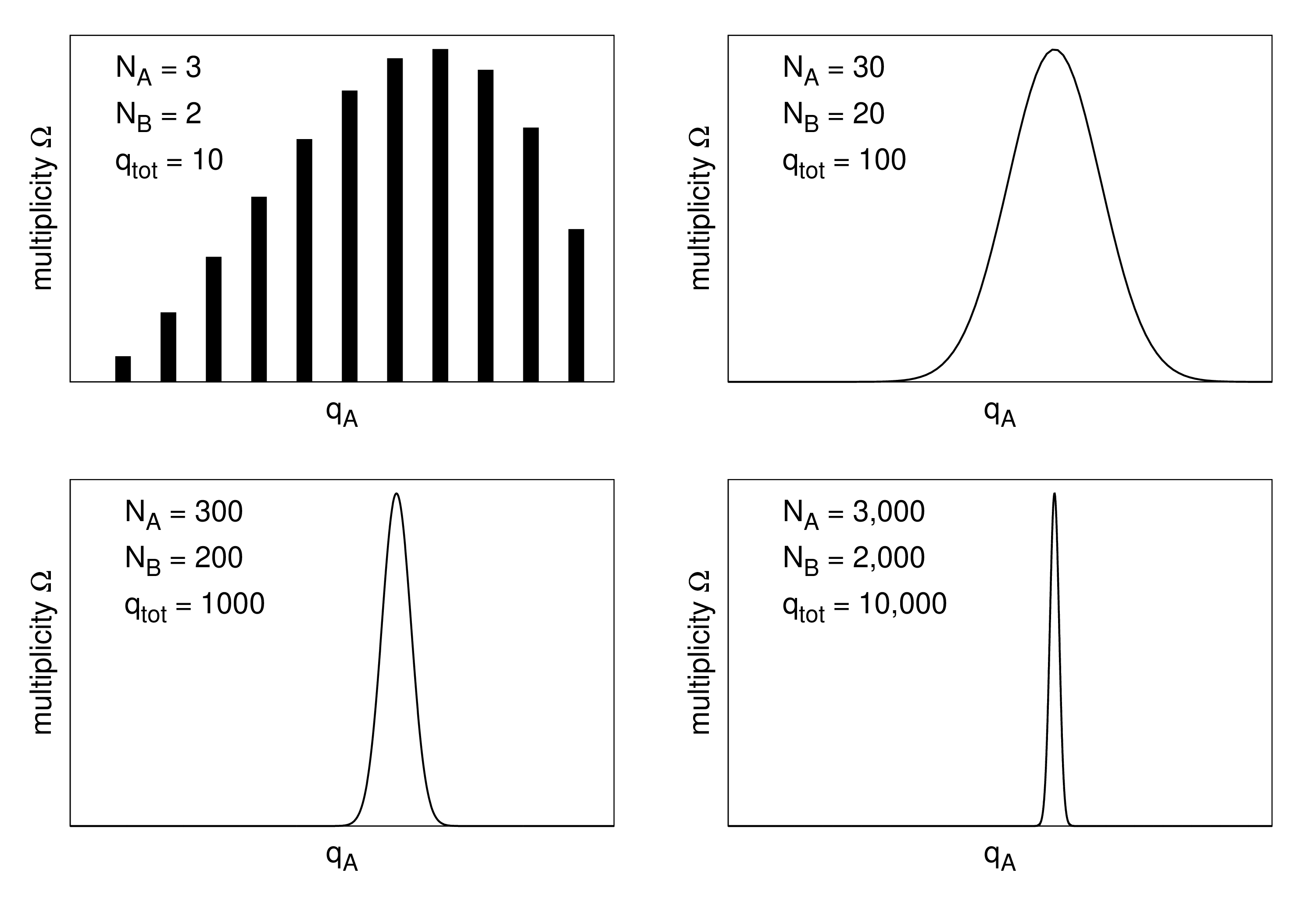
Now we have the probabilistic origin of the second law. Subsystems \(A\) and \(B\text{,}\) before they are thermally coupled, can be prepared with any thermal energy we would like. We made the metal object hot and the water cold before plunging the metal into the water. But once the subsystems are thermally coupled, they will move from whatever division of energy they started with toward the maximally probable arrangement of energy for the coupled system. They are irresistibly led to it by essentially random exchanges of energy between the subsystems. The energy transferred along the way is what we had previously identified as heat.
To summarize:
This is an incredibly important result!!!! With this statement, we don’t have to worry at all about the detailed, Newtonian mechanics of the (many, many) individual molecules or atoms in a solid, liquid or gas. We treat all the motion as though it is random and then simply figure out the probabilities.

