Pick up your larger superball (the one in your toy kit with the animal inside it), toss it straight up, and catch it when it comes back down to your hand. Watch the motion very carefully. Answer the following questions: Just after the ball leaves your hand, is the speed the largest, in the middle, the smallest, or zero? Is the velocity direction up or down? Answer the same questions for the ball when it is halfway up to its highest point, when it is at its highest point, when it is halfway down, and when it reaches your hand again.
Now, make sketches of the ball’s (i) vertical position versus time (choose “up” as the positive direction and \(y = 0\) as the ground) as the ball rises and then falls back to your hand, (ii) velocity versus time, and (iii) acceleration versus time. Don’t worry about putting any numbers on the graphs; just make a qualitative sketch. Make sure that your plot of velocity versus time is consistent with your answers from part (a).
Drop the ball on the ground and watch it carefully as it bounces up and down a few times. Answer the following questions: just before the ball hits the ground, is the speed at its peak (i.e., large), in the middle, near its slowest value, or zero, and does the velocity point upward or downward? Answer the same questions for the ball just after it hits the ground and starts moving upward.
Now, make qualitative sketches of the ball’s (i) vertical position versus time as the ball drops toward the ground before the bounce, and while the ball moves away from the ground after the bounce, (ii) velocity versus time, and (iii) acceleration versus time. Make sure your plot of velocity is consistent with your answers from part (c).
Consider what the graphs of vertical position versus time, velocity versus time, and acceleration versus time look like for the short period of time while the ball is in contact with the ground. Sketch on your graph from part (d).
Problem0.2Graphing Motion II: Spring and Hopping Popper.
Take your round metal spring and your “hopping popper” (the hemispherical plastic toy). Stretch the last few turns of the spring and jam the hopping popper in from the side (it looks a bit like a Pac-Man when you do this). When you have the hopping popper jammed into one end of the spring, hold the spring from the other end, and let the spring/hopping popper system hang vertically and allow it to come to rest (you are welcome to use your other hand to help the end of the spring with the hopping popper stop moving).
Call the position of the hopping popper when it is motionless \(y = 0\text{.}\) Now, pull the hopping popper end of the spring straight down approximately 6 — 10 inches (the exact distance isn’t that important) and release the hopping popper end of the spring. Make sure that the subsequent motion of the hopping popper and the spring is as vertical as possible.
Make qualitative plots of the hopping popper’s (i) vertical position versus time for a few cycles, and (ii) vertical velocity versus time. Use your sketch of the hopping popper’s vertical velocity versus time to make a qualitative sketch of the hopping popper’s vertical acceleration vs. time. (Hint: ask the same questions as in Problem A 0.1 if you are stuck. Specifically consider the hopping popper’s position and velocity when it is at the maximum distance from \(y = 0\) and also consider the hopping popper’s position and velocity when it is passing through \(y = 0\text{.}\))
Consider a badminton birdie that is falling under the influence of gravity and air resistance. Assume that the vertical acceleration of this birdie is given by
\begin{equation*}
a_y = \frac{dv}{dt} = g - bv,
\end{equation*}
where \(g = 9.8\,\text{m} /\text{s} ^2\) and \(b\) is some constant that depends on the mass and shape of the birdie along with properties of the air, and \(v\) is the instantaneous velocity of the bird (positive if the velocity is down and negative if the velocity is up). Suppose that the birdie is released from rest at time \(t=0\text{.}\)
Discuss qualitatively how the speed of the birdie varies with time, given your knowledge of the relationship between the acceleration and the rate of change of the velocity. What is the velocity when the acceleration is zero? (This is called the terminal velocity.) What happens to the velocity after the acceleration reaches zero?
Without solving the equation above, sketch \(v(t)\) vs. \(t\text{.}\) This can be done as follows: at \(t=0\text{,}\)\(v\) is zero and the slope is \(g\text{.}\) Sketch a straight-line segment, neglecting any change in the slope for a short time interval. At the end of the interval, the velocity is no longer zero, so the slope is no longer \(g\text{.}\) Sketch another straight-line segment with the qualitatively appropriate slope for the next short time interval. Continue until your sketch shows the birdie has reached terminal velocity. What is the slope of the line after the birdie has reached terminal velocity?
Problem0.4Estimating Velocities: Muzzle Speed of a Blow Dart.
Be careful! Students in the past have set off the sprinkler and fire alarms in their dorms! Consider doing this outside or somewhere where the ceiling is very high.
To estimate the “muzzle speed” of a blow dart, fire the dart straight up into the air and time how long it takes to come back down. Roughly half of that time is the time for the object to decelerate from its initial velocity to motionless (at the top of its motion). Warning: students often over-estimate the time required for the trip. Remember to count “0” when you fire the dart (“0 and 1 and 2 and …”)
Fire a blow dart roughly horizontally (don’t worry about the vertical motion here) at a smooth surface on which it will stick. (Windows make nice targets, but be careful with flat panel displays — students have broken them in the past with their blow darts!)
Make qualitative plots of (i) the dart’s horizontal position versus time up until and shortly after the dart hits its target, (ii) the dart’s horizontal velocity; and (iii) the dart’s horizontal acceleration. In the plot of acceleration, include the small time interval between when the dart first makes contact to when it is completely compressed and stuck. (Hint: ask the same questions as in Problem A 0.1 if you are stuck.)
during the first moments of takeoff, where \(y\) is the height of the rocket in meters and \(t\) is the time in seconds after the rocket clears the support tower. Assuming the motion of the rocket is purely vertical, determine both the speed and the acceleration of the rocket at time \(t = 10\,\text{s}\text{.}\)
Problem0.7Average Velocity: Round Trip of a Blow Dart.
Fire a blow dart straight up into the air and wait for it to come back down to its initial position. Question: for the entire flight, what is the average velocity? (A very quick estimate is fine — if this question takes you more than 1 or 2 minutes to answer, then discuss this with a friend or your problem session instructor.)
Now, fire the blow dart at an angle somewhere in the vicinity of \(45^\circ\) (the actual angle isn’t critical). Watch the entire flight, and comment on the average velocity (both magnitude and direction — if not zero).
Using the method of components, add the following vectors, and determine the \(x\)-component and \(y\)-component of the total, and the magnitude and direction of the total: 10 paces at \(45^\circ\text{,}\) 12 paces at \(90^\circ\text{,}\) 17 paces at \(-45^\circ\text{,}\) and 10 paces at \(-135^\circ\text{.}\)
Do the experiment. [We will do the following as a class exercise during problem session, so you don’t have to do this on your own.] On a sunny day, pick a starting location in the middle of an open field or grassy area. (Lamp posts work well.) Choose the direction that your shadow casts as the \(0^\circ\) direction and imagine a \(360^\circ\) arc around that direction. Now, walk 10 paces at an angle of \(45^\circ\) (you’ll be taking your shadow with you, so you’ll be able to see that you are walking at the correct angle). Then, walk 12 paces at an angle of \(90^\circ\text{,}\) 17 paces at an angle of \(-45^\circ\text{,}\) and 10 paces at \(-135^\circ\text{.}\) Where do you end up relative to your starting location? Does this agree with your calculation? Write down how you compared your result with your calculation.
Now, do the same experiment again starting from the same initial location. But this time walk off the vectors in a very different order, say, 10 paces at an angle of \(-135^\circ\text{,}\) 17 paces at an angle of \(-45^\circ\text{,}\) 12 paces at an angle of \(90^\circ\text{,}\) and 10 paces at an angle of \(45^\circ\text{.}\) Do you end up in the same place as you did in the previous experiment? (You should.) Comment on your results.
A kitten, who has been napping in a patch of sun, sees a flying bug and sprints \(3\,\text{m}\) due North. She leaps straight up in the air, misses the bug, and comes straight back down. She then calmly strolls \(5\,\text{m}\) in a direction \(40^\circ\) S of W, where she spits up a hairball under the kitchen table, then walks \(2\,\text{m}\) in a direction \(30^\circ\) S of E where she begins to lick up some spilled milk.
Draw a diagram showing all the displacements of the kitten.
The kitten’s sister was napping with the kitten in the patch of sun. How far and in what direction should the kitten’s sister walk to go directly from the patch of sun to the spilled milk?
Juliet is traveling on a fast gondola that is moving at a constant speed of \(10\,\text{m/s}\) down a canal. Romeo is standing still on the bank of the canal and watching the gondola go by. To attract his attention, Juliet throws her ring into the air and catches it as it falls. Relative to the gondola, the initial velocity of the ring is \(15\,\text{m/s}\) straight up. Answer the following questions according to both Juliet and Romeo. Neglect the effects of air resistance in this problem.
What is the magnitude and direction of the initial velocity of the ring?
Continuing from Problem A 0.1: Toss your large superball straight up in the air and catch it when it comes back down. Make a qualitative graph of vertical component of the net force acting on the ball versus time while in the air (you can neglect air resistance here). Compare this graph with the ones that you made for Problem A 0.1. What is the net force acting on the ball at the top of its motion (when it stops its upward motion and starts falling back down)? How does the force at the top of its motion relate to the acceleration (from Problem A 0.1)?
Now, make a graph of vertical component of the net force acting on the ball versus time when you include the effects of air resistance on the ball. In doing this, you’ll need to think about the direction of the resistive force, as well as how its magnitude depends on its motion.
Problem0.12Tension: Playing with an Elastic String with Bead.
Attach one end of the elastic white string to the wooden bead. Take the string with bead and hang it straight down with the bead at the bottom. Wait for it to stop moving. Note the length of the string (you don’t have to measure it). Question: How does the tension in the string at this moment compare to the weight \(mg\) of the bead? Is \(T \lt mg\text{,}\) does \(T =mg\text{,}\) or is \(T> mg\text{?}\) Now, add the weight of the round metal spring to the bead. (One way to do this: put the bead inside in the middle of the spring and thread the string out between the coils.) Let the system hang motionless (hold the string with the bead and spring at the bottom pulling downward). Comment on the length of the elastic string now. What is the tension in the string now (answer qualitatively — no numbers)?
Qualitatively, what happens to the length of the string when the tension increases? What happens to the length of the string when the tension decreases? What do you think will happen to the string if the tension goes to zero?
Now let the weight and bead hang straight down. Once the system is motionless, pull the top of the string upward, accelerating the system momentarily. What happens to the string’s length? What does this mean about the tension in the string when the bead is accelerated upward? Do the same thing, but this time accelerate the bead/weight downward (quickly lower your hand holding the top of the string). What happens to the tension in the elastic string when the bead accelerates downward?
Now, take the yo-yo and hang it straight down from its string. Accelerate the yo-yo upward and watch what happens. Accelerate the yo-yo downward and watch what happens. Do you observe any changes in the string in either case? What do you think is happening to the tension in the string in both cases? Note that if you accelerate the yo-yo downward hard enough, the string buckles. What does this mean about the tension in the string for a large downward acceleration?
A very common misconception is that tension for a hanging object is always equivalent to its weight \(mg\text{.}\)This is not true if the object is accelerating!! If this exercise hasn’t made that point clear, talk with your problem session instructor. Under what circumstances is the tension in the string equal to its weight?
Problem0.13Components of Forces: Tension in a Horizontal String.
Put a piece of string (e.g. the string of your yo-yo) through the round metal spring. Grab the ends of the string in your hands, and pull the ends tight until you think the string is perfectly horizontal with the spring hanging from the middle. Is the string perfectly horizontal? To find out, do this right next to a good horizontal edge, such as the bottom/top edge of a bulletin board or the bottom edge of the top of a flat desk or bed frame. Describe what you see.
Why is it impossible to get the string perfectly horizontal with some mass hanging from the center? The words “component” and “force” should be featured prominently in your answer to this question.
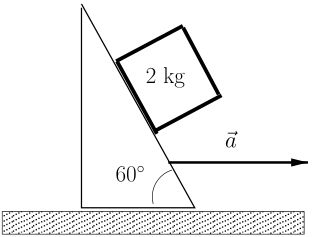
A \(2\,\text{kg}\) block is placed on a frictionless wedge that is inclined at an angle of \(60^\circ\) from the horizontal as shown in Figure 1. If you release the block, it would slide down the wedge. It turns out that if you push the wedge to the right with just the right acceleration \(a\text{,}\) the block will actually remain stationary with respect to the wedge. In other words, the block will not have any vertical acceleration, though it does have the same horizontal acceleration as the wedge.
Problem0.15Using Forces to Predict Motion: Dropping a Spring.
Dangle your “magic spring,” holding it by one end, with the other end stretched out and hanging (relatively motionless) an inch or two above your other hand. Don’t do anything yet. Think about what will happen when you let go of the top of the spring.
Before doing the experiment, predict the order of the following five events. Write down your prediction:. (i) The top end starts to move downward; (ii) The bottom end starts to move downward; (iii) The spring contracts halfway back to its unstretched size; (iv) The spring contracts all the way back to its unstretched size; (v) The bottom of the slinky hits your other hand.
Now, once you have made your prediction, let go of the spring and see what actually happens. You might have to do this a few times to figure out what the correct order is, or have a friend or two watch with you. Write down the order of events as you actually observed them.
Explain the results. In doing so, you might want to draw a force diagram for the forces acting on the bottom loop of the spring both before and after the top of the spring is released. (Treat the bottom loop as a small mass hanging from the rest of the spring.)
Problem0.16Force and Acceleration: Unwinding Yo-Yo.
Wind up your yo-yo, and hold the end of the string (or put your finger through the loop). Now, let the yo-yo fall out of your hand and unroll and drop downward (while holding the end of the string motionless). Observe what happens. Write down your observations.
What can you say about the tension in the string while the yo-yo is unwinding? Is the tension (i) equal to the weight of the yo-yo; (ii) less than the weight of the yo-yo but nonzero; or (iii) zero?
Explain how you arrived at your answer. You should be able to use the results of your observations, a force diagram and a simple use of Newton’s 2\(^{ nd}\) law to give a clear, definitive answer to the question. (We’ll revisit this example again when we study rotations later in the semester.)
Problem0.17Circular Motion: Around the World with Your Yo-Yo.
Let the yo-yo hang at the end of the string and (holding the other end of the string) twirl it in a vertical circle so that it goes all the way around, being careful not to hit yourself or anyone around you in the head! You should realize that you have to swing the yo-yo sufficiently fast; otherwise, it won’t get all the way around. Now, watch the string of the yo-yo as you swing it successively slower and slower until it falls out of the loop.
Determine an expression for the theoretical minimum speed for the yo-yo at the top of its motion for it to complete the loop. Assume the string has a length \(l\) and the yo-yo has a mass \(m\) and determine the minimum speed \(v_{ top}\) as a function of \(l\text{,}\)\(m\text{,}\) and any fundamental constants. Hints: what happens to the string when the yo-yo is going just slightly too slow to be able to complete the loop? What does this imply? (The answer to this question is the key to solving this problem.) Think back to Problem A 0.12.
The goal of this exercise is to determine the average friction force acting on a blow dart as it slides across the floor. Find a long, smooth, carpetless floor where you can fire a blow dart and watch it slide across the floor and eventually stop. Smooth floors are the easiest surfaces to work with (the floors in Olin Science work well); for most other surfaces (e.g., carpeted floors), the dart will tend to bounce rather than slide. You also might want to crouch down low and fire at a small, glancing angle.
Determine the average friction force acting on the blow dart as it slows to a stop. Make whatever measurements you deem relevant, and use the work-kinetic energy theorem — this exercise is a snap if you do it this way, and a major pain if you try it any other way. You can use your previous measurements of the initial speed of the blow dart once fired, and you might also be interested to know that the blow darts have a mass of \(2.5\,
\mbox{g}\) and a length of \(6\,\text{cm}\text{,}\) contain roughly \(1.5\times 10^{24}\) protons and neutrons, and stick nicely to the front of your glasses.
Let’s say that you were stranded on a deserted island and a few dozen Federal Express boxes washed ashore. Let’s say further that one of the boxes contained a Bandito Blow Gun. In addition to being delighted at being able to complete your PHYS 211 homework, you also realized that you could replace the suction cups with pointed tips and use this to hunt the birds that flew overhead. (You may neglect any effects of air resistance when working this problem.)
Use the Work-Kinetic Energy theorem along with results of previous measurements to calculate how low a bird would have to fly for you to have any chance of hitting it.
To test your prediction, fire a dart straight up into the air, just look at its path, and see if your result seems reasonable. You might even try firing it up near a tree or building whose height you know approximately.
Take one of your superballs and release it from rest above a hard surface such as your desk or uncarpeted floor. Questions: Does it bounce back up to the height you released it from? Is its mechanical energy conserved?
Estimate how much mechanical energy is lost in one bounce of the superball. Make whatever measurements you deem relevant, and explain your process. Some information that you may find helpful: the small and large superballs have masses 6.5 and \(40.5\,
\mbox{g}\text{,}\) respectively.
A woman of mass \(m\) rides upward on a spring-loaded ejector pad of spring constant \(k\text{.}\) It moves upward from rest through a distance \(x_0\) at which point the spring potential energy is zero. Right then the woman leaves the spring with speed \(v\) and flies upward reaching a maximum height \(h\) above her starting position. Assume that there is no air drag.
Make a sketch showing her starting position, launch point, and maximum height.
Equate these expressions to determine the woman’s ejection speed and maximum height above her initial position in terms of \(k\text{,}\)\(x_0\text{,}\) and \(m\text{.}\)
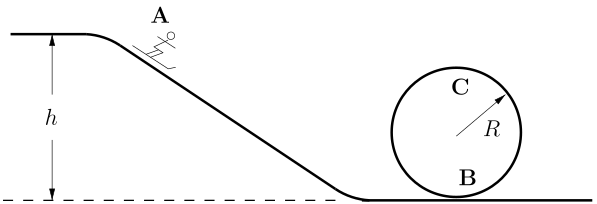
Lindsey Vonn has been challenged to test out a new ski event. A loop of radius \(R\) has been installed at the end of a ramp of height \(h\) as shown in Figure 2. In this event the skier starts essentially from rest at the top of the ramp and gains enough speed going down the ramp to complete a circle on the inside of the loop. You will need to use both force and energy methods in this problem, and you may assume that the snow is frictionless.
Draw a force diagram on Lindsey when she is at point A. Which statement about the magnitude of the normal force (N) of the ramp on Lindsey at point A is correct?
\begin{equation*}
N = mg \hspace{0.3in}N \lt mg \hspace{0.3in} N > mg\hspace{0.3in}
N= 0\hspace{0.3in} \mbox{not enough info}
\end{equation*}
Draw a force diagram on Lindsey when she is at point B, just after she has entered the circular loop. Which statement about the magnitude of the normal force of the loop on Lindsey at B is correct?
\begin{equation*}
N = mg \hspace{0.3in}N \lt mg \hspace{0.3in} N > mg\hspace{0.3in}
N= 0\hspace{0.3in} \mbox{not enough info}
\end{equation*}
Draw a force diagram on Lindsey when she is at point C at the top of the loop. Which statement about the magnitude of the normal force of the loop on Lindsey at C is correct?
\begin{equation*}
N = mg \hspace{0.3in}N \lt mg \hspace{0.3in} N > mg\hspace{0.3in}
N= 0\hspace{0.3in} \mbox{not enough info}
\end{equation*}
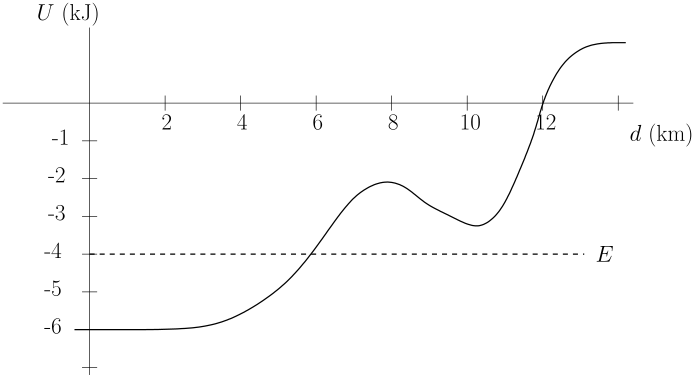
A spacecraft drifting through the center of a giant cosmic dust cloud experiences a potential energy that varies with position as shown in Figure 3 (\(d\) is the distance from the center of the dust cloud). The spacecraft starts at the center of the dust cloud.
In your kit, there should be a small rubber hemisphere that is referred to as a “popper.” If you turn it inside out and flex it for a few seconds, you can lay it on a table before it pops back into its original shape. When it pops, it will jump up off the table, giving a nice demonstration of the conversion of potential energy into kinetic energy.
Using whatever means you see fit, estimate the potential energy (in J) stored in the popper just before it pops. (There’s a really easy way to do this.) The diameter of the popper is 1 inch, its mass is \(1.8\,\text{g}\text{,}\) the hole in the center has a diameter of \(2\,\text{mm}\text{,}\) and there are approximately 3300 students at Bucknell.
You push a block against a horizontal spring, compressing the spring by \(15\,\text{cm}\text{.}\) When you release the block, the spring propels it across a level tabletop. The block stops \(75\,\text{cm}\) from its release point. The spring constant is \(200\,\text{N/m}\text{.}\) Determine the magnitude of the friction force (assumed constant) between the block and the table.
Take your larger superball and carefully balance your smaller superball on top of it. Release both from rest, and allow them to fall perfectly vertically in a line. The large superball should hit the ground first and then collide (going up) with the small superball (still on its way down). This requires lots of patience and luck, but if you get it, the result is incredible! This can be understood by treating the various collisions as perfectly elastic collisions, which they almost are. Use the before and after sketches from lecture: In the before sketch the smaller superball continues downwards with speed \(v_i\) and the larger superball goes upwards also with speed \(v_i\text{.}\) In the after sketch both superballs go upwards, the smaller superball with \(v_{2,f}\) and the larger superball with \(v_{1,f}\text{.}\) Interpret your result for \(v_{2,f}\) for the case of \(m_1 \gg m_2\text{.}\)
There is nothing that makes a day more complete than firing a blow dart at a small, defenseless superball. Before doing this, though, here is some relevant information: the blow dart has a mass of \(2.5\,\text{g}\) and the superballs have masses \(8.5\,\text{g}\) and \(25\,\text{g}\text{.}\)
Now, put your larger superball (the animal ball) at the edge of a table and softly fire a blow dart directly at it (do it until the blow dart hits almost straight on). By “softly” we mean don’t blow as hard as you usually do. If you do this correctly, the dart should bounce straight back, and the large ball will move forward with only a very small speed.
Now, the main question: What changes do you have to make such that the blow dart will continue forward after a head-on collision with another object? Predict what you need to do, write down your prediction, and then test out your theory. (In making your prediction you may assume that the collision is elastic.)
Harry and Hermione are playing in the GraviFree Room at Hogwarts. Harry (mass \(55\,\text{kg}\)) is floating motionless in the center of the room. Hermione (mass \(45\,\text{kg}\)) pushes off from the wall and approaches Harry at a speed of \(6.0\,\text{m/s}\text{.}\) Neglect air resistance in this problem.
As Hermione moves past Harry, he reaches out and grabs her outstretched hand, holding on tightly. Determine the speed with which Hermione and Harry move after they grab hold of each other.
An open railroad car of mass \(2\times 10^4\,\text{kg}\) is rolling without friction along a level track at \(5\,\text{m/s}\) when it starts to rain. After the car has collected \(2000\,\text{kg}\) of water, it stops raining. Assume that the rain fell perfectly vertically.
What is the rail-car’s speed after it stops raining?
After the rain has stopped, a hole in the bottom of the rail-car is unplugged, and the rain water begins to leak out of the hole at a rate of \(5\,\text{kg/s}\text{.}\) What is the speed of the rail-car after half the rain water has leaked out?
A typical person walks with a speed of about \(2\,\text{m/s}\) relative to the ground. While you are walking between classes, watch other students who happen to be walking in the same and opposite direction as you, and answer the questions in the following parts.
Choose a student walking in the same direction as you with the same approximate speed. Note how far away that person is from you. Then, after the two of you have walked for a few seconds, note again how far that person is from you. Has the distance between the two of you increased, decreased or stayed roughly the same? Assuming that you are both walking at a speed of \(2\,
\mbox{m/s}\) relative to the ground, what does your previous answer imply about the speed of the other person as measured in your reference frame?
Problem0.31Measuring the Length of a Moving Object, Take 1.
Measuring the length of an object that is at rest with respect to you is pretty easy: one method is to take a ruler of some kind, hold it up to the object, and note where each end of the object is with respect to the ruler.
What difficulties arise if you try to measure the length of an object that is moving with respect to you using the technique described above?
Other methods need to be developed to measure the length of a moving object. We’ll have you try an approach that employs a group of people. [We will do the following as a class exercise during problem session, so you won’t have to gather a group of your own.] Go outside, and line up in a row, parallel to a street with some automobile traffic. (Please stand a safe distance away from the street!). Stand so that there is approximately equal distance between you and your nearest neighbors
Your instructor will stand across the street. When a car comes by, your instructor will yell “Now!”. If the front of the car is directly in front of you, raise your hand and keep it raised. If the back of the car is directly in front of you, raise your hand and keep it raised. (By yelling “Now!” your instructor has basically synchronized your clocks, so that you are making your measurements — i.e., raising your hand — simultaneously. You’ll see in Problem A 0.33 that to make this measurement even more carefully, we would have to come up with a better method of synchronization. We’ll discuss some thorny issues involving simultaneity in an upcoming lecture.)
Now, measure the distance between people who have their hand raised. How is this distance related to the length of the car? Does it matter how fast the car is going in using this technique?
Problem0.32Measuring the Length of a Moving Object, Take 2.
In problem A 0.31 you measured the length of a moving object using several people and synchronization. In this problem, you will develop a technique that you could use on your own.
Assume that you know the velocity of the car (say the car is going the speed limit), and that your available tools are a ruler and a clock. Figure out a method to determine the length of the moving car. Describe what you would do and what you would measure. and how you would use the results of your measurement to determine the length.
You likely measured a time interval and/or a distance. Think how the driver of the car views the situation, especially if the speed were relativistic (say if the car were going at \(0.8c\) relative to you). Would the driver of the car agree with your measurement of the time interval and/or distance? Would she think your measurements are too high? too low? correct?
Problem0.33Synchronization, Simultaneity and Spacetime Diagrams.
Grab a friend or roommate (it doesn’t have to be someone taking PHYS 211). Stand on opposite sides of a room or a long hallway (the larger the separation distance, the better). Throw a ball to your friend (or have that person throw the ball to you). Draw a qualitative spacetime diagram of this situation, showing world lines for you, your friend, and the ball.
Your next goal is to have both of you clap your hands at precisely the same time, but you have to keep your eyes closed while doing it. Here’s an approach that you might try: you could say (loudly), “On the count of three, we’ll both clap our hands. One, two, THREE!” Go ahead and try this, and then comment on inaccuracies in this method (i.e., why doesn’t this work?). Draw a spacetime diagram to support the argument.
See if you can figure out a way that will result in you and your friend clapping at the same time. Write down the method, and draw a spacetime diagram that demonstrates that this is a good approach.
A typical person walks with a speed of about \(3\,\text{mph}\) relative to the ground. For this problem, imagine that the speed of light were actually \(4\,\text{mph}\) rather than \(3.0\times 10^8\,\text{m/s}\text{.}\)
Walk across campus, perhaps on your way to or from class or going to dinner. Choose a time when there is a lot of activity around you (cars moving around, other people walking around, etc). While you are walking, watch everything around you. Note what you see, what you feel, whatever you experience (when you are moving, waiting to cross a street, etc.), and think about how any of these things would be different if the speed of light were \(4\,\text{mph}\text{.}\)Write a couple of paragraphs summarizing your thoughts. And feel free to discuss this with other people in the class. (Some things to think about in particular: length contraction, time dilation, and simultaneity — all of these things would be very noticeable in this hypothetical scenario.)
If you really think about a lot of the things around, you should come to the conclusion that if \(c\) were really \(4\,\text{mph}\text{,}\) it would truly be a whacked-out, psychedelic, something-out-of-a-Salvador-Dali-painting experience.
Pick up your largest superball and just stare at it for a little while. Does this look like it contains a lot of energy? Now, estimate its mass (or alternately look back at the Problem A 0.27 where the mass is given) and determine the rest energy of the superball (in Joules). Now, consider that an atomic bomb releases \(10^{14}\) to \(10^{15}\,\text{J}\) of energy; consider also that a typical household uses about \(10^{10}\,\text{J}\) of energy per year. Stare at your little ball again. Write a sentence or two about your thoughts. (Feel free to post your thoughts on the “Questions” page at the course web-site if you want to share them.)
Let’s think a little more about what it would be like walking across campus if the speed of light were \(4\,\text{mph}\) rather than \(3\times 10^8\,\text{m/s}\text{.}\) You’ve already thought about time dilation, length contraction and simultaneity in problem A 0.34. Now, think about what the relationship \(E =
mc^2/\sqrt{1-v^2/c^2}\) would mean in a relativistic world.
If the speed of light were \(4\,\text{mph}\text{,}\) how much kinetic energy would be involved in walking at a speed of \(3.5\,\text{mph}\text{?}\) (Use your own body mass in these estimates.) How much kinetic energy would you have walking at \(3.8\,
\mbox{mph}\text{?}\) How do you think you would feel as you start trying to walk faster and faster, past \(3.0\,\text{mph}\text{,}\) past \(3.5\,
\mbox{mph}\text{,}\) past \(3.8\,\text{mph}\text{,}\) past \(3.9\,\text{mph}\text{,}\) … ?
What do you think might happen if you collided with another person if you were both walking with a speed of \(3.8\,\text{mph}\) but in opposite directions?
Common misconceptions about relativity abound. You’ll hear people say that relativity states that “if you are on a ship traveling close to the speed of light, your mass increases to infinity, you shrink down to zero size, and you never age.” Statements like this have led people to think that life would be very strange on such a spaceship. We want you to experience what it really would be like to be on such a spaceship.
So, go ahead and do this experiment. Hop on a spaceship that is traveling at a speed of at least \(0.8c\) relative to some reference frame. Before you start saying that we’ve completely cracked up, there is a spaceship that everyone in this class has access to that meets this requirement. (Hint: the name of the ship starts with the letter \(E\) and its name rhymes with birth, and it is currently traveling at a speeds of greater than \(0.9c\) relative to distant galaxies and quasars.)
Question: Do you feel at all strange being on such a ship? Write a sentence or two of your thoughts about this. (Feel free to post your thoughts on the “Questions” page at the course web-site if you want to share them.)
An elementary particle has a mass of \(1125\,\text{MeV} /c^2\text{,}\) and is motionless in some reference frame. A photon with momentum \(750\,\text{MeV} /c\) strikes the particle and is absorbed, leaving an “excited” particle that is recoiling and nothing else. Determine the mass and recoil velocity of the excited particle after the interaction.
Particle A of mass \(400\,\text{MeV} /c^2\) collides with the stationary particle B of mass \(350\,\text{MeV} /c^2\text{.}\) The result of this collision is a single particle C at rest, and a \(300\,\text{MeV}\) photon. Determine the mass of particle C.
We can take advantage of the fidget spinners and the animal in your larger superball to comment on the relationship between angular velocity and linear velocity.
Take your fidget spinner and spin it. Do the same with the large superball. (For the superball, you can either rotate it in your hand, or toss it gently with a little rotation — whichever enables you to see the object spinning easiest.) For both the fidget spinner and the animal-ball, try rotating them slowly and then quickly. What can you say about the motion of the middle portion of the object, as opposed to the motion of the part of the object farthest from the middle? How does your answer to the previous question relate to the equation \(v = r\omega\) for tangential speed?
Now, drop the superball straight down while spinning it very rapidly about a horizontal axis. The best way to do this is to use two hands to get it spinning as fast as you can while releasing the ball. What happens when the ball bounces? Specifically, does it bounce straight up? Why not? (You’ll want to use a diagram and Newton’s \(2^{ nd}\) and \(3^{ rd}\) laws to support your argument.) Also, what happens to the angular velocity of the superball after it bounces? Explain why this happens. (Consider the torque acting on the ball when it bounces on the floor.)
(Optional) If you are good at spinning the ball, try this: toss the ball slightly away from you, but spinning with the top toward you. If you do this well, you can get the ball to bounce back and forth on the ground. Explain why this happens.
We’re going to repeat Problem A 0.16, but this time we’re going to be quantitative and take rotation into account.
Count how many turns of the string are required to wind up the yo-yo all the way. From this, calculate \(\Delta\theta\) for the yo-yo to unwind completely (in radians). Now, holding the end of the string, let the yo-yo unwind all the way, and estimate the time for it to reach the bottom (within a couple of tenths of a second). Since the angular acceleration is constant during this process, you should be able to take two integrals of \(\alpha\) to find that \(\Delta\theta = \alpha t^2/2\text{.}\) From this information, determine the angular acceleration of the yo-yo as it falls.
Now estimate the average radius of the spool (i.e., the average distance of the point-of-contact of the string from the center of the yo-yo), and use this information to estimate the linear acceleration of the yo-yo during its fall. Then, use this information (along with a force diagram and Newton’s second law) to determine the tension in the string while the yo-yo is falling. Note: the mass of the yo-yo is \(52\,\text{g}\text{,}\) its total thickness is \(3.5\,\text{cm}\text{,}\) and it fits nicely in your pocket.
If the ball had the same mass and diameter, but all the mass was at the outer surface of the ball (in other words, the ball were hollow), would the ball have more or less kinetic energy than you calculated in part a)? Assume this hollow ball has the same angular speed.
Back to the rotating solid ball again. If you give the ball an additional \(0.2\,\mbox{J}\) of rotational kinetic energy, determine the solid ball’s new angular speed.
Problem0.43Yo-yos, mechanical energy, and angular momentum.
Unwind the yo-yo and rotate it in a vertical circle at the end of its string. Once it is going, allow the yo-yo string to wrap around your arm — the result should be that the yo-yo spirals inward until all the string is wrapped around your arm. Do this a few times and watch the yo-yo as it spirals inward. Do you think the yo-yo is speeding up, slowing down, or going at basically the same speed during this process? (Watch the yo-yo very carefully here — your eyes can easily trick you.)
Now, think about this process both from a perspective of mechanical energy and angular momentum. Which of these quantities do you think are conserved during this process (or do you think that neither or both are conserved)? Justify your answers: for angular momentum, you’ll need to show either that torque acting on the yo-yo is zero or non-zero, and for energy, you’ll need to explain either that work is or is not being done on the yo-yo. Based on these answers, should the yo-yo be speeding up, slowing down or basically going at the same speed while spiraling inward?
Now do the same thing again, but this time, instead of letting the string wind around your arm, thread the string through a PVC tube (which we’ll provide in problem session) and pull the string through the tube to pull the yo-yo inward. Answer all the same questions that you did in parts a) and b).
Take a partially-wound (i.e., partially-unwound) yo-yo and place it on a level surface such that it could roll if pushed or pulled. Now, predict which way it will roll if you pull the string straight up. (Justify your prediction with diagrams.) Try the experiment — were you correct? If not, justify what actually happened.
Now, do this again, but this time let the string go over the top of the yo-yo and pull it parallel to the table. Again, first make a prediction about which direction the yo-yo will move (and justify it), then try the experiment. Again, if you were not correct in your prediction, justify what actually happened with diagrams and Newton’s laws.
Finally, predict which way the yo-yo will move if the string goes underneath the yo-yo, and you pull it parallel to the table. (Again, justify your prediction with a diagram. Try the experiment. Were you correct? Again, if you were not, then justify what you actually saw.
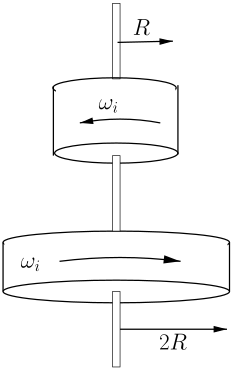
Two solid wheels of identical mass but different radii (\(R\) and \(2R\)) are spinning on the same axle (on very smooth bearings). The wheels are spinning in opposite directions, but with the same angular speed \(\omega_i\text{,}\) as shown in Figure 4. The two wheels are slowly brought together, and the resulting frictional interaction between the touching surfaces eventually brings the wheels to a common angular speed \(\omega_f\text{.}\)
We’re not actually going to use the dunking bird in its intended purpose here (don’t worry — that will come). Instead, grab the Bird’s bottom in the palm of your hand and wrap your hand around it. Presumably, if your hand is at normal body temperature (37\(^\circ\) C), the fluid in the Bird will rise up toward the head, leaving a larger volume of gas than when you started.
Estimate the volume of the gas in the Bird’s bottom before and after you warmed it up with your hand. Actually, you really only need to approximate the ratio of the two volumes \(V_{ after}/V_{ before}\text{.}\) Now, determine the ratio of the temperature of your hand to the temperature of the air, using estimates of the room temperature and your body temperature. (What units are you using for temperature?) Using the ideal gas law, determine if the change in the volume is consistent with the change in the temperature. (Show all your work here.)
What else do you think is going on inside the Bird? We’re not expecting a complete answer — this is more of a set-up to help motivate the next class. But you should be able to use the ideal gas law to make some statements about what else is going on inside the Bird.
It is fairly straightforward to estimate the pressure inside a blow dart’s suction cup when it is sticking to something. First, we’ll look at it qualitatively, then put some numbers in.
Wet the suction cup on one of your darts and press it onto a flat, smooth surface so that it sticks. (It’s best to have the dart wet, because this will keep air from leaking in around the suction cup.) Pull on the dart and note how much force is necessary to pull the dart off the surface. You don’t have to be quantitative here; simply comment on how difficult it is to pull off.
While you are pulling on the dart, what is causing the force that pulls (pushes) the dart back onto the surface? Of course, this is due to the pressure difference between the inside and the outside of the suction cup, but what physically is causing the force? (Refer to the kinetic theory of gases to answer this.)
Now, let’s do this semi-quantitatively. If you stuck the dart to the underside of a smooth surface, you could hang about \(1\,
\mbox{kg}\) of mass from the dart without it coming off. Based on this, you can determine the maximum force (in N) that the dart can withstand before coming off the surface. And once you have the maximum weight that it can hold, use the definition of pressure (in terms of force and area) to estimate the pressure within the suction cup. Note: the suction cup has a diameter of about \(1.8\,
\mbox{cm}\text{.}\) (You should estimate the pressure difference between the air and the inside of the cup first, then you can get the absolute pressure inside the cup.)
Do the following experiment: Get a glass drink container — one of those juice/cranberry bottles will work, but a taller/deeper glass drink container is better. (You might be able to pluck something out of one of the recycling bins if needed.) You’ll need to stretch a balloon across the opening of the jar, so try that out to make sure you can do it, then take the balloon off. Then, boil a small amount of water (you can use a microwave if you want, but make sure that the water is really hot and steaming). Pour a small amount of the boiling water into the jar (cover only the bottom cm or so). If the water is hot enough, there should be a noticeable amount of steam coming out of it. Then, stretch the balloon over the mouth of the jar and then watch the system as things slowly cool down.
Describe what happens, and explain why it happens. In particular, comment on any condensation of the steam that you see on the inside of the container. Is this condensation important as far as the behavior of the balloon is concerned?
Problem0.50Using Phase Transitions to Cool a Drink.
You’ll need to do this at lunch or dinner, or somewhere that you have access to ice.
Get three glasses or cups. Fill one glass (let’s call it glass A) with a mixture of ice and water (plenty of ice), and fill the other two glasses each halfway full with room temperature water. Let the ice/water mixture in glass A sit for a few minutes: this will ensure that both the ice and the water in the glass are at temperature 0\(^\circ\) C. Next, you are going to take out a fair amount of \(0^\circ\) C ice from glass A (a spoon is a convenient way to do this) and dump it into glass B, one of the half-filled room-temperature glasses. Then pour an equivalent amount of \(0^\circ\) C water from glass A into glass C, the other half-filled glass. The idea is to compare the cooling effects of \(0^\circ\) C ice compared to \(0^\circ\) C water. Before doing the experiment predict whether glass B and glass C should be equally cooled, or if not, which will be cooler. Write down your prediction.
Now, go ahead and do the experiment. Record the results in your notes. Is the result what you expected? Use heat flow arguments to explain why you obtained this result.
In Problem A 0.47, you should have found that the temperature change alone wasn’t enough to cause the volume change and the resulting movement of the fluid up into the Bird’s head — there must have been a significant change in \(N\text{,}\) the number of gas molecules in the Bird.
Explain how \(N\) is increasing in the Bird’s bottom when you heat it with your hand. Explain also how \(N\) decreases in the head when the head is cooled. What about the fluid inside the Bird — why do you think the Dunking Bird is filled with methylene chloride instead of simply dyed water?
Now, how is the head of the Bird cooled during its normal dunking operation? Does the water in the glass have to be cooler than the room temperature? Try the following experiment: try using water in the glass that is measured to be the same as room temperature or better yet, heat up the water to be several degrees above room temperature, and dip the Bird’s head in this warm water. Question: does the Bird still dunk? (The result might surprise you.) So, how does the Bird’s head cool?
A Dunking Bird with a wet head is comparable in many respects to a person who is sweating on a hot day. Based on what you know about phase transitions (melting, vaporization, etc.), explain why it is necessary for a person to sweat on a hot day. Why doesn’t a person sweat as much on cooler days?
When you blow up a balloon, you are clearly doing work on the balloon. Alternatively, you can say that the gas in the expanding balloon is doing work. And this work goes into potential energy. Question: where is that energy “stored”?
In this problem, we’re going to estimate that stored energy using \(W = \int p\, dV\text{.}\) We’ll use the approximation that the pressure is almost constant (we’ll estimate an average pressure) so that \(W= p\, \Delta V\text{.}\) And since the air outside the balloon is doing negative work on the balloon while it expands, and we want the net work done by the gas, you can use the gauge pressure to get the net work done by the air while the balloon expands. To estimate the gauge pressure, you need to attach the balloon to the end of your flexible hose with a rubber band, blow the balloon up half-way, then make sure to pinch off that end of the balloon. Now, get some water into the tube (still holding the balloon end pinched off), and then hold up the tube (in a U-shape, with the balloon at one end and the open end of the tube at the other). Finally, release the balloon such that the gauge pressure of the balloon pushes the water in the tube.
Use this technique to estimate the average gauge pressure (see problem [cross-reference to target(s) "prob_suck" missing or not unique] for a refresher if you have forgotten), and estimate the change in volume when the balloon is fully inflated. From this, you should be able to estimate the energy stored in the balloon.
Let’s think about what happens when you fire a blow dart. We’ll use the results from problem [cross-reference to target(s) "prob_suck" missing or not unique] (in which you determined the gauge pressure that your lungs can produce) to estimate the ideal maximum speed that you could achieve when firing a blow dart.
When you blow on the dart, the pressure \(p_{ lung}\) from your lungs pushes the dart down the tube while atmospheric pressure \(p_0\) pushes the dart the other way. Draw a quick sketch of the dart, and draw arrows corresponding to the forces \(F_{
lung}\) and \(F_{ atm}\) on the dart. Considering that the dart has a cross-sectional area \(A\text{,}\) what is the net force acting on the dart when you fire? Re-write this result in terms of the gauge pressure for your lungs.
Now, use the result from [cross-reference to target(s) "prob_suck" missing or not unique] and the fact that the dart has a diameter of about \(1.8\,\text{cm}\) to estimate the net force acting on the dart when you blow. Now, considering that the active part of the blow gun is about \(50\,\text{cm}\) long, estimate the work done on the dart when firing. (Note: you’d get the same result by using \(W = P_{ gauge}\, \Delta V\text{.}\)) Finally, use the work to predict the exit speed for the dart when you fire.
The answer that you get here might differ significantly from what you measured in Problem A 0.4. Why do you suppose these two results could be so different? Do not use “human error” anywhere in your response!
One mole of an ideal monatomic gas is heated from \(300\,\text{K}\) to \(600\,\text{K}\text{.}\)
If the gas is held at constant volume, find the change in the gas’s internal energy, the work done by the gas, and the heat added to the gas during this process.
If the gas is held at constant pressure, find the change in the gas’s internal energy, the work done by the gas, and the heat added to the gas during this process.
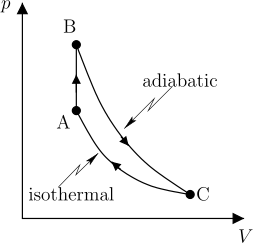
In the cycle shown below, \(1.0\) mole of a monatomic ideal gas is initially at a pressure of \(p_A=100\,\text{kPa}\) and a temperature of \(T_A=0^\circ\,\text{C}\text{.}\) The gas is heated at constant volume to \(T_B = 150^\circ\,\text{C}\) and is then expanded adiabatically until its pressure is back to \(p_C=100\,\text{kPa}\text{.}\) Finally, the gas is compressed at constant pressure until it is back to its original state \(A\text{.}\) Find
the temperature \(T_C\) after the adiabatic expansion,
First, get your Dunking Bird going. You can actually operate it one of two different ways:
(I).
You can get the head wet and then just put it on a table. If the Bird is properly balanced (you may have to slide the metal piece up or down), then it should start going.
You could place the Bird on top of a TV or computer monitor and let the heat from that device warm the Bird’s bottom. (Warning: Be careful if you do it this way: people have wound up with blue or red stained monitors and desks as well as having to clean up broken glass!)
If the Dunking Bird is being powered by heating of its bottom (i.e., Method II above), the gas/fluid in the bottom will undergo several steps. (The steps are actually continuous, but we’ll break them up to make this easier to plot.) (i) As the bottom heats up, the pressure of the gas inside increases. (Do you remember why? It isn’t just the change in temperature.) (ii) After the pressure has increased, the fluid is forced out of the bottom, and the volume of gas in the bottom increases. (iii) The Bird tips over and the air in the bottom and the air in the head are connected, causing a quick drop in the pressure of the gas in the bottom down to its initial value. (iv) The Bird stands up again, and the fluid runs down into the bottom, decreasing the volume of gas in there. Plot the sequence described above on a \(P\)-\(V\) diagram. Do you have a cyclic process here? Show the work for the engine cycle on your \(P\)-\(V\) diagram.
What is the hot reservoir for this engine? What is the cold reservoir? What is the work done by the Bird (in words)? Draw an engine diagram for the Bird.
Scatter at least 10 coins over a large surface area. Then, carefully pick them all up and stack them into a neat pile. Has the entropy of the coins increased, decreased or stayed the same? Use arguments based on probability to answer this question. (e.g., “It is more probable that you’d …”).
Is your answer consistent with the Second Law of Thermodynamics? (The answer must, of course, be yes, but you might have to think a bit to figure out how to reconcile this with the Second Law.) Explain your reasoning.
This problem gives you practice with the idea of macrostates vs.\ microstates, in a different context than that provided in the reading. Let’s think about macrostates vs. microstates for the rolling of two six-sided dice.
When you roll two six-sided dice, each die can show a 1 through 6. The SUM of the numbers showing on the two dice is an integer from 2 through 12. That SUM is the macrostate. The microstate is the specific combination that resulted in that macrostate. So for example, if you rolled two six-sided dice, and the total of the two dice was an 8, that total could have been obtained a number of different ways: (2 and 6), or (3 and 5), etc. In this example, the MACROSTATE is the sum 8, and some of the MICROSTATES associated with that macrostate are (2 and 6) or (3 and 5).
Consider all of the possible macrostates for this system of two six-sided dice. For each macrostate, write down all the possible microstates associated with that macrostate. Assume that the dice are distinguishable from each other, which means that there is a difference between (2 and 6) or (6 and 2). Which macrostates have the most microstates associated with it/them? Which macrostates have the fewest microstates associated with it/them? Use this to argue which macrostates are the most probable, and which macrostates are the least probable.
Now, roll two six-sided dice 10 times, and record the macrostates that you observe. (If you don’t have access to dice, you’ll be able to do this part in problem session.) Does your experimental evidence support your predictions from part (a); in other words, was the most probable macrostate clearly rolled more than the least probable macrostate? You may be surprised by your results. What do you think you need to do in order for the predictions to more accurately model the results of the experiment? We’ll collect data from the entire class for the number of times your most probable macrostate came up, and the number of times your least probable macrostate came up.
Problem0.59Playing with the Period of Oscillation.
Take your round metal spring, hold it by one end, and let the other end oscillate in the vertical direction. Determine the period of oscillation using the following technique: find the approximate time for 5 complete periods and divide by 5. Record the period of oscillation for the round metal spring. What is the angular frequency of the oscillator?
Now, take your round metal spring and jam your hopping popper into one end of the spring (as you did in problem A 0.2.) (Note: you may want to increase the mass even more). Hold the spring by one end, letting the end with the ball wedged in dangle freely so that it can oscillate in the vertical direction. Predict whether the period of oscillation will be larger than, smaller than, or equal to the period of oscillation you obtained in part (a). Justify your prediction. Try the experiment — were you correct? If not, explain what actually happened.
Problem0.60Circular Motion Versus Oscillatory Motion.
Have a partner hold one end of the round metal spring and rotate it so that the other end makes a horizontal circle. Now, you should stand back a couple of meters, and with one eye closed, watch the rotating end of the spring from the side so that the motion appears as though it is on a line. If you view it from an appropriate angle, the motion should look exactly the same as if your friend were simply oscillating the spring back and forth along a line.
To develop this further, ask your friend to go ahead and swing the spring back and forth instead of in a circle. If you have one eye closed and if you are looking at it from the best angle, from your vantage point, it will look the same as if it were going in a circle. And to develop this even more, have your friend either rotate the spring in a circle or oscillate it back and forth while you try to figure out which kind of motion the spring is following. Treat it as a challenge — your friend should try to fool you into thinking it is straight line motion when it is actually going in a circle or vice-versa.
The point of this experience is to help clarify the idea that oscillatory motion can be thought of as one component of circular motion. This idea will be very important when we talk about waves and interference in PHYS 212.
We’re going to map out (approximately) a simple resonance curve for your round metal spring. You may use just the round metal spring, or you may use the round metal spring with the return ball jammed in one end. Just make sure you indicate what you are doing. In part (b) you will hold the spring by one end and let the other end dangle, and then oscillate your wrist at varying frequencies. Before doing this, draw a sketch of what you would expect a resonance curve (amplitude of response versus driving frequency) would look like for the spring, assuming very little damping. Based on your results from problem A 0.59, what would you expect the frequency to be for the peak of this curve? Write that frequency down.
Now, hold the spring by one end and let the other end dangle. Wait until any residual oscillations damp out, then oscillate your wrist very slightly (amplitude of only a cm or less) at a frequency significantly smaller than the one that you predicted for the peak of the curve. (Write down in your notes an approximation of what that frequency is.) Do this for a few periods of oscillation, and comment on how the motion of the bottom end of the spring relates to the motion of your hand during this procedure.
Now, repeat this again for a frequency that is significantly higher than the predicted resonance frequency, and comment on the results. Finally, repeat this again for a forcing frequency close to your predicted resonant frequency. Comment on your observations.
We often take Newton’s Universal Law of Gravitation for granted, but it was far from obvious in Newton’s era that every object attracted every other object in the universe. Why, for instance, don’t we feel a gravitational attraction every time we come near another person or near another object?
The experience part: get very close to another person or to some other object that is close to your mass. (It doesn’t have to be another person — you can stand close to a wall for the experience part.) Now, try to see if you can feel any gravitational attraction. In particular, can you feel the attraction getting stronger as you get closer? Briefly comment (no more than one or two sentences) on what you feel.
Now, let’s put some numbers on this experience. Estimate your mass and the mass of the other person or object, and estimate the smallest separation between the two of you (estimate the distance between the center of you and the center of the other person/object). Throw these numbers into Newton’s law of gravitation to come up with a numerical estimate of the gravitational attraction that you experienced. Is this a force that is strong enough to be noticeable? (You might want to compare this force with the weight of some objects.)
Problem0.63Orbits in a Non-Keplerian Solar System, Part I.
Suppose that the gravitational force of attraction depended not on \(1/r^2\text{,}\) but rather was proportional to the distance between the two masses (like the force due to a stretched spring). In a planetary system that felt this different form of gravity, what would be the relationship between the period of a planet and its orbital radius? Assume circular orbits.
Problem0.64Orbits in a Non-Keplerian Solar System, Part II.
This experience problem goes hand-in-hand with the previous problem, problem A 0.63. In that problem, you work out how the period of a planet’s orbit depends on radius if the force of attraction grew linearly with distance, rather than dropping off as \(1/r^2\text{.}\) It so happens that this is a very easy thing to test with your toy kit.
Take your round metal spring, hold it by one end, and twirl it slowly so that the other end makes a circle in a horizontal plane (similar to what you did in problem A 0.60). Determine the period of revolution using the following technique: find the time for 10 complete periods and divide by 10. Now, do it again, but this time twirl it harder so that it stretches out a lot, resulting in a circle of significantly larger radius. Again, determine the period (time for 10 revolutions divided by 10).
Do your results agree with your prediction from problem A 0.63? Specifically, when you increase the radius (by twirling faster), does the period grow linearly with radius, drop as \(1/r\text{,}\) remain the same, … ?
Blow up and tie off a balloon. You are going to draw a circle on the balloon with a radius of \(10\,\text{cm}\) as measured by a 2-dimensional being that lived on this surface and wasn’t aware that the surface was curved in a 3-dimensional world. Mark a point on the balloon that will act as the center of the circle. Now, mark off a \(10\,\text{cm}\) portion of the string in your toy kit (or you can use your yo-yo string or dental floss). Place one of end of that \(10\,\text{cm}\) segment at the marked point on the balloon and use the other end of the \(10\,\text{cm}\) segment like a drawing compass, pulling the string so that it is tight against the surface of the balloon and swinging it around in a circle, tracing out that circle on the balloon as you go. The net result should be a reasonably clean circle with a 2-dimensional radius \(r_{ 2D}\) (along the surface of the balloon) of \(10\,\text{cm}\text{.}\)
Now, measure the circumference of the circle. You can do this by taking the yo-yo string (or some other string) and wrapping it around the balloon until it lines up with the circle that you have just drawn. Then, straighten out the string and measure its length.
Is the circumference equal to \(2\pi r_{ 2D}\text{?}\) Your result shouldn’t bother you because you happen to live in a three-dimensional world, and you know therefore that the real center of the circle that you just drew is inside the balloon, so the real radius isn’t \(10\,\text{cm}\text{.}\) But if you couldn’t comprehend a third dimension and lived on the surface of the sphere, would you find the result surprising?
Now, imagine going outward a certain well-defined distance \(R\) from the center of our sun, and drawing a circle all the way around the sun with that distance as the radius. Would you be surprised if the circumference of that circle were less than \(2\pi
R\text{?}\) (This is, in fact, what you would find if you could do this measurement without being burned up.)
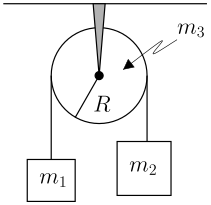
Two objects of masses \(m_1\) and \(m_2\text{,}\) with \(m_2>m_1\text{,}\) are connected by a string of negligible mass that passes over a pulley, as shown. The pulley is a uniform disk with mass \(m_3\) and radius \(R\) and is free to rotate without friction. The string does not slip on the pulley. Find the acceleration of the mass \(m_2\text{.}\)
(Note: then tension in the string for mass 1 is not the same as the tension in the string for mass 2, since the pulley has a non-zero rotational inertial.)
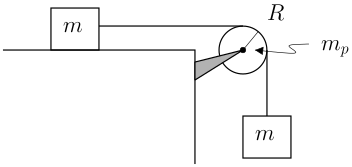
Two objects, each of mass \(m\text{,}\) are connected by a string of negligible mass that passes over a pulley, as shown. The surface is frictionless. The pulley is a uniform disk with radius \(R\) and mass \(m_p\text{,}\) and is free to rotate without friction. The string does not slip on the pulley. Find the acceleration of the hanging object.
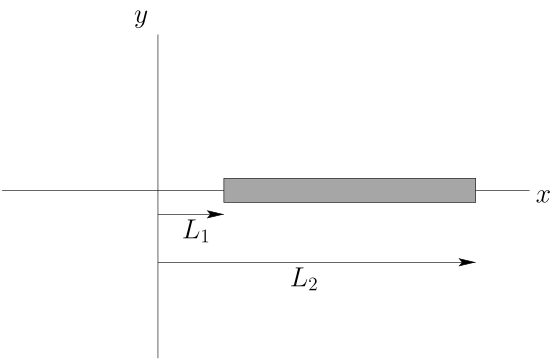
A rod lies on the \(x\)-axis with one end at \(x=L_1\) and the other end at \(x=L_2\text{.}\) The rod is not uniform, and its mass per unit length varies as \(\lambda = Cx\text{,}\) where \(C\) is a constant.
Problem0.71Gravitational Field via Integration II.
A uniform rod of mass \(M\) and length \(L\) lies along the \(x\)-axis with its center at the origin. Determine the gravitational field at the point \(x=d\text{,}\) where \(d>L/2\text{.}\)
Refer to Figure 5.27 in Wolfson (4\(^{ th}\) ed.). Let’s say that the guy there is pulling on the rope, but the trunk is completely motionless (and remains that way — it doesn’t budge). Calculate the magnitude of the friction force acting on the trunk in terms of the mass \(m\) of the trunk, the tension \(T\) in the rope, the angle \(\theta\) between the rope and the horizontal, the gravitational acceleration \(g\text{,}\) and the mass \(M_J\) of the planet Jupiter.
You throw a \(150\,\text{g}\) baseball straight down from a sixth-story window \(16\,\text{m}\) above the ground. The initial downward speed is \(7.2\,\text{m/s}\text{.}\)
Calculate the work that gravity does on the ball as it falls to the ground.
Assuming that air resistance does \(-12\,\text{J}\) of work on the ball, use the work-kinetic energy theorem to calculate the speed of the ball when it hits the ground.
A \(42\,\text{kg}\) child stands at rest on the surface of a frozen pond (i.e., a frictionless surface). She catches a \(1.1\,\text{kg}\) ball moving horizontally at \(9.5\,\text{m/s}\text{.}\) Calculate her speed immediately after catching the ball.
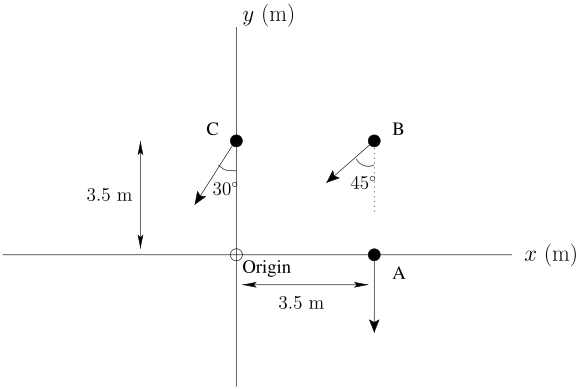
The figure shows 3 objects each with mass \(2.0\,\text{kg}\text{,}\) and each moving with a speed of \(4.5\,\text{m/s}\text{.}\) But the objects are traveling in different directions, each denoted by an arrow. Determine the angular momentum about the origin for each of objects A, B and C.
What is the difference between a solid just below its melting temperature and a liquid just above this melting temperature? Again, answer this question by discussing the behavior of individual molecules in the solid/liquid.
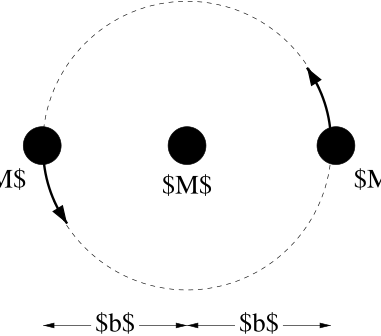
Consider a system of three co-linear stars, each with mass \(M\text{,}\) with a distance \(b\) separating them. The two outer stars orbit in a circle about the the stationary central star. Determine the square of the orbital period, \(T^2\text{.}\)
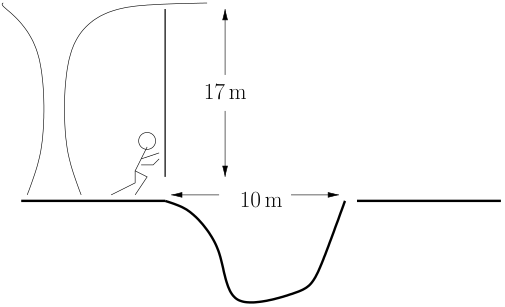
A \(17\,\text{m}\) vine hangs vertically from a tree on one side of a \(10\,\text{m}\)-wide gorge. Tarzan wants to run toward the vine, grab ahold of it, swing over the gorge, let go of the vine, and drop vertically to the ground on the other side of the gorge. How fast must he run to make sure that he makes it across the gorge?
Problem0.79Return of Work, Kinetic Energy, and Dissipation.
Repeat part b) of Problem A 0.73, but this time, instead of using the work-kinetic energy theorem, use \(W_\text{nc} = \Delta E_\text{mech}\text{.}\) Do you get the same answer for the speed of the ball?
Problem0.80A Bleching Blarg — Checking Dimensions of Answers.
A blarg with mass \(m\) blechs for a time \(T\text{,}\) after which it flomps a distance \(d\) under the influence of a srof \(F_0\) with dimensions (mass × distance)/(time)\(^2\text{.}\) For each of the following choices, determine if the expression could represent the speed (dimensions distance/time) of the blarg after all of this. Show your work for each case (there might be more than one correct answer).
A florphtl with length \(L\) (in m) and mass \(m\) (in kg) has an initial speed \(v\) (in m/s). The florphtl is in a magnetic field \(B_0\) (in units of T where 1 T = 1\(\frac{\text{kg} }{\text{C} \cdot\text{s} }\)) and experiences an electrical current \(I_0\) (in C/s). Which of the following could be an expression for the acceleration (m/s\(^2\)) of the florphtl? (Don’t worry about what a “T” or “C” are — you’ll want these units to cancel out in the final answer anyway.)
In a traffic jam on Interstate I-5 near Los Angeles, assume that there are 6 cars every 100 feet. How many cars would you expect to be stuck in 1.0 km of one of these traffic jams?
Let’s say that a 9-inch diameter pizza at Francesco’s costs $12.50. How much should Francesco charge for a 12-inch diameter pizza, if the cost is determined solely by the total amount of the ingredients used to make the pizza?
The “ball pit” at Dunking Bird Amusement Park measures 11 m by 9 m with a depth of 60 cm. Assume that this ball pit contains 8000 balls. The ball pit at Fred’s Amusement Park measures 13 m by 8 m with depth 40 cm, but uses balls that are half the diameter of those at Dunking Bird Park. Approximately how many balls are needed to fill the pit at Fred’s Park?
The asteroid Betty orbits the Sun with a semi-major axis of 3.8 AU. Use Kepler’s Third Law (and ratios) to determine the period (in years) of Betty’s orbit.
Jupiter’s moon Io orbits Jupiter with a semi-major axis 421,700 km and an orbital period of 1.77 days. Another moon — Ganymede — orbits Jupiter with a semi-major axis of 1,070,000 km. Calculate the orbital period of Ganymede.
The planet Zortox orbits around the star Xyl’pron with a semi-major axis of 570 klorvm and an orbital period of 2.7 flurps. Another planet — Rotnox — also orbits around Xyl’pron with an orbital period of 7.3 flurps. Determine the semi-major axis for Rotnox’s orbit.
Scribble out or erase every number and unit for parts (a) and (b). Now grade your work from parts (a) and (b) on a 0–10 point scale for each, basing the grade on how well someone could understand what you did and why from whatever remains visible on the page after the numbers and units have been erased or scribbled out.
Problem0.88Science Fiction and the Laws of Physics.
The following is a science fiction story that is inconsistent with the known laws of physics. Read the passage, and then list 4 different aspects of the story that are clearly inconsistent with the laws of physics as covered in PHYS 211 this semester.
The Starship Enterprise is on a mission 5 light years from the Earth, traveling at 7 times the speed of light while being chased by a hostile Borg ship. “At our current speed, the Borg won’t catch us for another three hours,” says Captain Picard to Admiral Janeway (who is back on Earth) on his iPad 563 as he stares at an ice cube floating lazily in equilibrium with the liquid in his iced tea. “Well, if they catch up with you,” replies Janeway, “fire a beam of anti-matter at the Borg ship. The anti-matter will annihilate part of the ship, and the kinetic energy that is produced by the resulting mass loss will blow up the rest of the ship.” “Understood,” replies Picard as he adds another ice cube to his tea, dropping its temperature down even more.
Just at that moment, Picard is thrown from his chair as a torpedo from the Borg ship slams into the Enterprise’s engines from behind. “Our engines have been destroyed ” says Geordi LaForge as the ship suddenly comes to a complete halt, motionless in space as the Borg ship close in. “Borg ship,” radios Picard, “this is the Starship Enterprise. We are prepared to talk with you.” “Prepare to be assimilated,” replies the Borg ship. “Resistance is fut — … ``End communication,” says Picard as the Enterprise fires, blowing up the Borg ship.
As a sign of opposition to Russian President Vladimir Putin, 1
See linked article for an explanation of how fidget spinners are being used to overthrow the Putin government.
\(^\text{,}\) 2
By the way, even if you are a supporter of Vladimir Putin, please try this experiment — you really won’t overthrow him by playing with a fidget spinner.
pull out your fidget spinner, hold it in the middle, and give the outside a quick flick to get it spinning. Do this a few times, and when you get it spinning as fast as is possible, time roughly how long it spins before stopping. Then try holding the outside and get the middle part spinning as fast as you can. Time how long the middle part spins before stopping.
How does the maximum spinning time compare when the outside is spinning versus when the middle part is spinning (i.e., which one is longer, and are they close, or is one significantly longer than the other)? Explain.
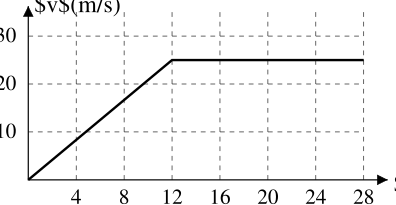
A car starts from rest and accelerates to a speed of \(25\,\text{m/s}\) and then continues with a constant speed, as shown in the figure. How far has the car travelled in the first 20 seconds of its motion?
Problem0.92Velocity addition/subtraction for an airplane.
You are a pilot beginning a 1500-km flight. Your plane’s speed is 1000 km/hr, and air traffic control says you’ll have to head 15\(^\circ\) west of south to maintain a southward course. If the flight takes 100 min, what’s the wind velocity?
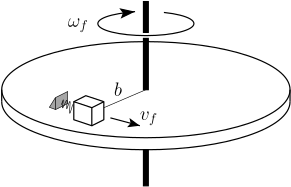
A massless spring with constant \(k\) is mounted on a turntable of rotational inertia \(I\text{,}\) as shown. The turntable is on a frictionless vertical axle, though initally it’s not rotating. The spring is com- pressed a distance \(d\) from its equilibrium, with a mass \(m\) placed against it. When the spring is released, the mass moves at right angles to a line through the turntable’s center, at a distance \(b\) from the center, and slides without friction across the table and off the edge. Find expressions for (a) the final linear speed of the mass and (b) the final rotational speed of the turntable.
Write expressions for the displacement \(x(t)\) in simple harmonic motion (a) with amplitude \(12.5\,\text{cm}\text{,}\) frequency \(6.68\,\text{Hz}\text{,}\) and maximum displacement when \(t = 0\text{,}\) and (b) with amplitude \(2.15\,\text{cm}\text{,}\) period \(1.36\,\text{s}\text{,}\) and maximum speed when \(t = 0\text{.}\)