If two events are separated by a time-like interval in one frame of reference, are they separated by a time-like interval in all frames of reference? Explain.
A simple way of synchronizing two clocks at rest relative to one another is to stand exactly halfway between them and emit light pulses toward each of them at the same instant of time. Each clock is then set to 0 when the synchronizing pulse reaches it.
How does this scheme ensure that the clocks are started simultaneously?
On a spacetime diagram show the world lines of two clocks at rest in the unprimed frame of reference at \(x = 0\) and at \(x =
L\text{,}\) along with the world lines of two synchronizing light pulses that start from the midpoint and reach each of the two clocks at \(t = 0.\)
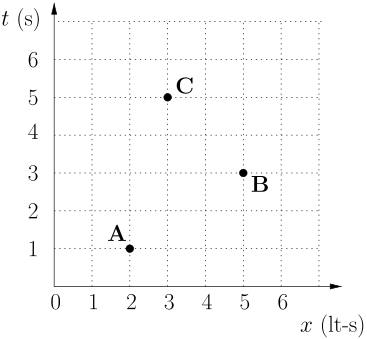
In the frame shown, event A occurs before B, which occurs before C. Which pairs of events could have their time-order reversed (switching before and after) by choosing an appropriate reference frame?
In the frame shown, event B occurs to the right of C, which occurs to the right of A. Which pairs of events could have their space-order reversed (switching left and right) by choosing an appropriate reference frame?
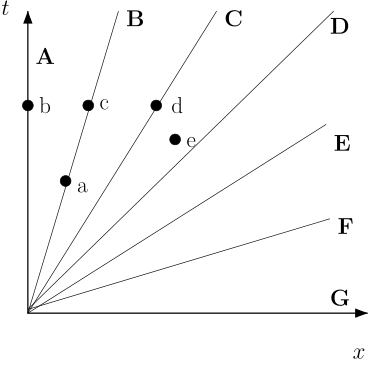
Figure 25 shows a spacetime diagram with seven straight lines through the origin labeled with capital letters A through G. Various events are marked as points with small letters a through e. The \(x\)-\(t\) axes belong to the Earth’s reference frame.
For Example 3.4.2 in the text, show from the spacetime diagram in Figure 23 that lightning hit the front of the train at a negative value of \(t^\prime\text{,}\) but that lightning hit the rear of the train at a positive value of \(t^\prime\text{.}\) Use the rule for finding the \(t^\prime\) coordinate of an event to solve this problem. [Hint: you might want to extend some of the axes in the negative direction.]
Farmer Brown, at rest in his frame, carries a ladder through a barn. According to Farmer Brown, the ladder measures \(20\,\text{lt-ns}\text{.}\) According to observers at rest with respect to the barn, Farmer Brown and his ladder are moving at a speed \(0.80c\) (alternately, Farmer Brown sees the barn moving at speed \(0.80c\)). In the barn’s frame, the front door of the barn is at \(x = 0 \,\text{lt-ns}\) and the back door is at \(x = 16\,\text{lt-ns}\text{.}\)
Calculate the length of the ladder as measured by observers in the barn’s reference frame. According to these observers, will the ladder fit within the barn?
Draw a careful spacetime plot for this situation, with appropriate tick marks on the axes (labeled with numbers). Starting with the barn frame, draw world lines for the entrance and exit of the barn (i.e., the front and back doors). Draw also world lines for the front and back of the ladder (which is moving as viewed in the barn frame). The distance between the front and back of the ladder in your plot should agree with your answer to part (a), and the slopes of these lines should be consistent with the known velocities.
Label the following events on your diagram: A = front of ladder enters the barn; B = front of ladder leaves the barn; C = back of ladder enters barn; D = back of ladder leaves barn. Determine the order of these events in time as viewed from the barn’s reference frame. Is this result consistent with your answer to (a), i.e., whether or not the ladder fits in the barn, according to barn-frame observers? (Consider whether the back of the ladder enters the barn before or after the front of the ladder leaves the barn.)
Based on your answers for this problem, can you see how relativistic time-ordering (i.e, the fact that different observers do not necessarily agree on the ordering of events in time) is necessarily linked with length contraction?
The Earth is \(8\,\text{lt-min}\) from the Sun. An astronomer on Earth, looking through a telescope, notices the sudden appearance of a giant solar flare on the Sun’s surface. At precisely that instant (when the astronomer detects the flare), a Klingon space ship whizzes over his head at speed \(0.8c\text{,}\) heading straight for the Sun.
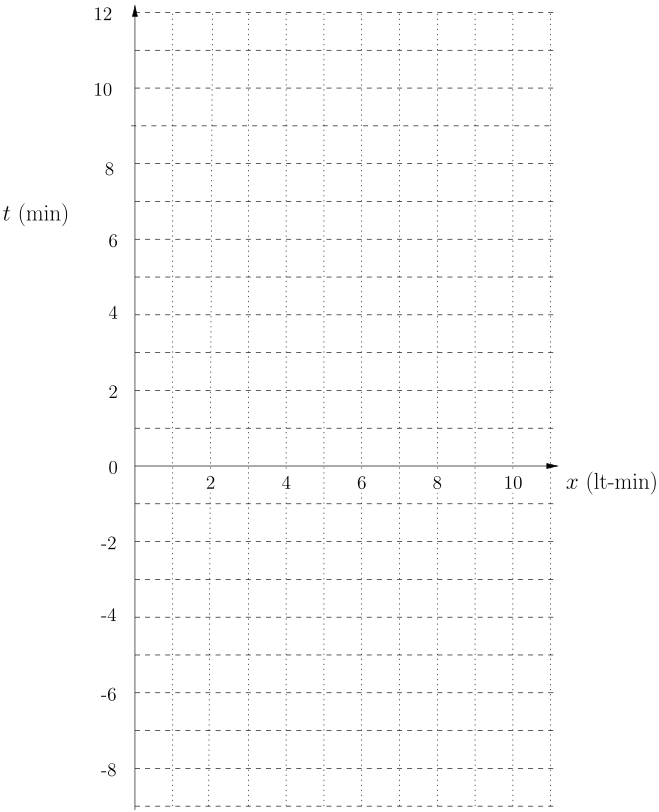
On the facing page, construct a spacetime diagram for this situation. Label the following three events: A: Klingon ship hits Sun, B: flare occurs on Sun, and C: Klingon ship passes Earth. (Note that event B is the occurrence of the flare on the Sun, not the detection of the flare by an astronomer on Earth.)
Two spacecrafts, Aaaak and Blech, are carrying aliens from the planet Zortox to Earth. Both spacecrafts are traveling at a speed of \(0.6c\) relative to the Earth, with Aaaak in front. In the Earth’s frame, Aaaak and Blech are a distance \(8.0\,\text{lt-s}\) apart. At the moment that Aaaak passes Earth, the Zortoxians aboard Aaaak dump its garbage. At a time \(10.0\,\text{s}\) later (as measured by earthlings) Blech dumps its garbage.
Draw a spacetime diagram in Earth’s frame that includes worldlines for Earth, Aaaak, and Blech. Indicate and label the events corresponding to the garbage dumps.
What is the distance between the two garbage dump events measured by the Zortoxians on board their ship? Warning: this is not the same as the distance between the two garbage piles. Hint: in the spacecraft frame, where did the first event and the second event happen?
A train of rest length \(40\,\text{lt-ns}\) moves along the tracks at \(0.8c\) and is struck by two lightning bolts. One bolt hits the front of the train and the other hits the back. According to observers on the tracks the bolts are simultaneous.
How far apart did the lightning bolts strike according to observers on the tracks?
Joe holds and lights a sparkler, and one minute later, it goes out. Cheri, riding in a rocket past these events, notes that, as measured in her frame, the sparkler burned for 100 seconds.
How far apart in Cheri’s frame did these two events (lighting and going out) occur?
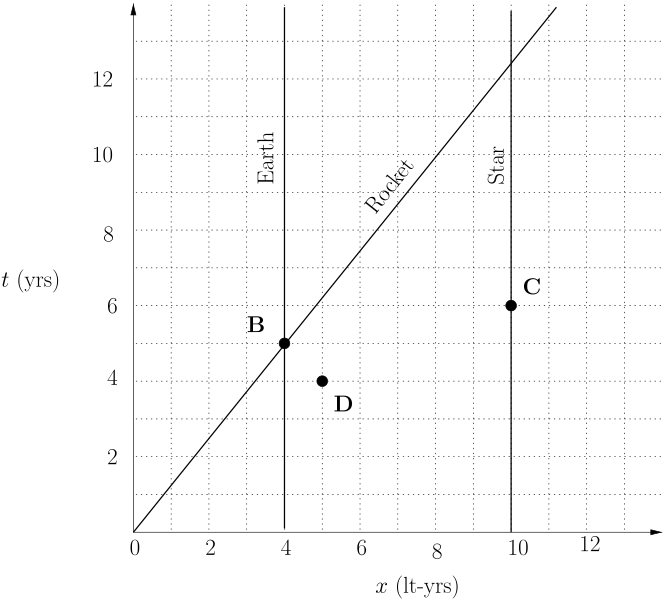
Draw the world line of a lost satellite passing the Earth at the same time as the Rocket, but going away from the Star at a speed that is \(\frac{1}{2}\) of the Rocket speed (as determined by Earth observers.) Label this line “Satellite.”