Section 11.2 Curved Space
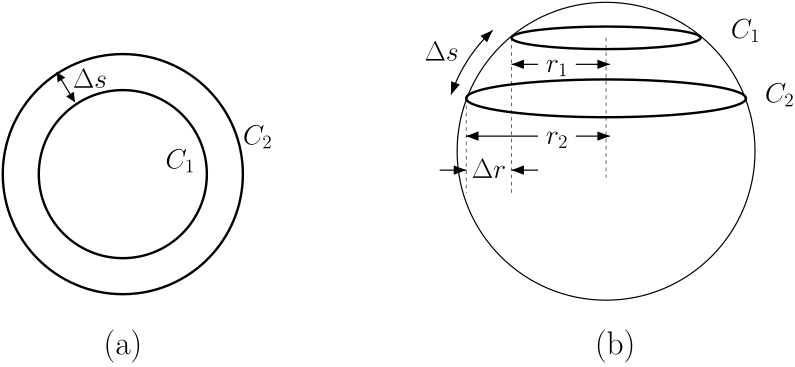
Imagine performing the following geometry experiment. Take a circle of a known circumference \(C_1\) and another larger circle with circumference \(C_2\) and arrange them concentrically, as in Figure 85a. Now ask yourself what is the shortest distance you could travel going from one circle to the other. A reasonable answer would be to go along a radial line, and the distance would be the difference in radii, \(\Delta r =
r_2-r_1 = C_2/(2\pi) - C_1/(2\pi)\text{.}\)
But now imagine that you measure this radial distance and you find it to be some distance \(\Delta s\) that is not equal to \(\Delta r\text{!}\) What’s going on? One possible explanation is that you might not be on a flat surface. For example, those two concentric circles may be sitting on the curved surface of a sphere, as depicted in Figure 85b. And now it would make sense that \(\Delta s\text{,}\) the distance you travel along the surface of the sphere to get from one circle to the other, is not equal to \(\Delta r\text{,}\) the difference between the radii of the circles.
You might also notice with further experiments on this curved surface that many rules of planar geometry are altered: the sum of the interior angles of a triangle do not have to add up to \(180^\circ\text{,}\) parallel lines may eventually meet, etc.
So what does this have to do with general relativity?

