You have learned previously that in interactions among low velocity particles in which the only forces are the interparticle forces (i.e. no external forces), the total momentum \(\sum_i
m_i\vec{u}_i\) and the total mass \(\sum_i m_i\) are conserved. (As previously, we use the symbol \(u\) to refer to the velocity of some particle as viewed from a reference frame, reserving \(v\) for the velocity of the reference frame itself.) For example, when particle 1 collides with particle 2 and particles 3, 4, and 5 emerge from the point of collision, we have two conservation laws:
After Einstein discovered the velocity transformation law, (4.2.1) and (4.2.4), he recognized that the classical definition of momentum (\(\vec{p} =
m\vec{u}\)) was incompatible with (4.3.1) and the Relativity Principle. That is, for a given collision, classical momentum could be conserved in one frame but not another. An example will illustrate this:
Example4.3.1Say goodbye to the classical expression for momentum.
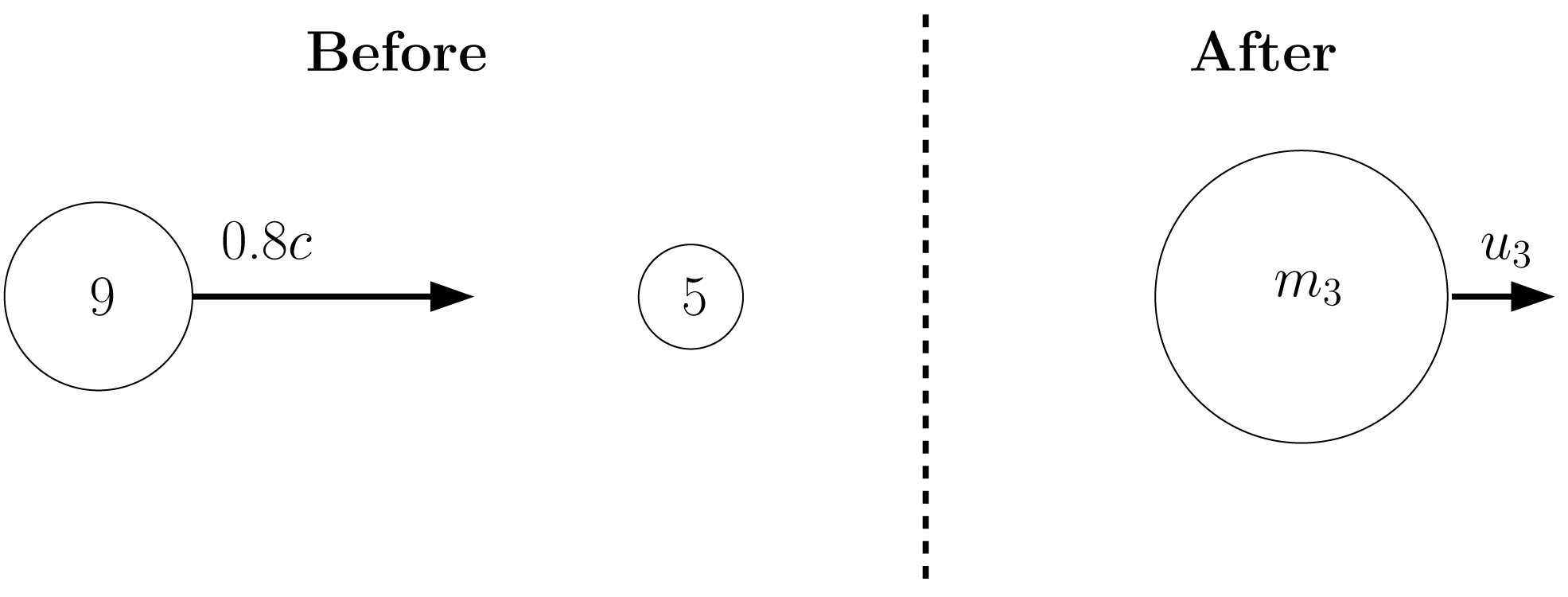
(For this example, we use the natural units of MeV, MeV/\(c\text{,}\) MeV/\(c^2\) and \(c\text{.}\) More detail on these units appears section 4.8.) Figure 29 shows a particle of mass \(9\,\text{MeV} /c^2\) and speed \(0.8c\) striking a stationary particle of mass \(5 \,\text{MeV} /c^2\text{,}\) producing a single particle. (a) Calculate the mass and speed of the single particle after the collision. (b) Show that classical momentum is not conserved in the frame in which the final particle is at rest.
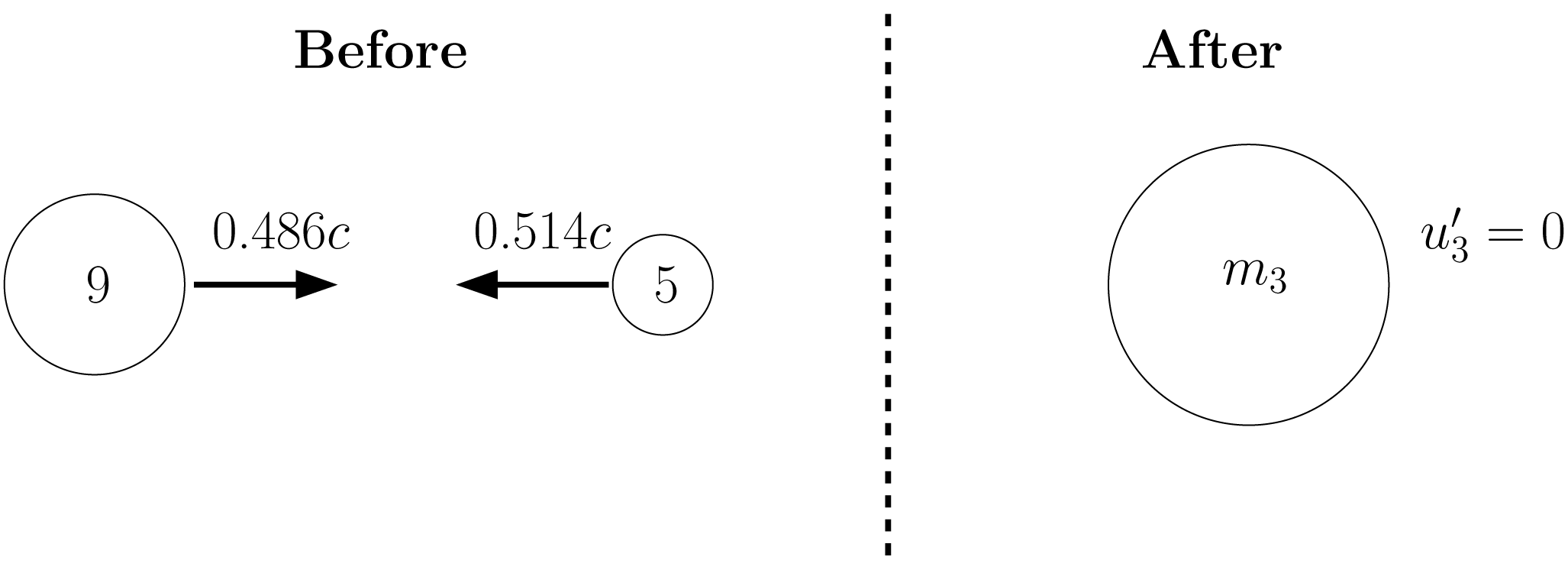
Transform now to a frame in which the final particle is at rest. This clearly means that we should view the collision from a spaceship traveling with particle 3 at \(0.514c\) to the right, relative to the original observer. Equation (4.2.4) gives
But the left side of this equation here works out to be \(1.80\,\text{MeV} /c\) which is NOT equal to the right side (which is 0). So, classical momentum is not conserved in this new frame. Therefore, either (a) conservation of momentum isn’t a valid law of physics; (b) the Relativity Principle (invariance of the laws of physics) is violated; or (c) we need a new definition for momentum.
You probably won’t be surprised to hear that Einstein wasn’t about to give up on the Relativity Principle because of this argument. After all, he had already redefined time and space to make the Principle work. And although the classical expression for momentum does not lead to invariance for high velocity collisions, there are attributes of particles involving their masses and velocities that do produce invariant conservation laws. These quantities are called relativistic momentum and relativistic energy, or more simply, momentum and energy. They are defined by
Einstein was motivated to define momentum and energy in this way because conservation of momentum and energy defined in this new way are invariant, as we will show with an example below. Of course, motivation is all very nice, but the most compelling reason that the momentum and energy of a particle must be defined this way instead of in the classical way is because in experiments with high-speed particles it is these new relativistic quantities that are conserved, and not those given by the classical definitions.
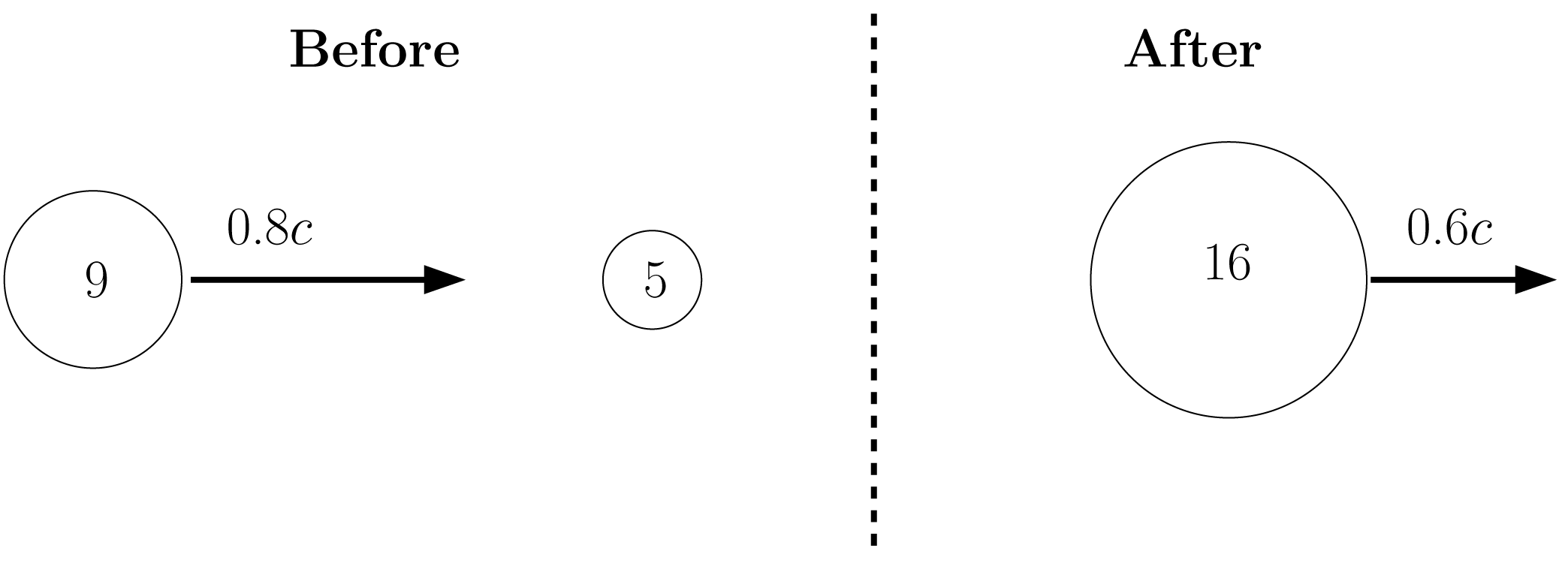
Figure 31 shows a particle of mass \(9\,\text{MeV} /c^2\) and speed \(0.8c\) striking a stationary particle of mass \(5\,\text{MeV} /c^2\text{,}\) producing a single particle of mass \(16\,\text{MeV} /c^2\text{.}\) You might not be too happy here with the final particle having a mass of \(16\,\text{MeV} /c^2\text{,}\) but hold on a little longer — we’ll explain this shortly. (A little preview — this might be a good time to take a pen and scribble (4.3.2) out of existence.) In the next chapter, we’ll learn more rigorously how to determine the correct attributes of the final particle. Here we just want to check the conservation laws. (a) Check the conservation of relativistic momentum and relativistic energy in the rest frame of the \(5\,\text{MeV} /c^2\) particle. (b) Check the conservation of relativistic momentum and relativistic energy in the rest frame of the \(16\,\text{MeV} /c^2\) particle.
The momentum equation gives \(12\,\text{MeV} /c = 12\,\text{MeV} /c\text{,}\) while the energy equation gives \(15\,\text{MeV} + 5\,\text{MeV} = 20\,\text{MeV}\text{.}\) So the conservation laws are satisfied in this frame.
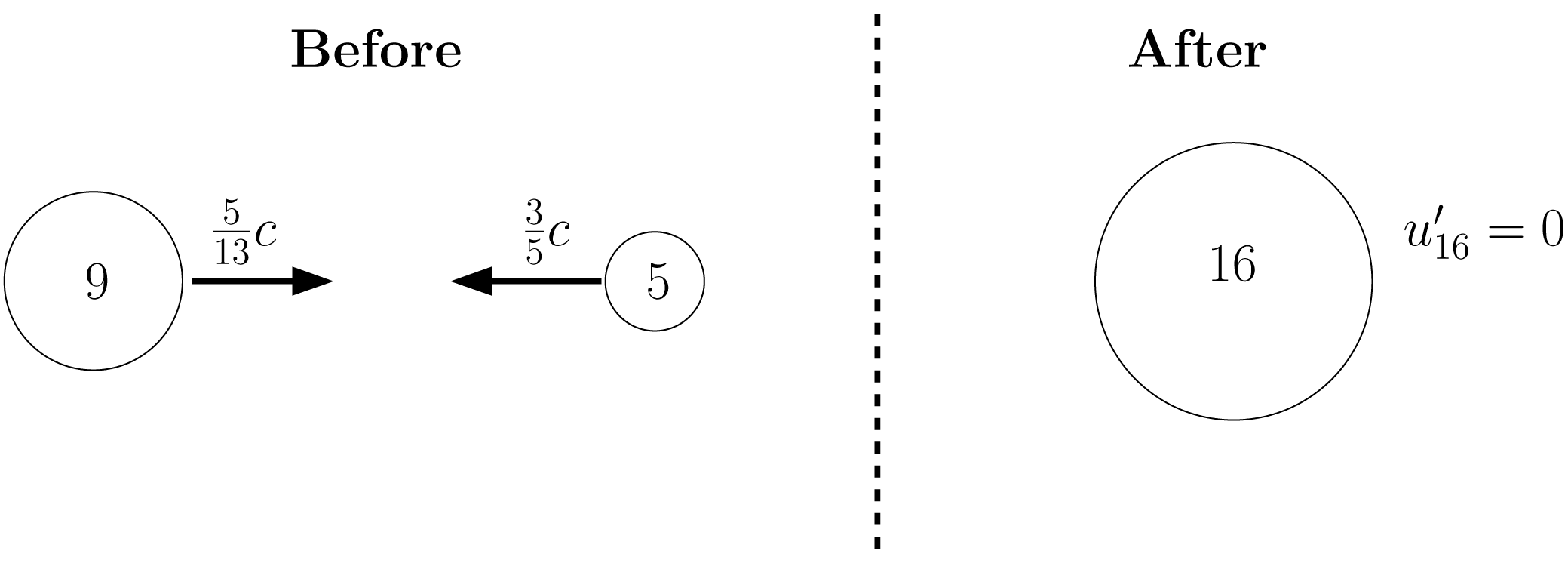
(b) Now, transform to a frame in which the final particle is at rest, by viewing from a spaceship moving at \(0.6c\) to the right. The velocity transformations give
which also checks out. This means the conservation laws are true in both the original and the new frame, and the Relativity Principle is upheld with Einstein’s new definitions.
This may be a nice argument on paper, but does it work in practice? Are relativistic momentum and energy, rather than classical momentum and mass, really conserved in particle interactions? The answer is an emphatic YES! In countless interactions observed in high-energy particle accelerators, relativistic momentum and energy are always found to be conserved.